en
en  русский
 Español
 عربى
عربى
Content
- 1 1. A Playful Product Concept with Broad Market Appeal
- 2 2. Product Specifications at a Glance
- 3 3. Soft Materials Designed for Comfort and Daily Use
- 4 4. Advantages over Ordinary Novelty Cushions
- 5 5. Advanced Manufacturing Capabilities
- 6 6. Quality Control from Material to Finished Product
- 7 7. Custom OEM and ODM Development
- 8 8. Packaging Solutions for Different Sales Channels
- 9 9. Logistics and Order Support
- 10 10. Commercial Applications and Merchandising Ideas
- 11 11. Why Manufacturing Experience Matters to Buyers
- 12 12. Recommended Purchasing and Development Process
- 13 13. Care, Storage, and Consumer Use
- 14 14. Frequently Asked Questions
- 14.1 Q1: What is the standard size of the hamburger plush pillow?
- 14.2 Q2: What materials are used?
- 14.3 Q3: Is the product suitable for children?
- 14.4 Q4: Can the design be customized?
- 14.5 Q5: Can I order a sample before placing a bulk order?
- 14.6 Q6: What is the reference MOQ?
- 14.7 Q7: What is the lead time for a bulk order?
- 14.8 Q8: Is the pillow washable?
- 14.9 Q9: Which packaging options are available?
- 14.10 Q10: Which shipping methods can be arranged?
- 14.11 Q11: Can a restaurant or food brand use its own logo?
- 14.12 Q12: What makes this product different from a standard plush toy?
- 15 15. Conclusion
- 16 References
- 17 Product: Creative Smiley Hamburger Plush Pillow
Food-inspired products continue to attract attention in the gift, home décor, children’s merchandise, and lifestyle product markets. Among these products, the Creative Smiley Hamburger Plush Pillow combines a familiar fast-food shape with expressive character design and practical comfort. Its layered appearance resembles a classic hamburger, while its friendly smiling face gives the product a playful personality that appeals to children, teenagers, families, food lovers, and collectors of unusual plush items.
More than a decorative cushion, this hamburger plush pillow is designed as a commercially adaptable product for retailers, importers, promotional merchandise companies, gift shops, themed stores, online sellers, and private-label brands. Its bright colors, recognizable silhouette, soft touch, and customizable structure make it suitable for different sales channels and customer groups. It can be offered as a nap cushion, bedroom accessory, sofa decoration, novelty gift, restaurant-themed item, seasonal merchandise product, or branded promotional gift.
The product is manufactured by Tianchang Bestjoy Craft & Gift Co., Ltd., an integrated plush product manufacturer with experience in research and development, design, production, sales, and after-sales service. The company operates a factory of more than 10,000 square meters in Jinji Industrial Park, Tianchang City, Anhui Province, China. Its production experience, export orientation, customization capabilities, and established supply-chain resources provide a strong foundation for developing plush products for international markets.
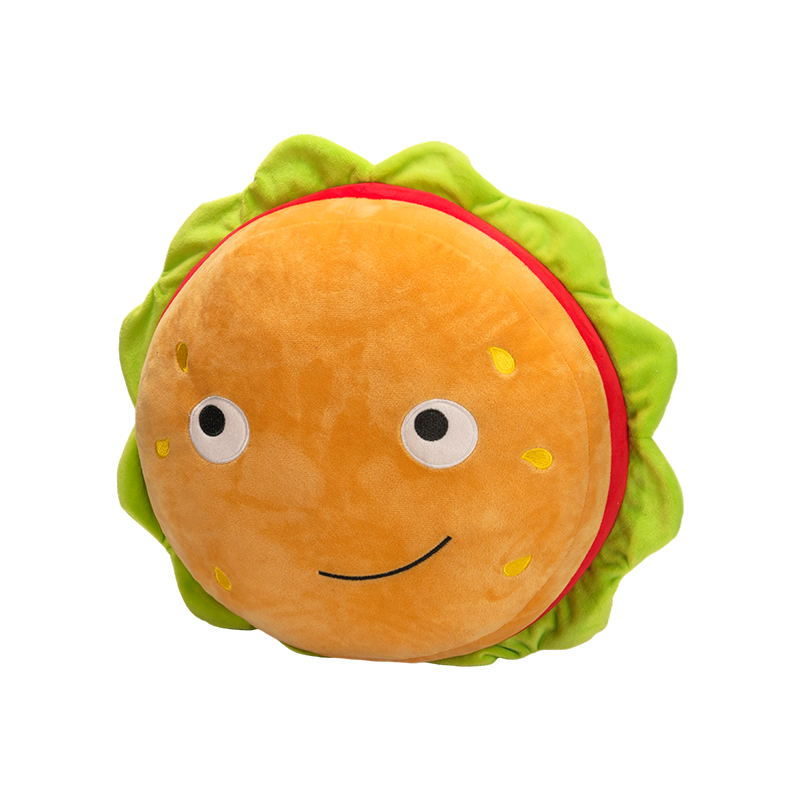
Creative Smiley Hamburger Plush Pillow
1. A Playful Product Concept with Broad Market Appeal
The Creative Smiley Hamburger Plush Pillow is built around a simple but highly recognizable product concept. It transforms the visual appearance of a hamburger into a soft, oversized plush cushion. The brown upper bun, simulated lettuce layer, patty details, lower bun, and smiling facial expression work together to create an appealing character product rather than an ordinary pillow.
This combination of food imagery and character styling gives the product strong visual recognition. A standard pillow may compete mainly through color, size, or fabric quality. A hamburger pillow competes through personality and memorability. Consumers can immediately understand what the product represents, even when viewing it in a thumbnail image on an e-commerce marketplace or from a distance on a retail shelf.
The smiley face is especially important because it changes the product from a simple food replica into a friendly plush character. Facial expressions encourage emotional engagement, making the item more suitable for gifting and impulse purchases. Customers may buy it because it reminds them of fast food, because it looks funny in a bedroom or game room, or because it offers a cheerful way to decorate a sofa, dormitory, office, restaurant, or entertainment space.
The product’s concept also supports a wide range of merchandising themes. It can be included in fast-food gift collections, food-themed home décor, novelty plush assortments, youth lifestyle products, restaurant promotional campaigns, humorous office accessories, or seasonal gift programs. Its recognizable shape allows retailers to display it together with other food-shaped cushions, while its facial design enables it to stand alone as an individual character product.
Suitable Customer Groups
The pillow is suitable for children who enjoy colorful and expressive toys, although the intended market may also include teenagers and adults. Food-themed plush products are popular among customers who enjoy playful interiors, pop-culture-inspired décor, kawaii-style products, novelty gifts, and collectible character merchandise. The oversized 42-centimeter format gives it enough visual presence to function as both a plush toy and a home accessory.
For parents, the product offers a soft and decorative item that can be used in a child’s bedroom, reading corner, playroom, or family living area. For teenagers and young adults, it can add personality to beds, sofas, gaming rooms, dormitories, and social-media photo settings. For adults, it can serve as a humorous gift for fast-food lovers, restaurant employees, food bloggers, collectors, or colleagues.
Retailers can also position the product differently according to their target market. A children’s store may emphasize softness, color, and character appeal. A home-gift store may present it as a decorative throw pillow. A restaurant or food brand may use it as a promotional product. An online seller may present it as an amusing novelty cushion with strong visual appeal and gifting potential.
2. Product Specifications at a Glance
The standard product is designed to provide a balance between visual impact, comfortable handling, and efficient shipment. Its dimensions make it large enough to be noticed without becoming difficult to store or display. The following table summarizes the principal specifications supplied for the product.
| Specification | Standard Information |
|---|---|
| Product name | Creative Smiley Hamburger Plush Pillow |
| Product category | Plush throw pillows |
| Shape | Layered hamburger with a smiling face |
| Standard size | 42 cm |
| Customization | Customized sizes available |
| Approximate weight | 160 g |
| Standard color | Brown with contrasting food-layer details |
| Shell fabric | Super-soft plush |
| Filling material | PP cotton |
| OEM/ODM | Available |
| Reference MOQ | 1,000 pieces |
| Sample fee | US$100 per design |
| Sample development time | Approximately 3–7 working days |
| Reference delivery time | Approximately 45 days for customized production |
Specifications may be adjusted according to the final design, order quantity, packaging method, material selection, and destination market. Buyers should confirm the final technical details, testing requirements, production schedule, packaging configuration, and shipping plan before placing a formal order.
3. Soft Materials Designed for Comfort and Daily Use
One of the most important advantages of this product is its tactile quality. The outer shell uses super-soft short-pile plush fabric. This material gives the pillow a smooth and comfortable surface that is pleasant to touch and suitable for use as a nap cushion or decorative pillow. The short-pile construction also supports a clean, neat appearance and allows the printed, embroidered, or sewn facial details to remain visually prominent.
Inside the pillow is high-resilience PP cotton filling. This filling material is widely used in plush toys and cushions because it is lightweight, resilient, and capable of providing a soft yet supportive feel. When properly distributed during manufacturing, PP cotton helps the pillow maintain its rounded hamburger shape and reduces the likelihood of excessive flattening during ordinary use.
The combination of soft plush fabric and resilient filling provides a practical advantage over rigid novelty décor products. The hamburger pillow is not only visually attractive; it can also be hugged, leaned against, placed behind the back, or used as a comfortable support cushion. This functional element increases the number of situations in which consumers may use the product and can improve its perceived value.
The materials are described as skin-friendly and hypoallergenic. For products intended for children or international retail markets, material selection is an important part of product development. Buyers may request additional documentation, laboratory testing, or market-specific safety certification depending on the destination country and intended age grading. Final compliance requirements should always be confirmed for the specific production batch and sales market.
Shape Retention and Long-Term Appearance
Novelty pillows can lose their appeal if they become flat, lumpy, or misshapen after limited use. The product is designed with a resilient filling structure and carefully assembled outer sections to help preserve its appearance over time. The layered bun, lettuce, and patty details need to be positioned accurately so that the pillow continues to look like a hamburger rather than an ordinary round cushion.
Manufacturing consistency is particularly important for food-shaped products. Small differences in the thickness or placement of the layers can affect the overall expression and silhouette. A professional production process therefore needs to control pattern cutting, filling distribution, sewing tension, facial placement, and final shaping. These steps help ensure that bulk production remains visually consistent from the first piece to the last.
4. Advantages over Ordinary Novelty Cushions
The market includes many decorative pillows, but the Creative Smiley Hamburger Plush Pillow offers several characteristics that can help it compete effectively.
Distinctive Food-Themed Identity
The hamburger format gives the product an immediate theme. Ordinary cushions often depend on generic colors, geometric patterns, or simple animal shapes. This product adds a recognizable lifestyle reference that can attract customers who are looking for something humorous, unusual, and easy to understand.
Character Appeal Through Facial Expression
The smiling face creates a more emotional connection than a plain food replica. A character can be named, photographed, collected, displayed, and incorporated into marketing campaigns. The facial expression also makes the product suitable for social-media content, gift guides, promotional displays, and themed product collections.
Dual Function as Plush and Home Décor
Because it is both soft and decorative, the pillow can be sold through multiple categories. It may appear in a plush toy section, a home textile section, a novelty gift display, or a seasonal promotional assortment. This flexibility provides retailers with more opportunities to test different merchandising strategies.
Large, Noticeable Display Format
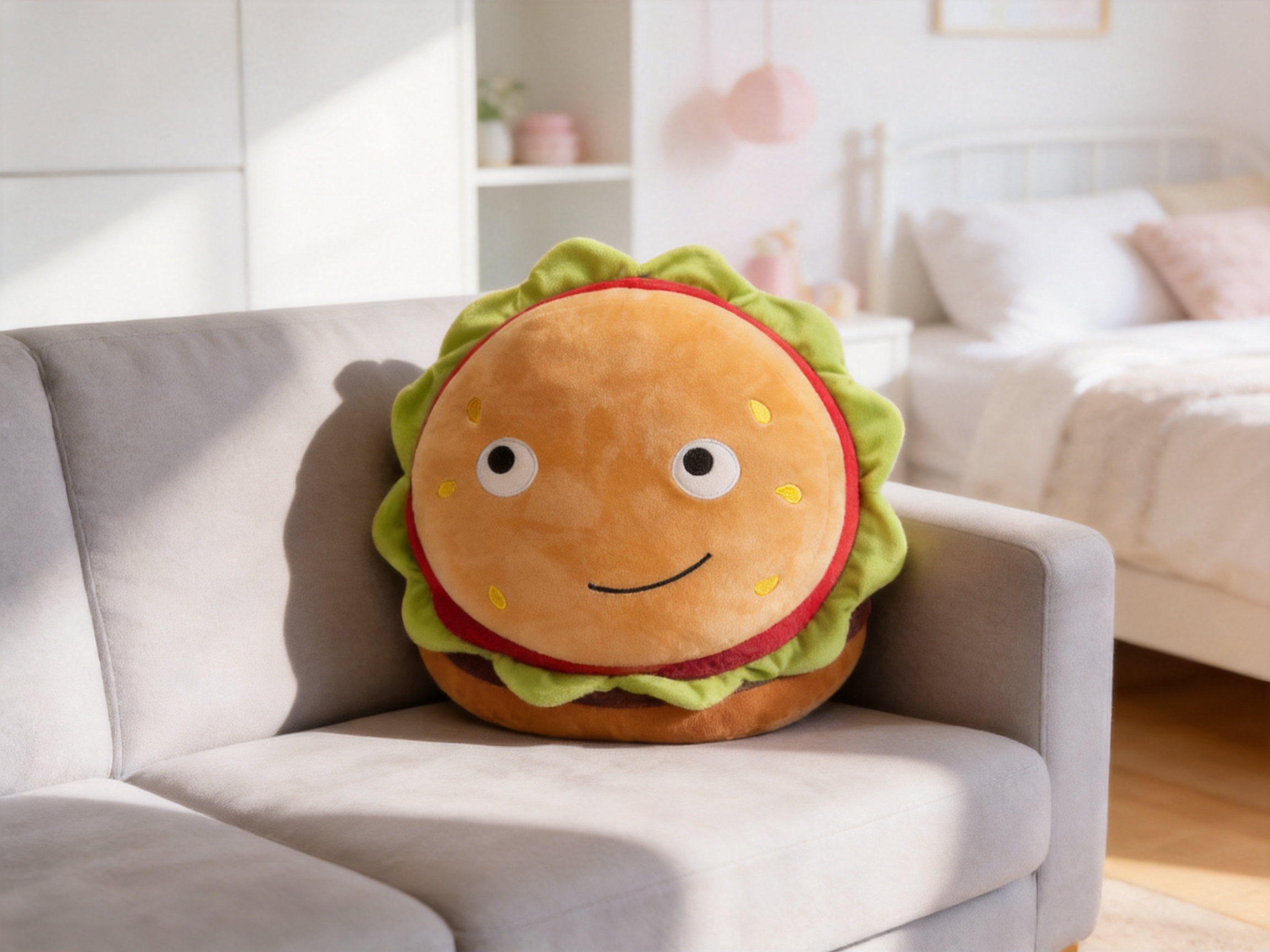
At approximately 42 centimeters, the product has sufficient scale to create a strong visual impact. A larger pillow can be used as a focal display item, helping online customers understand the product’s size and helping physical retailers create an attractive window or shelf presentation. It may also be photographed with a person, sofa, bed, or dining setting to communicate scale effectively.
Customization Potential
OEM and ODM support allows buyers to adapt the basic hamburger concept to their own requirements. Possible adjustments include size, color, facial expression, layer details, labels, logos, embroidery, printed branding, packaging, and limited-edition styling. This is a major advantage over ready-made products that cannot be modified for a particular campaign or sales channel.
Suitable for Cross-Border E-Commerce
The product’s simple visual story translates easily across languages and markets. A hamburger is widely recognized internationally, and the smiling face adds universal emotional appeal. This makes the pillow suitable for product listings, marketplace stores, social-commerce campaigns, gift websites, and international promotional catalogs.
5. Advanced Manufacturing Capabilities
The quality of a plush product depends not only on its concept but also on the manufacturer’s ability to transform a design into a stable, repeatable production process. Tianchang Bestjoy Craft & Gift Co., Ltd. operates as an integrated manufacturer covering research and development, design, production, sales, and after-sales service. This integrated structure can simplify communication and reduce the risk of misunderstandings between independent design, sourcing, and production suppliers.
The company was established in 2013 as a joint venture between Hong Kong Jintong International Co., Ltd. and Tianyuan Enterprise Investment Management Co., Ltd. Its factory is located in Tianchang City, Anhui Province, and covers more than 10,000 square meters. The company reports annual sales exceeding 12 million RMB and exports products to Europe, America, Australia, Japan, and South Korea.
Research and Development
A product such as the hamburger pillow requires more than a simple two-dimensional drawing. The development team must convert the visual concept into a three-dimensional pattern that can be filled, sewn, shaped, packed, and reproduced in quantity. R&D work may include product sketching, material selection, pattern engineering, sample construction, expression placement, filling tests, and production optimization.
The layered structure is an important development consideration. Each simulated hamburger ingredient must be visually recognizable while remaining securely attached to the main body. The top bun should have an appealing curve, the lettuce detail should provide contrast, and the patty layer should contribute depth without making the pillow uncomfortable or excessively heavy.
Pattern Engineering and Sampling
Pattern development determines the final silhouette and affects material consumption, sewing efficiency, and filling distribution. Experienced pattern technicians can optimize the shape so that it looks full and balanced while minimizing unnecessary seams or fabric waste. They can also adapt the pattern for different sizes, helping buyers create a family of related products.
Sample development is available in approximately 3–7 working days according to the supplied product information. A pre-production sample allows buyers to evaluate the fabric, color, shape, facial expression, filling firmness, stitching, logo placement, and packaging concept before approving bulk production. This stage is especially valuable for customized products because small visual changes can strongly affect the character’s personality.
Production Line Coordination
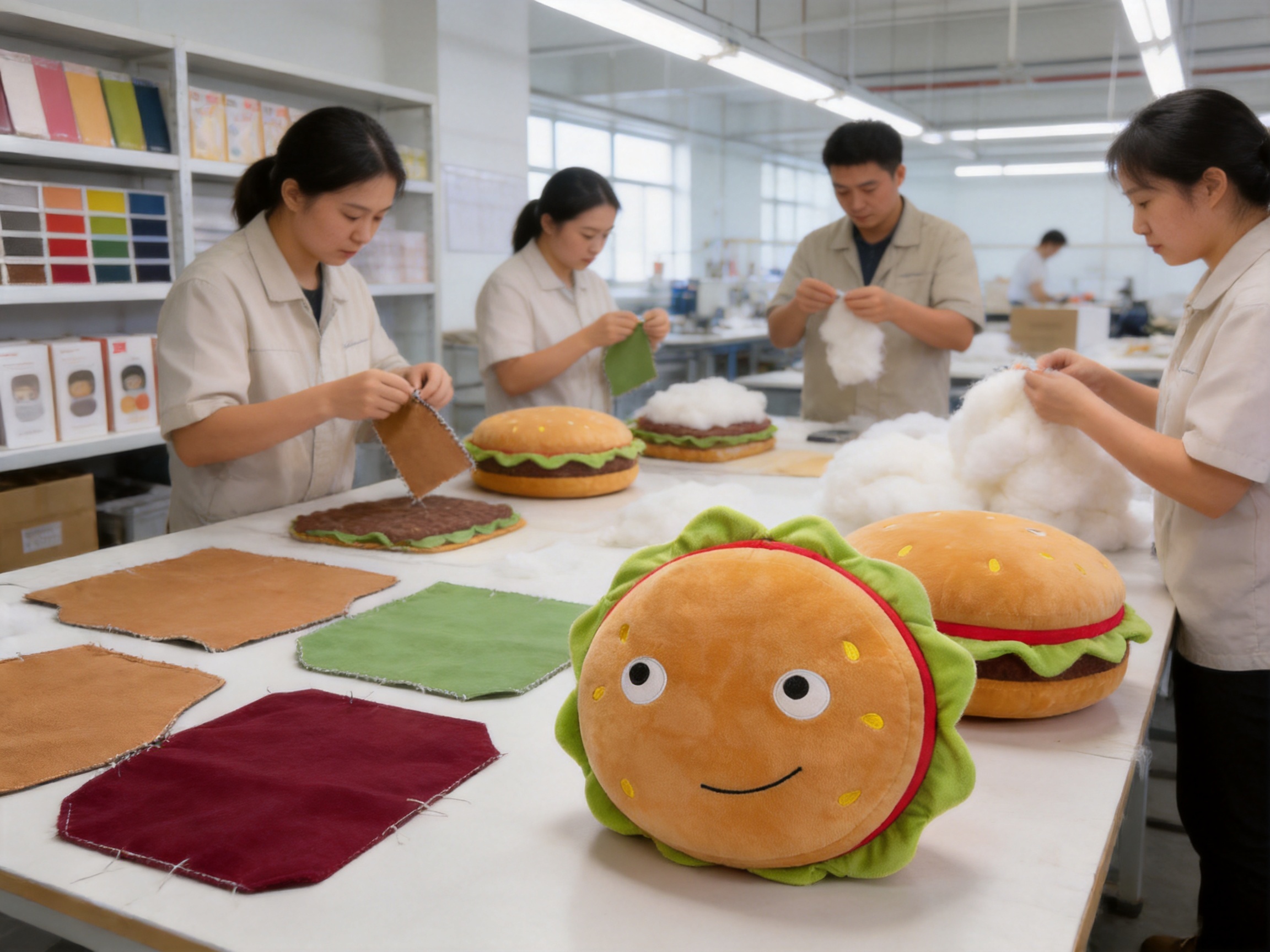
After sample approval, bulk manufacturing requires coordination among fabric preparation, cutting, sewing, stuffing, shaping, inspection, and packing departments. A mature production line can help make lead times more predictable and can support progress tracking throughout the order. This is valuable for importers and retailers that need to coordinate production with promotional calendars, seasonal launches, warehouse planning, and international transportation.
The company states that it provides full-process production progress tracking for each order. Buyers can use this service to monitor key milestones such as material preparation, cutting completion, sewing progress, stuffing, inspection, packaging, and shipment readiness. Clear communication at these stages can reduce uncertainty and support more accurate inventory planning.
6. Quality Control from Material to Finished Product
Quality control for a plush pillow begins before sewing starts. Fabric should be checked for color consistency, surface softness, width, defects, and compatibility with the approved sample. Filling material should be clean, evenly textured, and suitable for the required softness and resilience. Accessories, thread, labels, packaging components, and branding materials should also be reviewed before they enter production.
During cutting, pattern pieces need to match the approved dimensions. Inaccurate cutting may cause uneven layers, asymmetrical sides, or tension problems during sewing. For the hamburger design, color placement is also important because the bun, lettuce, patty, and facial features must remain visually distinct.
Sewing quality affects both durability and appearance. Stitch length, seam allowance, thread tension, corner reinforcement, and attachment strength all contribute to the finished product. Decorative components should be securely fixed, and facial details should be positioned consistently. A professional inspection system can identify loose threads, open seams, uneven stuffing, fabric marks, color differences, and packaging defects before shipment.
Filling and Final Shaping
Stuffing is one of the most important processes for a character pillow. Too little filling can make the product look flat and reduce its usefulness as a cushion. Too much filling may distort the pattern, strain the seams, or make the product unnecessarily difficult to compress for shipping. The correct filling volume must therefore be determined during sample development and reproduced during bulk production.
After stuffing, workers shape the pillow by distributing the PP cotton evenly and checking the position of the layered details. The final product should have a balanced appearance from the front, side, and rear. This process is particularly important for e-commerce products because customers expect the delivered pillow to resemble the images shown on the product listing.
Safety and Compliance Considerations
The supplied product information states that the raw materials are selected to comply with international toy safety standards and are BPA-free and non-toxic. It also states that the product has no small detachable choking-hazard parts. Buyers should request the applicable test reports and certificates for the exact product and destination market before making compliance claims in commercial listings.
Safety requirements can vary according to how the item is marketed. A pillow sold as home décor may be treated differently from a plush toy intended for young children. Age grading, labeling, flammability requirements, chemical restrictions, mechanical testing, packaging warnings, and import documentation may differ among countries. Best practice is to define the target market and intended use at the beginning of product development so the manufacturer can prepare suitable materials and documentation.
7. Custom OEM and ODM Development
Customization is one of the strongest commercial features of this hamburger plush pillow. Buyers may use the standard design as a ready-to-order product or develop a private-label version with unique details. This flexibility supports retailers that want to build their own product identity rather than compete solely on price with identical catalog items.
Size and Proportion Adjustments
The standard size is approximately 42 centimeters, but the product can be adapted to different dimensions. A smaller version may be suitable for key retail displays, children’s gift sets, capsule-style assortments, or lower-cost promotional campaigns. A larger version may be used as a statement cushion, restaurant mascot, event prop, or premium gift.
Changing the size affects fabric consumption, filling requirements, packaging volume, shipping cost, and production time. Buyers should evaluate these factors together rather than selecting a size based only on visual preference. The manufacturer can help create a sample so the buyer can compare the product’s appearance, handling, and logistics requirements.
Facial Expressions and Character Details
The smiling face can be modified to create different personalities. Buyers may request an open smile, a small closed smile, sleepy eyes, surprised eyes, winking features, or other expressions. Facial details may be embroidered, printed, appliquéd, or constructed from sewn fabric components, depending on the desired appearance and safety requirements.
Expressions can also support seasonal and campaign-based collections. A happy expression may suit everyday retail, while a festive version could include holiday colors, themed accessories, or limited-edition packaging. Restaurants, food brands, and entertainment businesses may develop a mascot variation that reflects their own visual identity.
Color and Material Customization
The standard product uses brown as the principal color, with contrasting layers that suggest lettuce and patty details. Custom colors can be developed to match a retailer’s brand palette, a restaurant’s menu, a sports team, a school, or a seasonal campaign. Fabric choices may also be adjusted according to softness, pile length, durability, printability, and target price.
Color approval should be based on physical samples whenever possible. Digital images may display colors differently depending on the screen, lighting, and image processing. For international production, buyers should confirm the approved color reference, tolerance range, and inspection method before bulk manufacturing.
Branding and Logo Integration
Custom logos can be added through embroidery, printing, woven labels, hangtags, patches, or custom packaging. Branding may be placed on the hamburger layer, a small label, a removable tag, or the gift box. The best location depends on the desired appearance and the product’s intended use.
Subtle branding is often suitable for retail products because it preserves the character’s visual appeal. More prominent branding may be appropriate for corporate gifts, food-service promotions, event merchandise, and advertising campaigns. The manufacturer can assist with the development of a branding sample before production approval.
8. Packaging Solutions for Different Sales Channels
Packaging influences product protection, display quality, shipping volume, and perceived value. The manufacturer offers several packaging options so buyers can select an approach that fits their distribution model.
Transparent OPP Bag Packaging
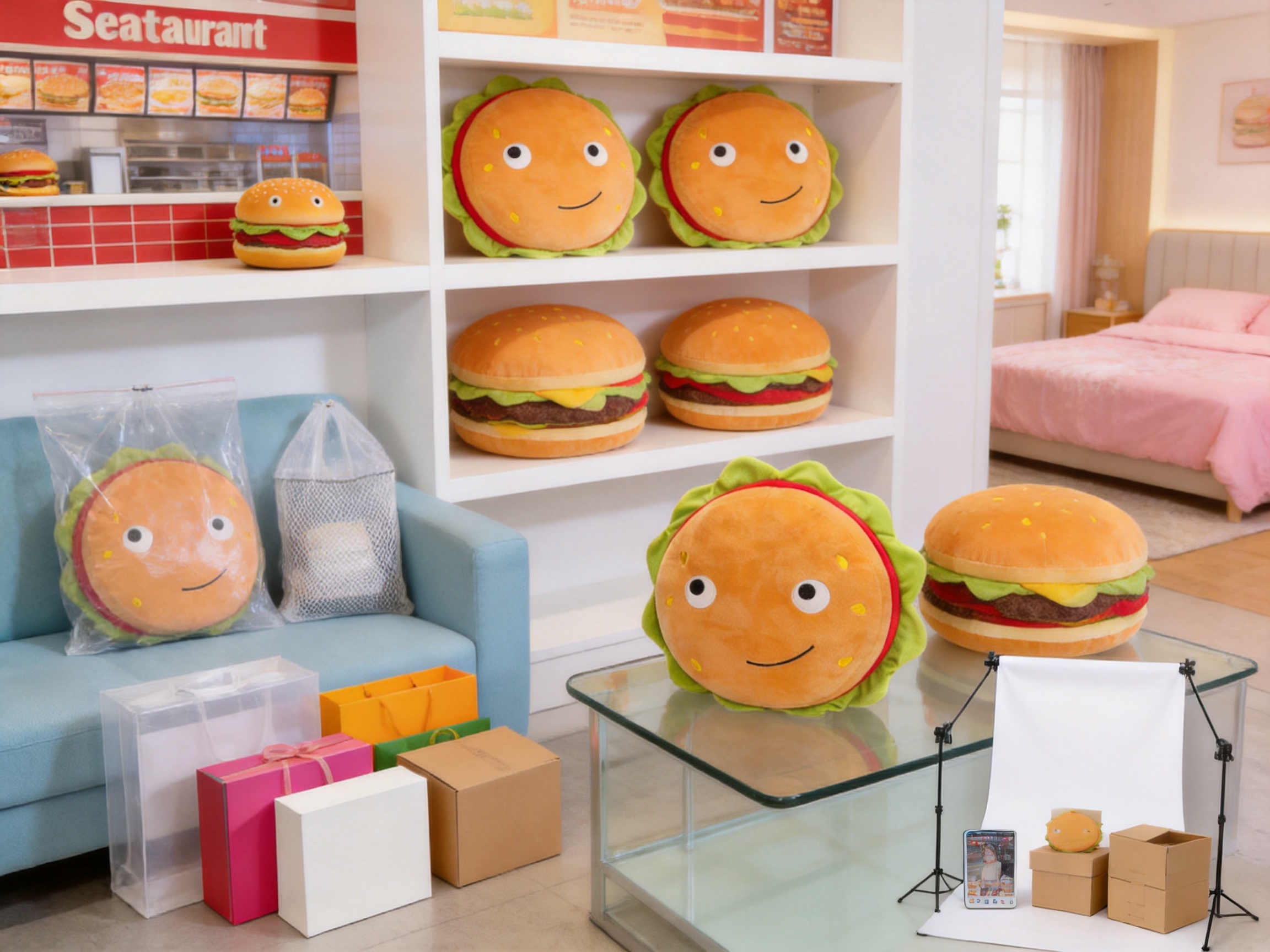
Basic transparent OPP bag packaging is a cost-effective option for bulk wholesale and large-volume orders. It allows buyers to see the product while protecting it from dust and handling during transport. This format is suitable when the buyer plans to place the pillow into a local retail package, warehouse carton, or store display.
Non-Woven Fabric or PE Mesh Bags
Breathable non-woven fabric or PE mesh bags provide a more display-friendly presentation. These bags can be useful for offline retail, supermarkets, lifestyle shops, and gift stores where customers want to see and touch the product. Their breathable structure may also support storage and handling before the product reaches the final consumer.
Custom Color Gift Boxes
A custom color gift box can significantly increase the product’s perceived value. The box may include a brand name, logo, character artwork, product information, care instructions, barcode, or seasonal graphics. Gift-box packaging is especially suitable for holiday promotions, food-themed gift sets, corporate programs, and premium online orders.
Vacuum Compression Packaging
Vacuum compression can reduce the volume of plush pillows during international transportation. Lower shipping volume may help reduce logistics costs, particularly for cross-border orders. Once unpacked, the product needs time to recover its intended shape. Buyers should conduct recovery tests and confirm suitable packing instructions before using compression packaging for commercial shipment.
Packaging selection should be made together with the shipping method. Sea freight may prioritize carton efficiency and volume reduction, while air freight and express delivery may require a different balance between protection, presentation, and dimensional weight. The manufacturer can help buyers compare packaging options according to order quantity and delivery destination.
9. Logistics and Order Support
International buyers often need more than a product quotation. They need a coordinated solution that includes sampling, production, inspection, packaging, documentation, and delivery. The company offers several logistics options, including sea freight, air freight, and express delivery through cooperating logistics providers.
Sea freight is generally suitable for larger wholesale orders when the buyer can plan further in advance. Air freight may be selected when a shorter transit time is important. Express delivery is useful for samples, small shipments, urgent replenishment, or time-sensitive promotional projects. The appropriate option depends on the destination, carton dimensions, total weight, delivery deadline, and budget.
Production planning should begin with a clear order schedule. Buyers should communicate the desired delivery date, packaging requirements, label specifications, inspection standards, and documentation needs before approving the order. This helps the manufacturer prepare materials and reserve production capacity more accurately.
The supplied information indicates a reference delivery time of approximately 45 days for customized production. The FAQ also indicates that fully customized orders may require approximately 30–45 working days, while regular stock orders may be available in approximately 3–7 working days. Actual timing should be confirmed according to the specific design, quantity, material availability, packaging, testing, and shipping plan.
10. Commercial Applications and Merchandising Ideas
Gift Shops and Novelty Stores
The hamburger pillow is naturally suited to stores that sell humorous gifts, unusual home accessories, and character merchandise. Its food identity makes it easy to place near other novelty items, while the soft construction gives it a useful function beyond simple decoration.
Fast-Food and Restaurant Promotions
Restaurants and food-service companies can customize the product with a logo, menu-inspired colors, mascot expression, or campaign message. It may be used as a loyalty-program reward, opening-event gift, social-media contest prize, employee gift, or limited-edition merchandise item.
Children’s and Family Retail
Bright colors and a smiling face make the pillow suitable for children’s product assortments. Retailers can display it with other food-shaped plush toys, animal cushions, or themed bedding accessories. For children’s markets, buyers should pay particular attention to age grading, testing, labeling, and the security of all decorative details.
Home and Lifestyle Stores
The product can be positioned as an expressive throw pillow for living rooms, bedrooms, dormitories, lounges, cafés, and entertainment rooms. Its shape adds a humorous visual accent to interiors and can be coordinated with food-themed artwork, kitchen décor, or colorful lifestyle accessories.
Promotional and Seasonal Programs
Custom colors, packaging, and expressions allow the product to support seasonal sales. Holiday editions may use themed gift boxes, special hangtags, or campaign-specific facial expressions. The same basic silhouette can be adapted for restaurant anniversaries, summer promotions, back-to-school collections, food festivals, and online shopping events.
Cross-Border E-Commerce
The product is well suited to online retail because its appearance can be understood quickly through a single image. Strong product photography should show the front design, side thickness, fabric texture, facial expression, and approximate size. Lifestyle images can demonstrate how the pillow looks on a sofa, bed, chair, or in a child’s room.
11. Why Manufacturing Experience Matters to Buyers
Choosing a plush supplier involves more than comparing unit prices. A product with an attractive concept can still fail commercially if the factory cannot reproduce the approved sample, maintain consistent colors, control filling, meet packaging specifications, or communicate clearly during production. An experienced manufacturer can help reduce these risks through integrated design, production, inspection, and order-management capabilities.
Tianchang Bestjoy Craft & Gift Co., Ltd. has developed a product range covering trendy plush toys, children’s plush toys, pet plush toys, promotional plush gifts, plush home furnishings, plush stationery gifts, plush handicrafts, and cartoon decorations. This broad category experience may help the company understand different construction methods, customer expectations, retail requirements, and customization challenges.
The company also reports that its products are exported to Europe, America, Australia, Japan, and South Korea. Export experience can be valuable because international orders often require more detailed communication about labeling, packaging, documentation, testing, carton marks, and delivery arrangements. Buyers should still confirm the requirements of their own market, but a supplier familiar with international business processes can make project coordination more efficient.
Another strength is the company’s stated ability to provide in-stock services as well as customized development. This gives buyers two potential purchasing paths. They may select a standard design for faster market testing, or they may develop a unique version for a private-label launch. A staged approach can be useful: begin with a standard or lightly customized product, evaluate customer response, and then invest in a larger exclusive collection.
12. Recommended Purchasing and Development Process
A clear purchasing process helps both the buyer and manufacturer achieve better results. The first step is to define the business objective. Buyers should decide whether the hamburger pillow is intended for general retail, corporate promotion, a restaurant campaign, online resale, seasonal merchandise, or a themed collection.
The second step is to confirm the basic product concept. This includes the target size, color palette, facial expression, fabric type, filling firmness, branding position, age group, packaging method, and intended sales market. A written specification sheet can reduce misunderstandings and make sample evaluation more objective.
The third step is sample development. A sample allows the buyer to assess the physical product rather than relying only on drawings or digital images. Important points to review include overall dimensions, symmetry, softness, filling distribution, layer attachment, color accuracy, expression placement, seam quality, label position, and recovery after packing.
The fourth step is testing and approval. Buyers should identify any applicable safety or quality tests before bulk production. If the product will be sold as a children’s item, age grading and toy-safety requirements should be addressed. If it will be marketed as a home cushion, textile labeling, flammability, chemical, and consumer-product requirements may apply depending on the destination.
The fifth step is bulk production. Once the sample, materials, artwork, packaging, and inspection requirements are approved, the manufacturer can organize material purchasing and production scheduling. Changes after production begins may increase costs or delay shipment, so final approval should be documented carefully.
The final step is inspection, packing, and delivery. Buyers may arrange factory inspection, third-party inspection, or a manufacturer-led quality inspection according to their purchasing policy. Finished cartons should be checked for quantity, product assortment, packaging condition, carton marks, and shipping documentation before dispatch.
13. Care, Storage, and Consumer Use
The FAQ information supplied for the product states that the outer plush cover is designed with a hidden zipper for removal and supports gentle machine washing or hand washing. Buyers should verify the zipper construction and cleaning instructions on the approved sample because care features may vary according to the final design and production version.
For consumer communication, gentle washing, mild detergent, low agitation, and thorough drying are generally recommended for plush products. Excessive heat, harsh chemicals, or aggressive spinning may affect fabric texture, colors, facial details, or filling shape. A care label or instruction card can help customers maintain the product properly.
During storage, plush pillows should be kept in a clean, dry environment away from moisture, direct sunlight, strong odors, and sharp objects. If vacuum compression packaging is used, the product should be unpacked and reshaped according to the supplier’s instructions. Retailers may wish to test how long the product requires to regain its intended appearance after compressed shipment.
The product should be displayed in a way that protects its facial details and prevents excessive handling damage. In a physical shop, a sample can be placed outside the packaging so customers can feel the fabric, while stock units remain protected. In an online store, detailed photographs and accurate dimensions can help reduce customer uncertainty and returns.
14. Frequently Asked Questions
Q1: What is the standard size of the hamburger plush pillow?
The standard size is approximately 42 centimeters. Customized sizes are available, although changing the dimensions may affect material usage, packaging volume, shipping cost, and production lead time.
Q2: What materials are used?
The shell uses super-soft plush fabric, and the interior is filled with PP cotton. The combination is intended to provide a soft touch, lightweight handling, and resilient cushioning.
Q3: Is the product suitable for children?
The supplied product information describes the materials as skin-friendly, hypoallergenic, BPA-free, and non-toxic, with no small detachable choking-hazard parts. Buyers should request current test documents for the exact production version and confirm all requirements for the destination market and intended age group.
Q4: Can the design be customized?
Yes. OEM and ODM services are available. Buyers may request changes to size, color, facial expression, pattern details, logo embroidery or printing, labels, packaging, and limited-edition styling.
Q5: Can I order a sample before placing a bulk order?
Yes. Paid sample customization is supported. The reference sample fee is US$100 per design, and the sample development time is approximately 3–7 working days. The possible refund of the sample fee should be confirmed with the sales team before ordering.
Q6: What is the reference MOQ?
The listed MOQ is 1,000 pieces. The company also describes flexible order solutions for market testing and larger wholesale orders. Buyers should confirm the applicable MOQ according to the selected design, customization level, packaging, and production plan.
Q7: What is the lead time for a bulk order?
The listed delivery reference is approximately 45 days. The FAQ indicates that fully customized orders may take approximately 30–45 working days, while regular stock orders may be available in approximately 3–7 working days. The final schedule must be confirmed after reviewing the design and order details.
Q8: Is the pillow washable?
The supplied information states that the outer cover has a hidden zipper for removal and supports gentle machine washing or hand washing. Buyers should verify the final construction and provide consumers with the approved care instructions.
Q9: Which packaging options are available?
Available options include transparent OPP bags, non-woven fabric or PE mesh bags, custom color gift boxes, and vacuum compression packaging. The most appropriate choice depends on retail presentation, shipping volume, protection requirements, and budget.
Q10: Which shipping methods can be arranged?
Sea freight, air freight, express delivery, and other logistics solutions are available through cooperating providers. The best method depends on the destination, order size, delivery deadline, carton dimensions, and total shipment weight.
Q11: Can a restaurant or food brand use its own logo?
Yes. Custom logo embroidery, printing, labels, hangtags, and branded packaging can be discussed during product development. A logo sample should be approved before bulk production.
Q12: What makes this product different from a standard plush toy?
It combines the comfort of a plush cushion with the visual identity of a hamburger and the emotional appeal of a smiling character. Its food-themed form, expressive design, home-use function, and customization potential make it suitable for both novelty merchandise and practical décor.
15. Conclusion
The Creative Smiley Hamburger Plush Pillow is a versatile product that combines humor, comfort, visual recognition, and commercial flexibility. Its layered hamburger appearance gives it a distinctive identity, while the friendly face broadens its appeal to children, families, teenagers, adults, gift buyers, food lovers, and lifestyle shoppers. The super-soft plush shell and PP cotton filling support comfortable daily use as a nap cushion, decorative pillow, or novelty gift.
Compared with ordinary cushions, the product offers a stronger theme, greater emotional appeal, and more opportunities for merchandising. It can be sold through plush toy stores, home and lifestyle retailers, gift shops, restaurants, promotional campaigns, seasonal collections, and cross-border e-commerce channels. Its 42-centimeter format creates strong shelf and photographic presence, while OEM and ODM support allows buyers to develop exclusive versions for different markets.
The manufacturing capabilities of Tianchang Bestjoy Craft & Gift Co., Ltd. further support the product’s commercial potential. With integrated R&D, design, production, sales, and after-sales services, a factory of more than 10,000 square meters, international export experience, and customization support, the company can provide a complete development and supply solution rather than a simple catalog item.
For buyers, the best results will come from confirming the final specification, sample, safety requirements, packaging, MOQ, inspection standards, and delivery schedule before placing a bulk order. With a carefully approved design and suitable market positioning, this hamburger plush pillow can become a memorable addition to a retailer’s novelty assortment, a food brand’s promotional program, or a global lifestyle product collection.
References
1. Product specification sheet for the Creative Smiley Hamburger Plush Pillow, including size, materials, customization, sampling, and delivery information.
2. Company profile of Tianchang Bestjoy Craft & Gift Co., Ltd., including manufacturing history, factory scale, product categories, export markets, and organizational capabilities.
3. General principles of plush toy pattern engineering, filling distribution, seam construction, and finished-product inspection.
4. General guidance on textile product care, plush cleaning, packaging selection, and international shipment preparation.
5. Applicable toy safety, consumer-product, textile-labeling, chemical, and packaging requirements for the destination market should be confirmed with qualified testing and compliance professionals before commercial sale.