en
 русский
 Español
 عربى

Content
- 1 What Makes Penguin-Shaped Plush Pillows Stand Out?
- 2 Advantages Compared with Ordinary Plush Toys and Basic Cushions
- 3 Product Design and Visual Character
- 4 Materials and Comfort Performance
- 5 Customization Opportunities for OEM and ODM Projects
- 6 Manufacturing Process from Concept to Finished Product
- 7 Manufacturing Strengths and Company Capabilities
- 8 Quality Control Considerations for Buyers
- 9 Order Information and Commercial Planning
- 10 Retail, Promotional, and Seasonal Applications
- 11 How to Build a Strong Product Collection Around the Penguin Pillow
- 12 Why the Product Is Suitable for International Buyers
- 13 Practical Guidance for Selecting This Product
- 14 Frequently Asked Questions
- 14.1 What is the standard size of the penguin-shaped plush pillow?
- 14.2 How much does one pillow weigh?
- 14.3 What materials are used?
- 14.4 What colors are available?
- 14.5 Can the product be customized with a logo?
- 14.6 What is the minimum order quantity?
- 14.7 How much is the sample fee?
- 14.8 How long does sample development take?
- 14.9 What is the expected delivery time for a bulk order?
- 14.10 How are the products packed?
- 14.11 Can the penguin pillow be used as a home décor item?
- 14.12 Is this product suitable for promotional programs?
- 14.13 What should buyers check during sample approval?
- 15 Conclusion
- 16 References
- 17 Product: Penguin-shaped plush pillows
Penguin-shaped plush pillows combine the comfort of a soft cushion with the personality of a lovable stuffed animal. Designed with rounded silhouettes, cheerful facial details, rosy cheeks, and small orange-yellow feet, these pillows create an immediate emotional connection with children, families, gift shoppers, and anyone who enjoys playful home décor. Their compact size, approachable appearance, and adaptable color options make them suitable for bedrooms, nurseries, reading corners, sofas, offices, themed rooms, retail displays, promotional campaigns, and seasonal gift programs.
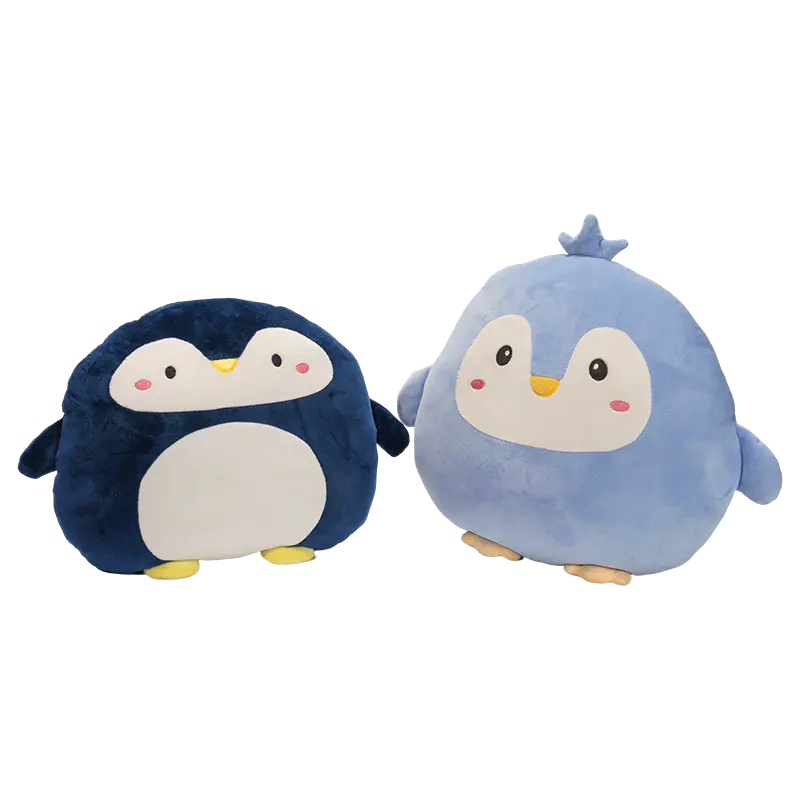
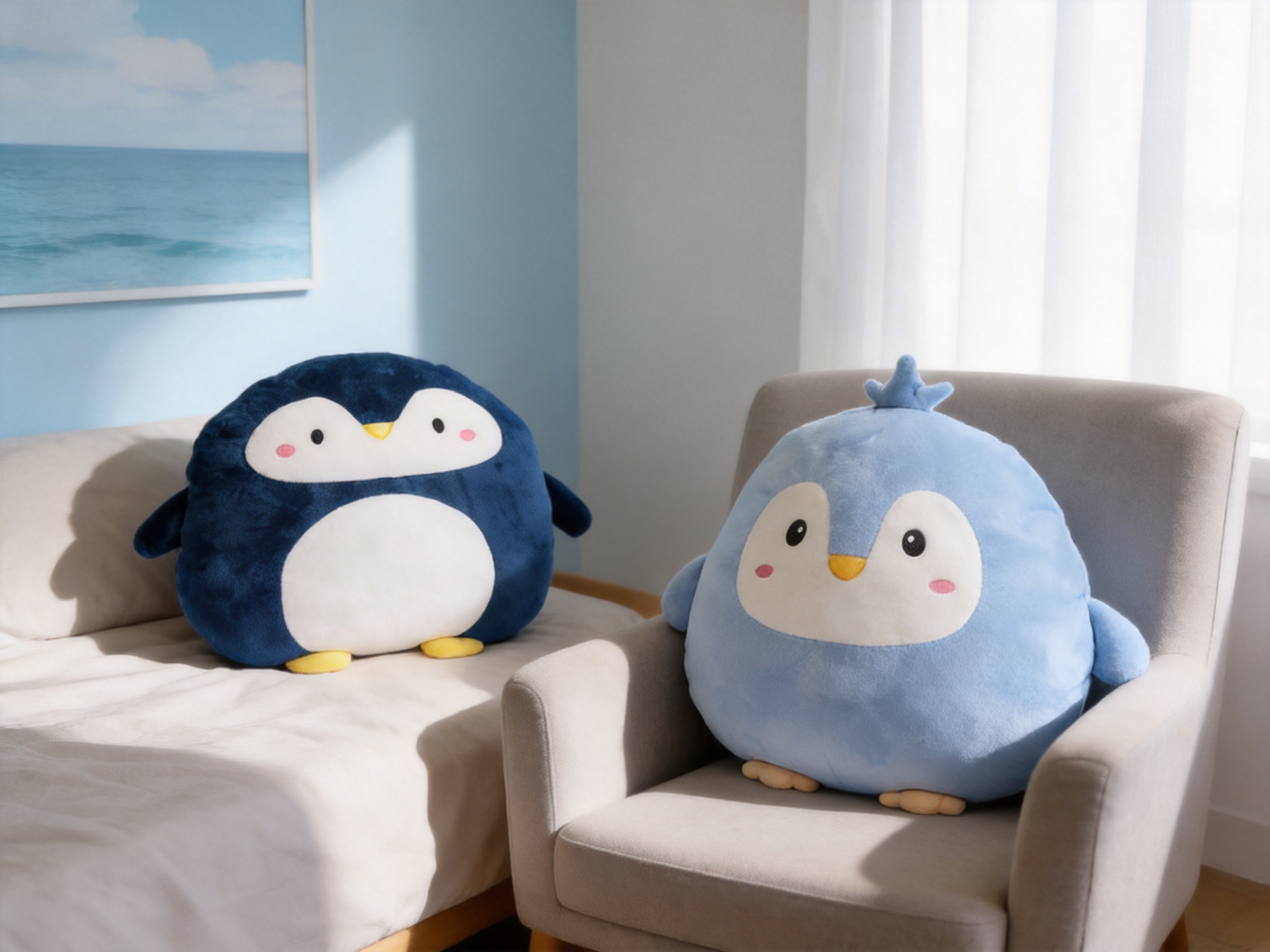
This product is more than an ordinary decorative cushion. It is a character-based plush item that can function as a comfort companion, a collectible, a branded promotional gift, or a distinctive home accessory. The deep-blue and light-blue color versions provide two different visual personalities. The darker design suggests the calmness of the ocean, while the lighter version evokes a clear sky and a fresh, gentle atmosphere. Both designs use a chubby round form that gives the product a soft, friendly, and highly recognizable appearance.
For buyers seeking a plush product with broad commercial potential, penguin-shaped plush pillows offer an attractive balance of visual appeal, manufacturing practicality, customization flexibility, and gift value. They can be developed for children’s product lines, winter collections, marine-themed promotions, travel retail, hotel amenities, lifestyle stores, seasonal events, and corporate campaigns. Their design is simple enough to be produced efficiently while still offering many opportunities for customization.
Penguin-shaped plush pillows
What Makes Penguin-Shaped Plush Pillows Stand Out?
The strongest advantage of this product is its instant recognizability. Penguins are widely associated with friendliness, curiosity, winter, nature, family bonds, and playful adventure. A penguin character can therefore communicate warmth and positive emotion without requiring a complicated story or elaborate decoration. The shape is easy to understand at a glance, which is especially valuable in retail environments and online product listings where customers often make quick visual judgments.
The round body and head create a soft, cushion-like profile rather than the narrow or highly articulated shape of a traditional stuffed animal. This gives the product a wider range of uses. It can be hugged, placed behind the back, displayed on a bed, positioned on a chair, or used as a decorative accent on a sofa. A conventional plush toy may be purchased primarily for play, while a plush pillow can appeal to both toy shoppers and home-furnishing customers.
The facial design is deliberately restrained. Small eyes establish a sweet and gentle expression, while pink cheek details provide a sense of shyness and liveliness. The little orange-yellow feet add contrast to the blue body and make the silhouette more distinctive. This combination of simple facial features and bright accent colors helps the product remain visually clear even when viewed from a distance or shown in a small online thumbnail.
Another important advantage is emotional versatility. The deep-blue version can be presented as calm, cozy, and ocean-inspired. The light-blue version can be positioned as fresh, airy, and suitable for children’s rooms or spring and summer collections. The two color directions may be sold individually, as a coordinated pair, or as part of a larger penguin family with additional colors and accessories.
Advantages Compared with Ordinary Plush Toys and Basic Cushions
Many basic cushions are functional but lack character. They may provide softness and support, yet they do not necessarily encourage attachment or repeat purchasing. Penguin-shaped plush pillows solve this problem by combining a practical cushion format with a memorable character identity. The customer is not simply buying a pillow; the customer is choosing a friendly companion with a recognizable appearance.
Traditional stuffed animals often include separate arms, legs, tails, ears, clothing, or accessories. These details can make a product expressive, but they may also increase production complexity, component count, sewing time, and quality-control requirements. The penguin-shaped pillow uses a streamlined rounded construction with integrated character elements. This can support efficient manufacturing while preserving a clear and attractive design.
Compared with flat printed cushions, the three-dimensional plush form creates greater tactile value. Customers can feel the softness of the shell fabric and the resilience of the PP cotton filling. The rounded shape also creates a more substantial visual presence. Instead of appearing like a flat image placed on fabric, the penguin becomes a complete object with volume, personality, and display appeal.
Compared with highly specialized décor products, the penguin pillow has a wider audience. It can be sold as a children’s gift, a nursery accessory, a winter-themed decoration, a travel souvenir, a promotional item, or a casual home gift. This multi-purpose positioning helps buyers reduce dependence on a single market segment and makes it easier to develop different sales channels around one core design.
The product also has strong gifting potential. A soft penguin is suitable for birthdays, winter holidays, school rewards, family events, employee gifts, children’s activity programs, and seasonal campaigns. Its friendly appearance does not depend on a specific age group or complicated cultural reference. This broad emotional appeal can help retailers and promotional buyers use the product across multiple occasions.
Product Design and Visual Character
The product is designed around a rounded, chubby silhouette. The circular head and body create a gentle outline with no sharp visual interruptions. This soft geometry supports the core message of comfort and friendliness. It also helps the pillow sit naturally against other cushions, plush toys, or bedding products.
The deep-blue version presents a richer and more tranquil visual effect. Its color can be associated with the ocean, evening calm, winter skies, or a modern navy palette. This makes it especially suitable for lifestyle stores, nautical themes, adult bedrooms, children’s reading areas, and gift collections that require a slightly more mature color direction.
The light-blue version has a brighter and more delicate personality. It can be associated with open skies, clean air, peaceful rooms, and gentle children’s décor. The lighter shade may work well in nurseries, baby gift collections, spring displays, pastel-themed assortments, and retail environments that favor a fresh and calming color scheme.
Pink cheek details soften both color versions and prevent the blue body from appearing cold or distant. The cheeks communicate warmth and create a small focal point around the face. The orange-yellow feet perform a similar function at the bottom of the product. These contrasting accents make the character more expressive without adding excessive ornamentation.
The design is also suitable for extension into a wider collection. A buyer may request different body colors, seasonal scarves, embroidered expressions, themed belly panels, removable accessories, or coordinated mini versions. Because the basic shape is recognizable and uncluttered, new variations can be introduced without losing the identity of the original product.
Materials and Comfort Performance
The standard shell fabric is soft plush fabric, selected to provide a comfortable hand feel and an attractive surface appearance. A soft exterior is essential for a product intended to be hugged, held, or placed against the body. It also contributes to the visual impression of warmth, which is one of the most important qualities in a plush pillow.
PP cotton is used as the filling material. This filling provides a lightweight, cushion-like structure while allowing the product to maintain its rounded profile. At a listed weight of approximately 300 grams, the pillow is substantial enough to feel satisfying in the hands without becoming difficult to move or display. Its manageable weight is useful for children, retail packaging, promotional distribution, and international shipping.
The 20-centimeter standard size creates a compact product with strong versatility. It is large enough to show the facial details and feet clearly, yet small enough for shelves, beds, desks, display baskets, gift boxes, and event tables. The availability of customized sizing gives buyers additional flexibility. A smaller version could be developed as a key promotional item or collectible, while a larger version could be positioned as a more substantial home cushion or premium gift.
For commercial buyers, material selection should be considered together with intended use. A product for children’s bedrooms may prioritize an especially soft touch and gentle colors. A promotional item may emphasize logo placement, efficient packaging, and cost control. A premium lifestyle collection may require a more luxurious fabric surface, additional embroidery, or upgraded presentation. The base construction can be adapted according to the needs of the target market.
Material and construction decisions should always be confirmed during the sample stage. Buyers can review the fabric hand feel, filling density, seam appearance, color matching, facial placement, and overall proportions before approving mass production. This process helps ensure that the final product reflects the desired balance between softness, appearance, durability, and cost.
Customization Opportunities for OEM and ODM Projects
OEM and ODM services are available for the penguin-shaped plush pillow. This allows importers, retailers, distributors, promotional agencies, and brand owners to develop a product that matches their own commercial identity. Customization may involve color, size, facial expression, embroidery, labels, packaging, accessories, and product combinations.
Color customization is one of the simplest ways to create a distinct collection. A buyer may select a specific blue tone to match an existing brand palette or request a broader seasonal assortment. Additional colors could include white, gray, lavender, mint, yellow, or soft pink, depending on the intended market. The key consideration is maintaining sufficient contrast between the body, face, cheeks, and feet so that the penguin remains recognizable.
Size customization supports different retail categories. The listed size is 20 centimeters, but customized dimensions can be discussed for specific programs. Small versions may be useful for party favors, promotional giveaways, capsule-style collections, or multi-item gift sets. Medium versions can serve as standard retail plush pillows. Larger versions can be used for premium displays, children’s furniture accents, or oversized seasonal promotions.
Facial customization can create different emotional personalities. A gentle smile may support a comforting nursery product, while a surprised or excited expression may suit a children’s entertainment campaign. Closed eyes can produce a sleepy bedtime theme. Subtle changes to the eye shape, cheek position, or mouth embroidery can create a family of characters without requiring a completely new body pattern.
Branding can be integrated through woven labels, printed hangtags, embroidered logos, custom packaging, or themed accessories. For promotional orders, the penguin may carry a small emblem, wear a branded scarf, or include a message card. Retailers can request packaging that communicates product features, care information, collection identity, and seasonal use.
ODM development is also suitable for buyers who have a general concept but do not yet have a completed production drawing. The manufacturer’s R&D and design team can help translate a theme into a workable plush structure. This may include refining proportions, selecting practical construction methods, balancing visual details with production costs, and preparing a sample for review.
Manufacturing Process from Concept to Finished Product
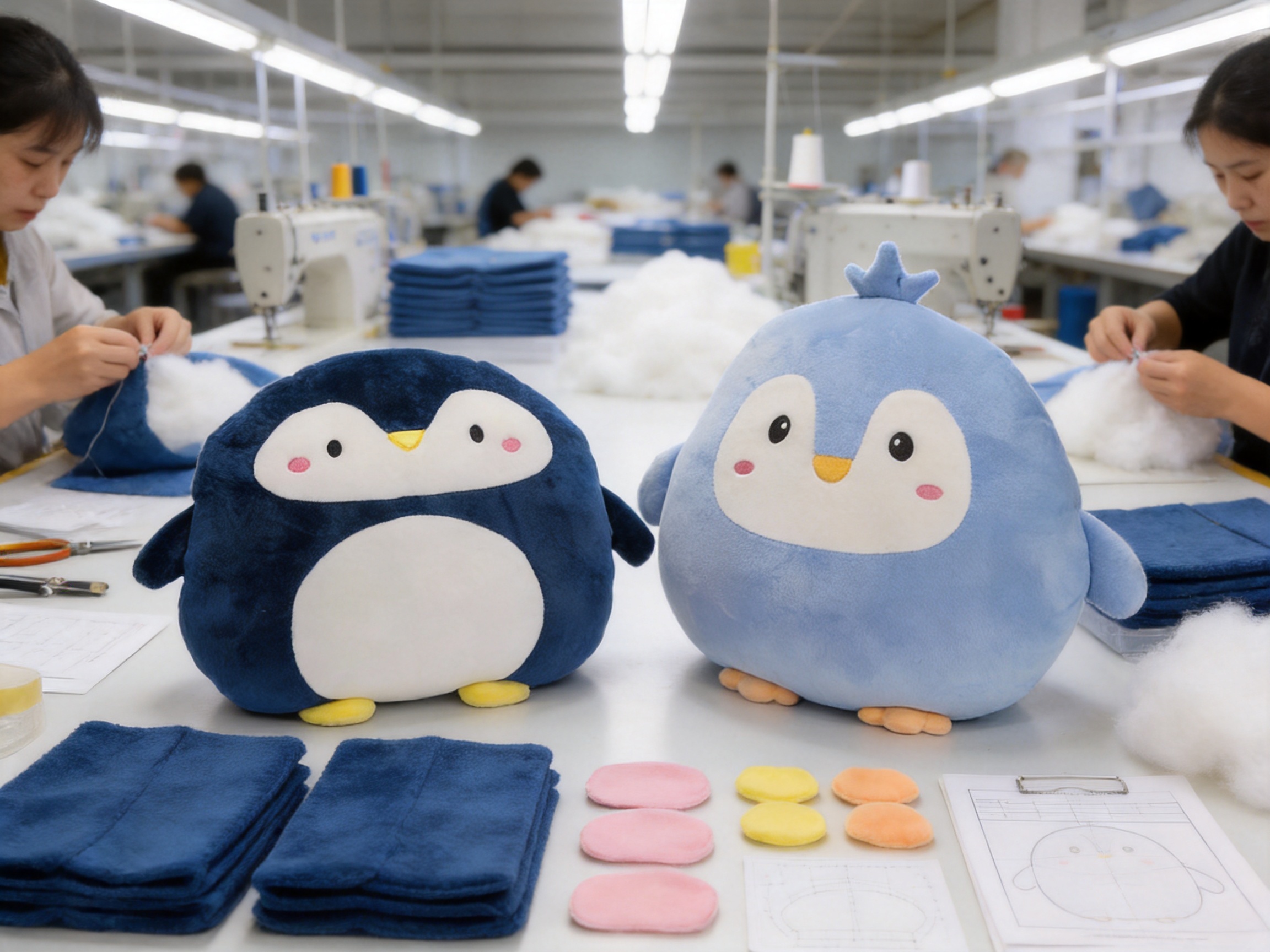
A reliable plush product depends on more than an attractive sketch. The design must be translated into patterns, materials, sewing operations, filling procedures, finishing work, inspection standards, and packaging specifications. An integrated manufacturer with R&D, design, production, sales, and after-sales capabilities can coordinate these stages more efficiently than a fragmented supply chain.
1. Concept Development and Design Review
The process begins with the product concept. For the penguin pillow, the central requirements include a rounded silhouette, soft plush fabric, small eyes, rosy cheeks, orange-yellow feet, and a stable cushion form. During design review, the team considers the intended size, target age group, retail positioning, color direction, filling volume, and customization requirements.
A design review also identifies which features should be sewn, embroidered, appliquéd, or constructed as separate components. This matters because each method influences appearance, durability, production time, and cost. A simple face may be best represented through embroidery, while feet may be formed from contrasting fabric pieces. The goal is to preserve the character’s charm while keeping the construction practical for repeat production.
2. Pattern Engineering
Pattern engineering converts the visual concept into fabric components. The pattern must account for seam allowances, turning points, filling access, fabric stretch, and the final three-dimensional shape. Rounded products require careful control of symmetry. If the pattern is not balanced, the head may lean, the body may twist, or the face may sit unevenly.
For a plush pillow, pattern engineering also influences the product’s ability to retain its rounded appearance. Too little fabric can create excessive tension, while too much fabric can cause loose folds. The pattern must be developed alongside the selected plush fabric because different fabric piles and stretch characteristics behave differently during sewing and filling.
3. Material Preparation and Color Control
Once the design and materials are confirmed, fabric and component preparation can begin. The shell fabric, PP cotton filling, thread, embroidery materials, and accent fabrics should be organized according to the approved sample. Color consistency is particularly important for the blue body, pink cheeks, and orange-yellow feet because these details define the character’s visual identity.
Color references should be recorded during sample approval. This helps the production team compare incoming materials and finished components against an agreed standard. For custom projects, the buyer may provide a color reference or approve a physical swatch. A documented color process reduces the risk of variation between sample and bulk production.
4. Cutting and Component Formation
Fabric cutting must follow the approved patterns so that corresponding parts remain consistent. Accurate cutting supports symmetry and helps reduce waste. The direction of the plush pile should also be considered. When the pile faces different directions on adjacent panels, the product may appear to have uneven shading. Consistent pile direction contributes to a smoother, more professional appearance.
Small components such as cheeks and feet require particular attention because their position and proportion affect the character’s expression. Even a minor change in cheek height or foot spacing can make the penguin look noticeably different. Component placement should therefore be guided by templates, markings, or approved production references.
5. Sewing and Assembly
During sewing, individual panels are joined to create the body and head. Seams must be secure and appropriately shaped for the intended filling density. Curved seams are especially important in a rounded pillow because uneven stitching can distort the outline. Assembly staff need to maintain consistent seam allowances and carefully manage the plush fabric at corners and transitions.
The facial elements and feet are attached according to the approved position. This stage requires visual consistency across the production run. A professional manufacturing process treats placement as a measurable quality requirement rather than an informal judgment. Position guides and sample comparisons can help the team maintain a uniform appearance.
6. Filling with PP Cotton
After the shell is assembled, PP cotton is inserted to create the pillow’s volume and softness. Filling density influences the product’s comfort, weight, shape retention, and visual fullness. Insufficient filling may cause a flat or loosely structured appearance, while excessive filling may make the pillow too firm and place unnecessary pressure on the seams.
The target weight of approximately 300 grams provides a useful reference for production control. The final filling amount may require adjustment according to fabric thickness, customized size, and the desired level of softness. A controlled filling procedure helps ensure that products in the same order have a consistent feel and appearance.
7. Closing, Shaping, and Finishing
Once the filling is distributed, the remaining opening is closed securely. The product is then shaped by hand or through controlled finishing procedures so that the head, body, cheeks, and feet present the intended proportions. Loose threads, excess material, and visible irregularities are removed during finishing.
Finishing is especially important for plush pillows because their simplicity makes defects easy to notice. There are few decorative elements to distract from uneven seams, misplaced features, or inconsistent filling. A clean final finish therefore has a direct effect on perceived quality and retail value.
8. Inspection and Packing
Inspection may cover appearance, dimensions, weight, color, seam integrity, feature placement, filling distribution, cleanliness, and packaging accuracy. The approved sample serves as a key reference. For customized orders, the inspection process should also verify labels, hangtags, accessories, carton markings, and any buyer-specific requirements.
Standard packaging information lists a carton size of 30L × 25W × 18H, with 12 pieces per carton. The listed gross weight is 3 kilograms and the net weight is 2 kilograms. These figures provide a starting point for logistics planning, although final shipping details should be confirmed according to the actual order configuration, packaging method, and customized specifications.
Manufacturing Strengths and Company Capabilities
The manufacturer behind this product is an integrated plush product company established in 2013. Its capabilities include research and development, design, production, sales, and after-sales service. This integrated structure is important for buyers because product development often requires decisions that cross multiple departments. A design choice may affect pattern engineering, material usage, production efficiency, packaging, and shipping. Coordinated internal teams can address these connections more directly.
The factory covers more than 10,000 square meters and has professional production equipment. A facility of this scale supports organized workflows, production planning, material management, sample development, and bulk-order coordination. It also gives the company a foundation for handling different categories of plush products, including trendy plush toys, children’s plush toys, pet plush toys, promotional gifts, home furnishings, stationery gifts, handicrafts, and cartoon decorations.
The company reports annual sales exceeding 12 million RMB and exports products to Europe, America, Australia, Japan, and South Korea. Experience across multiple international markets can help the manufacturer understand the importance of consistent specifications, clear communication, packaging coordination, and delivery planning. Buyers serving different regions can discuss market-specific product requirements during the development process.
The customer base includes major retail organizations such as Walmart, Target, Albertsons, and Kmart. This type of commercial experience suggests familiarity with structured purchasing programs and the need for repeatable production. Large retail and distribution channels generally require attention to product consistency, documentation, carton planning, delivery schedules, and communication across an extended supply chain.
The company also offers in-stock services in addition to customized production. In-stock availability may be useful for buyers who need to test a product, respond to a short-term opportunity, or place a smaller initial program before developing a fully customized version. OEM and ODM services, meanwhile, support larger or more specialized projects that require a unique design identity.
Quality Control Considerations for Buyers
Quality control for a plush pillow should begin before mass production. Buyers should approve the fabric, body color, filling feel, dimensions, facial expression, cheek placement, foot shape, packaging, and labeling during the sample stage. The sample fee is listed as 100 dollars per design, with a sample lead time of approximately 3 to 7 working days. These terms allow the buyer to assess the product before committing to a full order.
Dimensional tolerances should be agreed in advance. A nominal size of 20 centimeters may vary slightly because plush products are soft and filled, but the acceptable range should be clarified for production. Customized sizes should be measured using a consistent method, such as the maximum height, width, or overall seated profile.
Filling consistency is another important inspection point. Samples should be handled and compared to confirm the preferred softness and shape retention. If the product is intended primarily as a decorative pillow, a fuller structure may be desirable. If it is intended for hugging or use as a comfort companion, a softer and more compressible filling level may be preferred.
Feature placement should be inspected visually and, where appropriate, against a positioning template. The eyes, cheeks, and feet give the penguin its personality. Inconsistent placement can result in a mixed expression across the production run. A clear approved reference reduces ambiguity for the manufacturing team.
Surface cleanliness and thread finishing are also important. Plush products should be free from obvious stains, loose threads, excessive lint, and unfinished seams. Packaging should protect the product from dust and handling during transport while still presenting it attractively to the customer.
Buyers should discuss any market-specific compliance or testing requirements before production begins. Requirements may differ according to the destination country, product classification, target age group, labeling system, packaging format, and intended use. Confirming these matters early helps prevent delays or costly changes later in the project.
Order Information and Commercial Planning
The listed minimum order quantity is 500 pieces. This quantity is suitable for retailers, importers, promotional distributors, online sellers, and organizations planning a coordinated product launch. A 500-piece minimum allows the buyer to distribute inventory across several channels while maintaining a consistent design and color direction.
For a two-color collection, the order quantity may be allocated between deep blue and light blue according to the buyer’s market research. Some customers may prefer an equal split, while others may place a larger quantity in the color most compatible with their existing assortment. The final allocation should be agreed during quotation and production planning.
The listed delivery time is 45 days. Buyers should confirm when this period begins, particularly if it depends on sample approval, deposit receipt, artwork confirmation, material availability, or packaging approval. Early planning is recommended for seasonal programs because ocean freight, warehouse scheduling, retail launch dates, and promotional events can add time beyond the manufacturing period.
Carton planning is useful when calculating warehouse capacity and shipping costs. With 12 pieces per carton, a 500-piece order may require a partial carton unless the final quantity is adjusted to a carton-compatible number. Buyers may choose to order in full carton quantities for simpler logistics, depending on inventory needs and commercial priorities.
Packaging can be developed for different sales environments. Bulk cartons may be suitable for distributors and warehouse fulfillment. Individual polybags, paper bands, hangtags, gift boxes, or printed cartons may be more appropriate for retail shelves or direct-to-consumer orders. Packaging decisions should consider protection, presentation, storage, sustainability goals, and destination-market requirements.
Retail, Promotional, and Seasonal Applications
Penguin-shaped plush pillows are well suited to children’s retail. Their rounded design, soft fabric, bright feet, and friendly face can attract attention in toy aisles, gift shops, department stores, and online children’s product categories. Retailers may place the pillows alongside blankets, bedding, pajamas, books, winter accessories, or other animal-themed products.
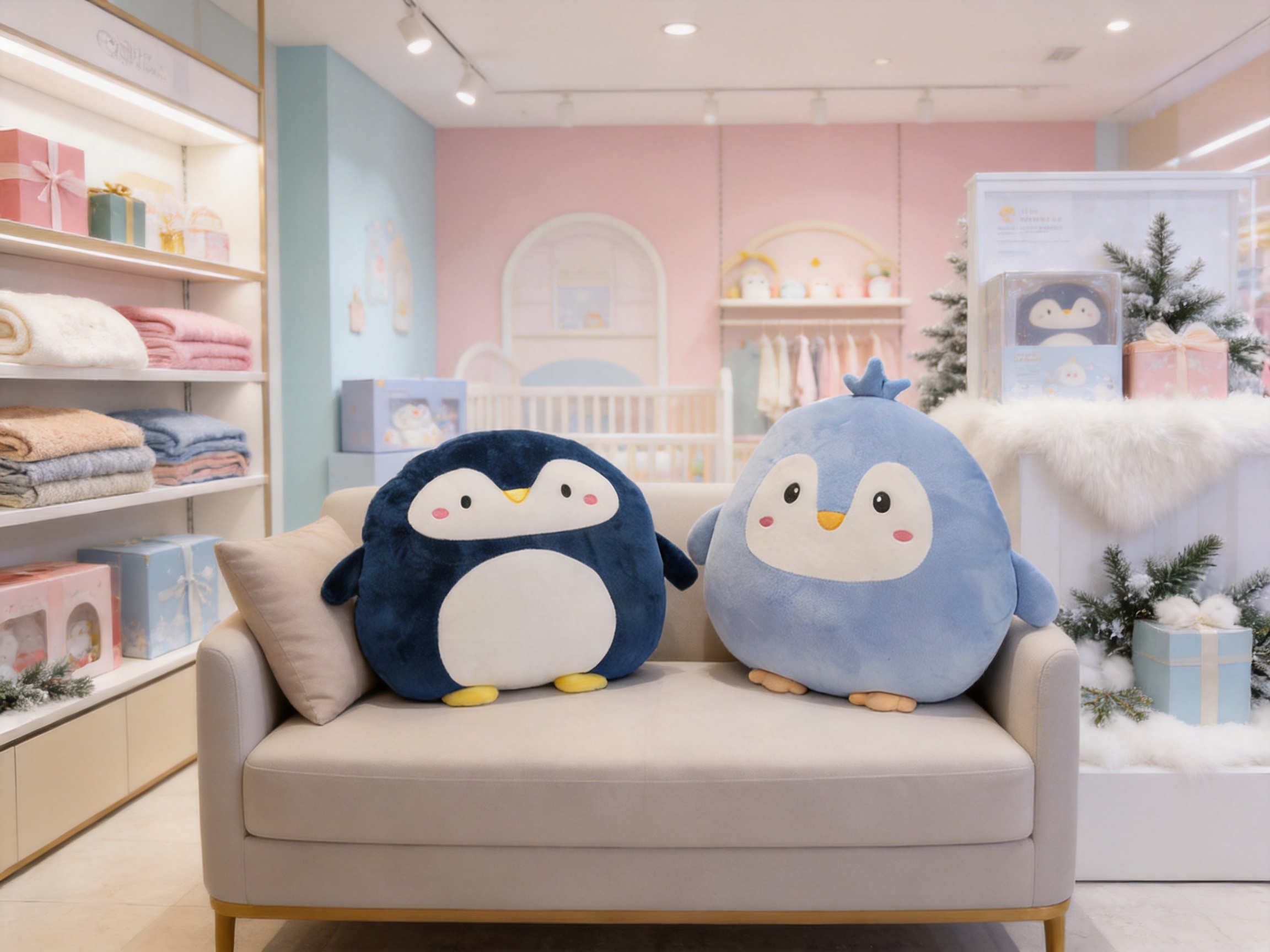
The product can also be marketed as home décor. Its compact size allows it to function as an accent pillow on a bed, reading chair, nursery shelf, sofa, or office seat. The deep-blue color may complement neutral interiors, while the light-blue version may fit pastel or airy décor collections. A coordinated pair can be displayed together to create a stronger visual merchandising effect.
Seasonal campaigns are another strong opportunity. Penguins are naturally associated with winter and snow-themed promotions, making them appropriate for holiday displays, winter festivals, school events, and cold-weather gift assortments. At the same time, the ocean-inspired deep-blue color and sky-inspired light-blue color allow the product to remain relevant beyond the winter season.
Promotional agencies may use the pillows for family-oriented campaigns, environmental events, educational programs, travel promotions, hospitality gifts, or community activities. A penguin character can support themes such as teamwork, exploration, protection of nature, friendship, and family. Custom accessories or printed tags can connect the product to a campaign message without changing the core pillow shape.
Hotels, resorts, aquariums, museums, amusement parks, and themed attractions may also find value in a customized penguin pillow. A unique color scheme, logo, tag, or character story can transform the standard design into a destination souvenir. Because the item is both a plush character and a home accessory, it can appeal to visitors seeking a practical keepsake rather than a purely decorative token.
Online retailers can emphasize the product’s emotional and functional qualities through lifestyle photography, size comparisons, close-up fabric images, and descriptions of the rounded shape. The compact 20-centimeter format is easy to communicate to online shoppers, while customization options create opportunities for exclusive marketplace collections or private-label launches.
How to Build a Strong Product Collection Around the Penguin Pillow
A single penguin pillow can serve as the starting point for a broader collection. Buyers may develop multiple colors, expressions, sizes, or seasonal accessories while maintaining one recognizable character family. This approach can encourage repeat purchases and allow customers to collect different versions.
A color series could include ocean blue, sky blue, snow white, charcoal gray, icy lavender, and soft mint. A seasonal series might add scarves, earmuffs, hats, or embroidered holiday symbols. A bedtime series could use sleepy eyes and softer colors, while an adventure series could include small backpacks or travel-themed tags.
Size variation can also create a product hierarchy. A mini version may be positioned as an entry-level gift, a standard version as the main retail item, and a large version as a premium décor piece. The same character identity across several sizes can encourage customers to create a group display or purchase different versions for different rooms.
Bundles offer another commercial strategy. The pillow may be paired with a blanket, sleep mask, notebook, keychain, baby accessory, or gift card. For promotional programs, the plush pillow can be included in a family event package or employee wellness kit. The simple character design makes it easier to coordinate the product with complementary goods.
Buyers should maintain a consistent design language across the collection. The face, cheek treatment, feet color, fabric texture, and packaging should remain recognizable even when the colors or accessories change. Consistency strengthens the character’s identity and helps customers understand that different items belong to the same family.
Why the Product Is Suitable for International Buyers
The penguin is a globally recognizable animal character with broad appeal across age groups and markets. Its visual meaning is comparatively easy to communicate because the product does not depend on complex text or region-specific humor. This is advantageous for export products, multilingual retail environments, online marketplaces, and international promotional programs.
The compact size and moderate weight also support international distribution. A 20-centimeter pillow can be packed efficiently, stored in cartons, displayed in different retail formats, and shipped through common logistics channels. Its manageable physical dimensions make it easier for distributors to test demand before committing to larger home-furnishing products.
The manufacturer’s export experience in Europe, America, Australia, Japan, and South Korea provides a foundation for communication with overseas customers. International buyers can discuss design files, samples, color expectations, packaging, shipping schedules, and customization requirements with a company accustomed to serving global markets.
The integrated structure of the business can simplify coordination. Instead of communicating separately with a designer, sewing workshop, packaging vendor, and sales office, the buyer can work with one manufacturer that manages multiple parts of the process. This may improve response time and reduce the risk that important product details are lost between different suppliers.
Practical Guidance for Selecting This Product
Buyers should begin by defining the intended use. A children’s toy line, home décor collection, promotional campaign, and seasonal gift program may all use the same basic penguin shape, but they may require different materials, packaging, labels, accessories, and quality standards. Clear positioning helps the manufacturer recommend suitable options.
The next step is to select the preferred color direction. The deep-blue and light-blue versions already provide contrasting choices, but a custom palette may be more appropriate for a specific retail identity. Buyers should consider shelf appearance, brand colors, seasonal timing, and how the product will look in photography.
Sample approval should focus on both appearance and touch. The product should be evaluated from multiple angles, including the front, side, and back. Check the roundness of the body, symmetry of the face, softness of the fabric, consistency of the filling, attachment of the feet, and overall weight. A sample that looks attractive but feels too firm or too flat may need adjustment before bulk production.
Packaging and labeling should be discussed before the sample is finalized. If a buyer needs a specific hangtag, barcode, warning statement, care label, or retail box, these details can affect the product and packing process. Early confirmation helps the manufacturer include them in the production plan.
Finally, buyers should align the order quantity and delivery schedule with the sales plan. The 500-piece MOQ and 45-day listed delivery time provide useful planning references. Seasonal and promotional orders should include sufficient time for sample review, production, inspection, freight, customs processing, and local distribution.
Frequently Asked Questions
What is the standard size of the penguin-shaped plush pillow?
The listed standard size is 20 centimeters. Customized sizes are available, subject to design confirmation, material selection, production requirements, and quotation.
How much does one pillow weigh?
The listed product weight is approximately 300 grams. The final weight may vary slightly according to customized dimensions, fabric selection, filling density, accessories, and packaging requirements.
What materials are used?
The shell is made from soft plush fabric, and the filling material is PP cotton. Buyers can discuss alternative fabric textures, colors, and construction details for OEM or ODM projects.
What colors are available?
The product is shown in deep blue and light blue, with pink cheeks and orange-yellow feet. Multiple color choices are available for custom development, subject to material and sample approval.
Can the product be customized with a logo?
OEM and ODM services are available. Branding may be developed through labels, hangtags, embroidery, packaging, accessories, or other approved methods, depending on the project requirements.
What is the minimum order quantity?
The listed minimum order quantity is 500 pieces. Buyers should confirm whether different colors, sizes, or designs are counted separately when discussing the final quotation.
How much is the sample fee?
The listed sample fee is 100 dollars per design. The exact fee and any possible adjustment against a bulk order should be confirmed with the manufacturer.
How long does sample development take?
The listed sample lead time is approximately 3 to 7 working days. Timing may depend on artwork, material availability, design complexity, and approval of specifications.
What is the expected delivery time for a bulk order?
The listed delivery time is 45 days. Buyers should confirm the starting point of this period and allow additional time for approvals, inspection, freight, customs, and local delivery.
How are the products packed?
The listed carton size is 30L × 25W × 18H, with 12 pieces per carton. The listed gross weight is 3 kilograms and the net weight is 2 kilograms. Final packing details should be verified for the selected product and order quantity.
Can the penguin pillow be used as a home décor item?
Yes. Its rounded shape and soft plush surface make it suitable for beds, sofas, reading corners, nurseries, desks, shelves, and other lifestyle spaces. It can be marketed as both a plush companion and a decorative cushion.
Is this product suitable for promotional programs?
Yes. The character design is suitable for family campaigns, seasonal events, educational programs, retail promotions, hospitality gifts, destination souvenirs, and other promotional applications. Custom colors, labels, tags, and accessories can support campaign branding.
What should buyers check during sample approval?
Buyers should review the dimensions, color, fabric softness, filling density, face placement, cheek position, foot shape, seam quality, weight, labels, packaging, and overall appearance. The approved sample should become the reference for mass production.
Conclusion
Penguin-shaped plush pillows offer a strong combination of comfort, character, versatility, and customization potential. Their round form, soft plush fabric, PP cotton filling, rosy cheeks, and contrasting orange-yellow feet create an immediately appealing product that can move across toy, gift, home décor, promotional, and seasonal categories.
The product’s advantages over ordinary cushions and conventional plush toys come from its hybrid nature. It provides the tactile comfort of a pillow while retaining the emotional connection of a stuffed animal. Its simple construction supports practical manufacturing, while its recognizable character allows extensive variation in color, size, expression, packaging, and branding.
The manufacturer’s integrated R&D, design, production, sales, and after-sales capabilities provide a suitable foundation for OEM and ODM development. With a factory covering more than 10,000 square meters, professional production equipment, international export experience, in-stock services, and a portfolio covering multiple plush categories, the company can support both standard product orders and customized commercial programs.
For retailers, importers, promotional agencies, and brand owners, this penguin pillow can serve as an accessible entry point into character-based plush products. A carefully approved sample, clearly defined specifications, appropriate packaging, and coordinated production schedule can turn the simple penguin concept into a successful product line for modern customers around the world.
References
1. Product specification sheet for Penguin-Shaped Plush Pillows, including size, weight, materials, packaging, MOQ, sampling, and delivery information.
2. Manufacturer company profile for Tianchang Bestjoy Craft & Gift Co., Ltd., including company history, factory scale, product categories, export markets, and organizational capabilities.
3. General principles of plush toy product development, including concept design, pattern engineering, fabric preparation, sewing, filling, finishing, inspection, and packaging.
4. General retail merchandising practices for character products, home accessories, seasonal gifts, and promotional plush items.
5. General supply-chain planning principles for OEM and ODM consumer product development, including sample approval, quality control, carton planning, and delivery coordination.