en
 русский
 Español
 عربى

Content
- 1 1. Product Overview
- 2 2. Why the Three-Monkey Concept Stands Out
- 3 3. Soft Materials and Tactile Appeal
- 4 4. The Commercial Advantages of a Compact 13-Centimeter Format
- 5 5. Design Details That Improve Emotional Connection
- 6 6. Advantages Over Generic Plush Products
- 7 7. Manufacturing Strengths of the Supplier
- 8 8. Manufacturing Process for the Monkey Plush Collection
- 9 9. Quality Considerations for Buyers
- 10 10. OEM and ODM Customization Opportunities
- 11 11. Applications Across Retail and Promotion
- 12 12. Order Planning and Project Timeline
- 13 13. Why an Integrated Factory Can Add Value
- 14 14. Sustainability and Responsible Product Planning
- 15 15. Photography, Merchandising, and Content Potential
- 16 16. Frequently Asked Questions
- 16.1 Q1: What is the standard size of the stuffed monkey plush toys?
- 16.2 Q2: How many monkey designs are included in the collection?
- 16.3 Q3: What materials are used for the toys?
- 16.4 Q4: Are the toys sold as a set or individually?
- 16.5 Q5: Can the color be customized?
- 16.6 Q6: Can the banana and flower be replaced with other accessories?
- 16.7 Q7: What is the minimum order quantity?
- 16.8 Q8: What is the sample fee?
- 16.9 Q9: How long does sampling take?
- 16.10 Q10: How long does mass production take?
- 16.11 Q11: Is the product suitable for promotional campaigns?
- 16.12 Q12: What makes the sitting style useful?
- 16.13 Q13: What should buyers check in the sample?
- 16.14 Q14: Does the manufacturer support related plush products?
- 16.15 Q15: Where is the manufacturer located?
- 17 17. Conclusion
- 18 References
- 19 Product: Adorable stuffed monkeys plush toys with banana and flower
Adorable stuffed monkeys plush toys with banana and flower combine expressive character design, soft materials, compact sizing, and playful accessories in one memorable plush collection. Featuring three brown monkeys in different sitting poses, the design creates a small storytelling scene rather than presenting a single ordinary stuffed animal. One monkey holds a yellow item, another embraces a banana, and the third presents a pink flower. Together, these details give the collection warmth, personality, and strong visual appeal for children, gift buyers, retailers, promotional campaigns, and lifestyle product collections.
For buyers searching for plush toys that are easy to display, comfortable to hold, and suitable for customized production, this design offers a practical and attractive solution. The 13-centimeter size makes the toys convenient for shelves, desks, gift boxes, party favors, seasonal displays, and children’s rooms. The 55-gram weight also supports easy handling and efficient packing. At the same time, the soft plush exterior and resilient PP cotton filling provide the tactile comfort expected from a quality stuffed toy.
This article examines the product in detail, including its design advantages, material selection, manufacturing considerations, customization possibilities, commercial applications, packaging potential, and the production strengths of Tianchang Bestjoy Craft & Gift Co., Ltd. It also explains why a specialized plush toy manufacturer can provide more value than a general gift supplier when buyers need consistency, creative support, and scalable production.
1. Product Overview
The stuffed monkeys plush toys are designed as a coordinated three-character collection. Each monkey has a different pose, facial expression, and prop, allowing the products to work individually or as a group. This approach gives buyers more flexibility than a repetitive single-style plush item. A retailer can sell the monkeys separately, package them as a three-piece set, or use the characters as a visual theme across several products and promotional materials.
The monkeys are brown, with rounded eyes and friendly facial expressions. Their appearance is intended to communicate cleverness, innocence, and friendliness without creating an aggressive or overly complicated character style. These qualities make the toys suitable for a broad audience, including children, families, collectors of small plush figures, and consumers looking for cheerful home accessories.
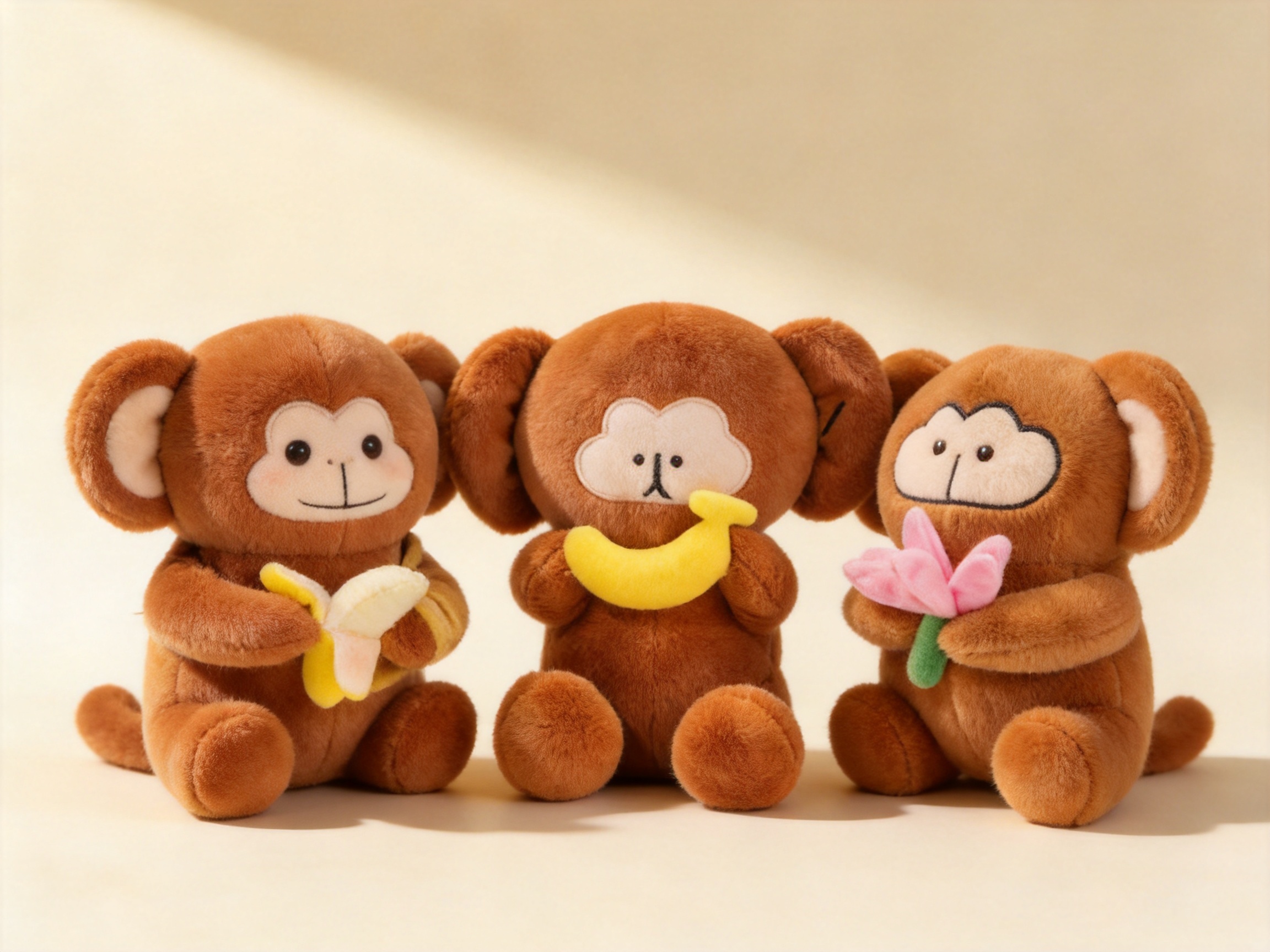
The central monkey hugs a yellow banana with both hands. This pose immediately communicates the animal’s identity and creates a strong color contrast against the brown body. The monkey on the left holds a yellow item as though protecting or playing with a treasured object. The monkey on the right holds a small pink flower, adding a gentle and heartwarming element to the collection. The combination of brown, yellow, and pink makes the toys visually recognizable and easy to coordinate with colorful retail displays.
| Product Attribute | Provided Specification | Commercial Value |
|---|---|---|
| Product type | Fantasy animal plush toys | Suitable for character, gift, lifestyle, and promotional collections |
| Design theme | Three adorable monkeys with banana and flower accessories | Creates variety and encourages set purchasing |
| Size | 13 cm or customized | Compact for displays, packaging, shipping, and gift applications |
| Weight | Approximately 55 g | Lightweight and easy to handle |
| Color | Brown with yellow and pink accents | Warm, friendly, and visually distinctive |
| Style | Sitting | Stable presentation on shelves, desks, and other flat surfaces |
| Shell fabric | Super soft plush | Comfortable tactile experience and attractive surface appearance |
| Filling | PP cotton | Soft, resilient, and suitable for maintaining shape |
| OEM/ODM | Welcome | Supports custom characters, colors, sizes, and accessories |
| Minimum order quantity | 1,000 pieces | Appropriate for retail launches, campaigns, and wholesale programs |
| Sample fee | US$100 per design | Provides a defined starting point for prototype development |
| Sample time | 3–7 working days | Allows buyers to review the design before mass production |
| Delivery time | Approximately 45 days | Supports structured production and launch planning |
2. Why the Three-Monkey Concept Stands Out
Many basic plush toys rely on one simple body shape and a single expression. Although such products can be economical, they may have limited storytelling value and may be less memorable in a crowded retail environment. The three-monkey design provides a more complete visual narrative. Each character performs a different action, and each accessory contributes to the emotional character of the collection.
Variation is one of the strongest advantages of this design. The sitting monkey with a yellow object can represent curiosity and playfulness. The banana-holding monkey suggests innocence and humor. The flower-holding monkey introduces tenderness and sharing. These small differences help buyers create a collection with multiple personalities while maintaining a consistent overall appearance.
The design also supports merchandising flexibility. A store can place the three monkeys together as a coordinated display, arrange them beside fruit-themed or jungle-themed products, or use them as individual impulse purchases. A gift company can include one monkey in a themed gift box or offer the full set as a friendship, birthday, spring, or family gift. This flexibility is an important advantage over products that have only one obvious sales format.
The accessories strengthen recognition without making the design visually overloaded. The banana and flower are easy to understand, easy to associate with the characters, and capable of creating color contrast. Because they are relatively simple elements, they can also be adapted during OEM or ODM development. A buyer may request different fruit, seasonal objects, logos, costumes, or color combinations while preserving the basic monkey concept.
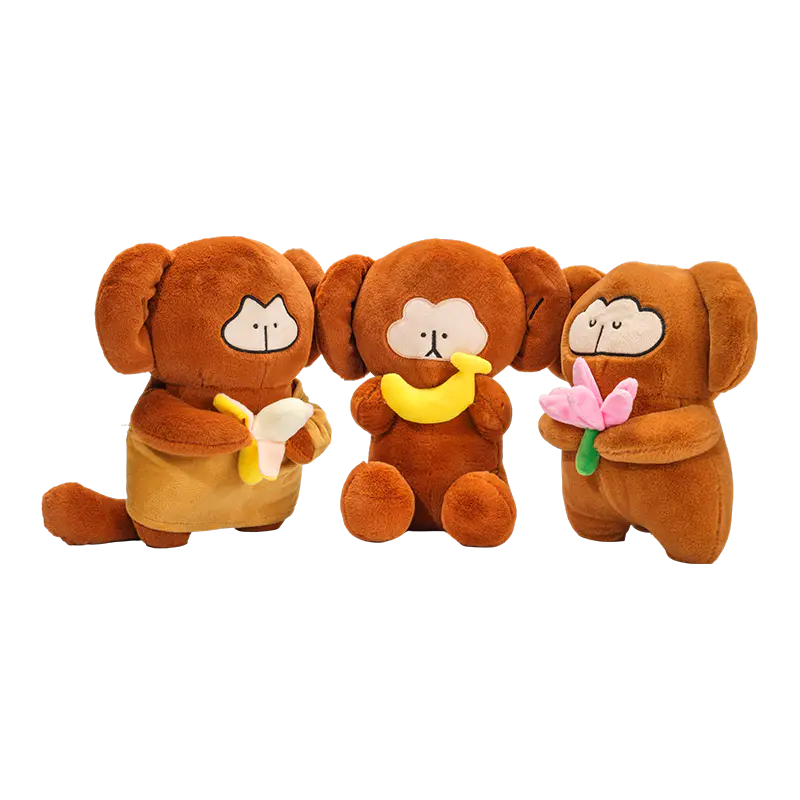
Adorable stuffed monkeys plush toys with banana and flower
3. Soft Materials and Tactile Appeal
Plush products are judged not only by their appearance but also by the way they feel in the hands. The supplied design uses super soft plush for the shell fabric. This material choice supports the comforting tactile quality expected from stuffed animals and helps the product feel more appealing when handled in a store or received as a gift.
A soft exterior can also improve the perceived value of a compact plush toy. At 13 centimeters, the monkeys are relatively small, so the quality of the fabric and filling becomes especially important. A pleasant surface texture helps the toy feel substantial and inviting even when the product is designed for lightweight use.
The filling material is PP cotton. PP cotton is widely used in plush production because it is lightweight, resilient, and capable of creating a rounded appearance. It allows the manufacturer to fill the body evenly while maintaining a soft, squeezable feel. Proper filling distribution is essential for these monkey characters because the sitting pose depends on balanced proportions and a stable lower body.
Material quality also influences long-term presentation. A plush toy that loses its shape quickly may appear less attractive after storage, shipping, or repeated handling. Resilient filling helps the product recover its form, while appropriate stitching and controlled assembly support the integrity of the outer shell. For wholesale customers, these details matter because the toys may spend time in cartons, warehouses, retail displays, and customer homes before reaching their final use.
The combination of a super soft plush shell and PP cotton filling gives the product a balanced material profile. It is soft enough for cuddling, light enough for efficient handling, and structured enough to display as a sitting character. These qualities help the product compete with larger plush toys that may be more expensive to ship or with lower-cost toys that may not provide the same tactile impression.
4. The Commercial Advantages of a Compact 13-Centimeter Format
The compact size is one of the product’s most practical advantages. A 13-centimeter plush toy can fit into small gift boxes, retail baskets, display trays, children’s rooms, office spaces, and seasonal promotional packages. It does not require the shelf volume of a large stuffed animal, allowing retailers to display more units in the same area.
Compact products can also be easier to integrate into themed collections. A retailer may place the monkey beside stationery, accessories, toys, home décor, or snack-themed merchandise. The banana and flower details make it particularly suitable for jungle, tropical, spring, animal, and friendship themes. The sitting pose allows the product to remain visible without requiring a hook, stand, or complicated display fixture.
The 55-gram weight provides an additional logistical benefit. Lightweight items can be easier to count, pack, move, and distribute. They may also be appropriate for promotional programs in which the product is included with a purchase, placed inside a gift set, or distributed at an event. The exact shipping economics will depend on carton dimensions, order quantity, packaging, and destination, but the compact form creates a useful foundation for efficient logistics.
For consumers, a small plush toy can be an accessible purchase. It may serve as a pocket-sized companion, desk decoration, backpack accessory, shelf ornament, or small gift. For buyers, the format allows multiple price-point strategies. The monkeys can be sold individually at an impulse-friendly price or bundled as a higher-value set with coordinated packaging.
5. Design Details That Improve Emotional Connection
Successful plush characters often depend on small visual signals rather than complex mechanical functions. The round eyes of these monkeys create an alert yet gentle expression. Their facial appearance suggests intelligence and curiosity while remaining friendly and approachable. This balance is useful for products intended for both children and adults.
The sitting posture is another effective design decision. Sitting characters naturally appear relaxed and stable. They can be displayed on a desk, bedside table, shelf, counter, or windowsill without needing to lean against another object. The pose also makes the monkeys look as though they are waiting, playing, holding a gift, or sharing a moment with the viewer.
The accessories contribute emotional meaning. A banana is immediately associated with the playful nature of a monkey, but the act of hugging it gives the character an additional sense of attachment. A flower implies kindness and sharing. A yellow object held by the left monkey can be interpreted as a toy, treasure, or discovery. These open-ended details invite consumers to create their own stories around the characters.
For children, the three monkeys may become imaginative play companions. For adults, the products may serve as cheerful decorative objects or sentimental gifts. For brands, the characters can become mascots or visual ambassadors for a campaign. The design therefore has broader utility than a plush item created only for one narrow age group or occasion.
6. Advantages Over Generic Plush Products
Compared with generic stuffed animals, this collection offers several competitive advantages. First, it has a clear character system. The three monkeys are related but not identical, which creates more visual interest and gives buyers the option of collecting multiple designs.
Second, the product includes recognizable accessories. Many simple plush toys depend only on body shape and color to create appeal. The banana, flower, and yellow handheld object provide additional points of recognition. They can also support packaging copy, promotional stories, social media content, and seasonal merchandising.
Third, the product is designed for stable presentation. The sitting form is convenient for retail display and home use. A toy that can sit upright is easier to arrange and photograph than a limp or highly flexible product that requires support.
Fourth, the product is adaptable. The listed OEM/ODM service means the basic design can serve as a starting point for custom development. Buyers may explore different sizes, fabrics, colors, facial expressions, accessories, labels, packaging formats, or character themes. Generic off-the-shelf products may not provide the same level of development support.
Finally, the product benefits from a manufacturer whose stated business covers research and development, design, production, sales, and after-sales service. This integrated structure can reduce communication gaps between creative planning and factory execution. For buyers, working with a supplier capable of supporting several stages may be more efficient than coordinating separate designers, sourcing agents, and production contractors.
7. Manufacturing Strengths of the Supplier
Tianchang Bestjoy Craft & Gift Co., Ltd. is an integrated plush product manufacturer established in 2013. According to the supplied company information, the company was formed as a joint venture between Hong Kong Jintong International Co., Ltd. and Tianyuan Enterprise Investment Management Co., Ltd. Its factory is located in Jinji Industrial Park, Jinji Town, Tianchang City, Anhui Province, China.
The company’s stated factory area exceeds 10,000 square meters, providing a substantial physical base for product development, production organization, material handling, and order fulfillment. A dedicated facility of this scale can support more structured workflows than a small workshop operating with limited space and equipment. It may also allow different production activities to be coordinated under one manufacturing system.
The company reports annual sales exceeding 12 million RMB and exports products to Europe, America, Australia, Japan, and South Korea. International market experience is valuable for buyers because overseas orders generally require careful attention to specifications, packaging, communication, delivery schedules, and product consistency. A supplier accustomed to serving multiple markets is more likely to understand the importance of clear documentation and coordinated order management.
The company’s stated customers include major retail organizations such as Walmart, Target, Albertsons, and Kmart. These customer references indicate experience with large-scale commercial expectations. While each project must still be evaluated according to its own specifications, a history of serving recognized retail clients suggests that the factory is familiar with professional purchasing processes and volume-oriented production requirements.
Bestjoy’s product range includes trendy plush toys, children’s plush toys, pet plush toys, plush promotional gifts, plush home furnishings, plush stationery gifts, plush handicrafts, and plush cartoon decorations. This broad category coverage can benefit buyers who need more than one type of product. A company may develop a monkey plush collection together with promotional mascots, home accessories, event gifts, or related character merchandise through the same supplier.
7.1 Research and Development Support
A dedicated research and development and design team is important when a buyer wants to move beyond an existing sample. Plush toys require decisions about proportions, seam placement, facial embroidery, accessory attachment, filling density, material behavior, and production feasibility. A supplier with in-house design capabilities can help transform an initial idea into a product that is attractive and manufacturable.
For the monkey design, development may involve balancing the head, body, arms, legs, tail, and sitting base. The banana and flower must be sized appropriately so they are visible without overwhelming the character. The facial features must be positioned consistently across the three monkeys. These details affect the final appearance and should be addressed before mass production.
In-house development can also help identify potential production challenges early. A concept that appears simple in a drawing may require adjustments when converted into fabric panels and stuffed components. Design specialists can propose changes that preserve the intended character while improving sewing efficiency, stability, or material utilization.
7.2 Professional Production Equipment
The company describes itself as having professional production equipment. In plush manufacturing, suitable equipment supports repeatable cutting, sewing, embroidery, stuffing, trimming, assembly, and finishing operations. Equipment alone does not guarantee product quality, but it provides the foundation for consistent manufacturing when combined with trained workers and appropriate process control.
For a three-character collection, production consistency is particularly important. The monkeys should share a recognizable visual language even though their accessories and poses differ. The head shape, body proportions, fabric color, facial placement, and filling feel should remain coordinated across the collection. Organized equipment and production procedures help reduce unnecessary variation between pieces.
7.3 Integrated Sales and After-Sales Service
The company also reports an excellent sales team and a comprehensive after-sales service team. These functions are important for international buyers because a plush order involves more than manufacturing. Buyers may require quotation support, sample coordination, artwork review, production updates, packing information, shipping preparation, and post-delivery communication.
An integrated service structure can make it easier to resolve questions about customization, order quantities, delivery timing, packaging, and product revisions. It can also help establish clearer responsibility throughout the project. For a buyer placing a first order, communication quality may be just as important as the physical product.
8. Manufacturing Process for the Monkey Plush Collection
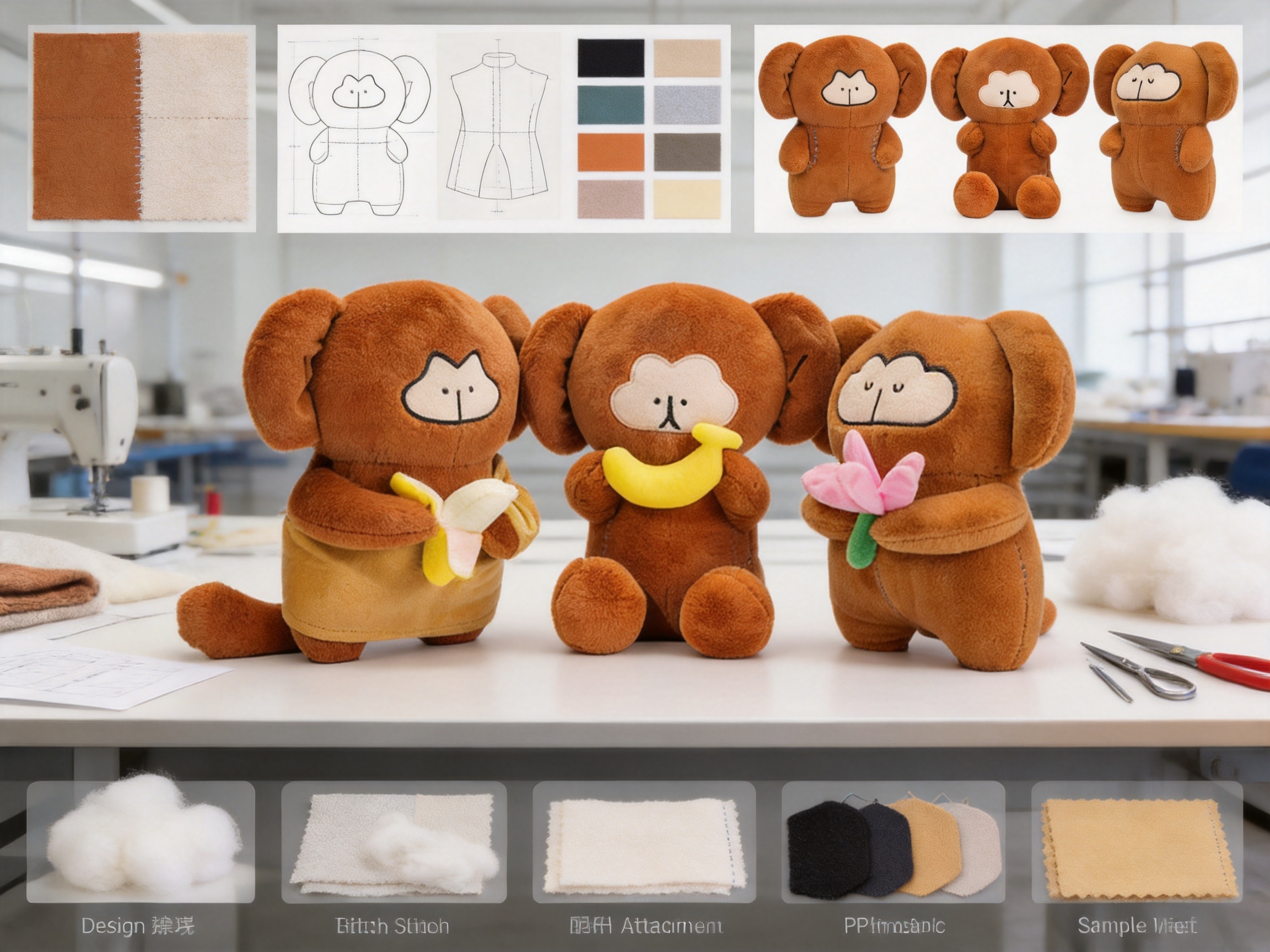
Although the exact internal process may vary according to the final design and buyer requirements, a professional plush project generally begins with product definition. The buyer and manufacturer confirm the size, character artwork, fabric, colors, accessories, labels, filling, packaging, quantity, and delivery expectations. For the featured monkeys, the base specification includes a 13-centimeter size, brown color, super soft plush shell, PP cotton filling, and sitting style.
The next step is pattern development. The three-dimensional monkey shape is divided into fabric sections that can be cut and sewn. Pattern development determines how the head, torso, limbs, ears, tail, and accessories will be formed. Good patterns help create a balanced shape and reduce unnecessary fabric waste.
After pattern approval, fabric and accessory materials are prepared. The brown plush fabric must be selected and matched consistently. Yellow materials are prepared for the banana and the left monkey’s object, while pink material is prepared for the flower. The choice of texture and color affects both visual appeal and tactile quality.
Facial details may be embroidered or otherwise applied according to the approved sample. Eyes, mouth lines, and other features must be positioned carefully because even a small change can alter a character’s expression. Consistent placement is especially important when producing multiple units of the same design.
Fabric pieces are then cut according to the patterns. Cutting accuracy affects final symmetry and assembly. Inaccurate pieces can lead to uneven heads, misaligned limbs, or inconsistent body shapes. Professional production planning helps ensure that the pieces are prepared in an organized manner for the sewing stage.
The sewing process joins the fabric panels and forms the basic monkey bodies. Certain areas may be sewn inside out and then turned, while other components may be attached during assembly. The seams must be secure and appropriate for the intended use. The sitting pose depends on the relationship between the lower body, legs, and filling distribution.
Stuffing follows the shell assembly. PP cotton is inserted and distributed to create the desired roundness and softness. Too little filling may cause the monkey to look flat, while too much may make it hard and distort the seams. Controlled filling is therefore essential for achieving the intended balance between cuddly softness and upright presentation.
Accessories are attached after or during the main assembly, depending on the design. The banana must remain visibly held by the central monkey, and the flower must be positioned securely in the right monkey’s hands. The yellow item held by the left monkey should also remain clear and visually distinct. Accessory attachment affects both appearance and durability.
Finishing work may include trimming loose threads, checking seams, adjusting the filling, cleaning the surface, and reviewing the final shape. Quality personnel can compare finished units with the approved sample and verify that the design remains consistent. Packaging is then completed according to the buyer’s requirements.
9. Quality Considerations for Buyers
Buyers evaluating this product should consider several quality points. The first is appearance consistency. All three monkey designs should maintain consistent facial placement, color, proportion, and accessory position. Even within a handmade or semi-handmade product category, controlled variation is important for professional retail presentation.
The second point is seam construction. Stitching should be neat and secure, particularly around the arms, hands, accessories, and sitting base. These areas may receive more handling than the rest of the toy. Buyers can review the sample carefully and specify any requirements related to seam strength, thread color, or finishing.
The third point is filling distribution. The monkeys should feel soft but not empty, and they should retain the intended sitting shape. The head, torso, arms, and legs may require different filling densities to achieve a balanced appearance. A clear approved sample provides a useful reference for production.
The fourth point is accessory security. The banana, flower, and yellow object are central to the visual story. Their attachment should be stable and their shapes should remain recognizable. Buyers should discuss the construction method and intended use before finalizing the order.
The fifth point is packaging and cleanliness. Plush toys should be protected during storage and transit. Packaging decisions may include individual bags, hangtags, gift boxes, sets, carton markings, and customized inserts. The appropriate method depends on the sales channel and destination market.
Product safety requirements should also be addressed according to the target market. Buyers should identify applicable regulations, testing expectations, labeling rules, and age grading before production. The supplier can then review the project requirements and determine the appropriate documentation or testing process. Compliance needs can differ between markets, so they should not be assumed to be identical.
10. OEM and ODM Customization Opportunities
The listed OEM/ODM service makes this monkey collection suitable as a starting point for customized projects. OEM production may involve manufacturing a buyer’s approved design, logo, packaging, or character specifications. ODM development may involve adapting the existing concept or creating a related design with support from the manufacturer’s design team.
Size customization is one of the most straightforward options. Although the standard size is 13 centimeters, buyers may request larger or smaller versions depending on the sales channel. A small version may be suitable for blind boxes, promotional gifts, or party favors. A larger version may be more appropriate for home décor, premium gifts, or character displays.
Color customization can create seasonal or brand-specific versions. The brown monkey body may be retained while the accessories change according to a campaign. For example, the flower could use a seasonal color palette, or the banana could be replaced with another fruit. Any custom color plan should be evaluated against available fabrics and production consistency.
Accessory customization can expand the collection. The monkeys may hold hearts, stars, books, gifts, leaves, food items, or branded objects. These additions can connect the plush toys to an event, business, educational theme, tourism program, or retail campaign. The accessories should remain proportionate and securely attached.
Facial and costume changes can also create new character identities. Buyers may request different expressions, clothing details, hats, scarves, uniforms, or themed decorations. A basic monkey character can become a school mascot, holiday figure, environmental campaign mascot, or promotional representative.
Packaging is another major customization opportunity. The three monkeys can be packed together in a printed box, displayed in a window package, placed in a reusable pouch, or sold individually with coordinated hangtags. Packaging can explain the personalities of the three characters and encourage consumers to collect the full set.
11. Applications Across Retail and Promotion
The product’s friendly appearance and manageable size make it suitable for many commercial applications. In traditional toy retail, the monkeys can be displayed in the plush section as individual characters or as a coordinated collection. Their bright accessories can help them stand out among brown or neutral-colored stuffed animals.
In gift retail, the flower-holding monkey may be positioned as a friendship or appreciation gift, while the banana-holding monkey may appeal to consumers looking for a humorous animal present. A three-piece set can be marketed as a group of playful companions, making it suitable for birthdays, family gifts, or casual celebrations.
Promotional use is another potential application. Companies may use customized plush monkeys as event giveaways, loyalty gifts, campaign merchandise, or branded mascots. The compact format is convenient for distribution, and the character design is suitable for adding custom tags, packaging, or accessory details.
Home and lifestyle stores may position the monkeys as desk companions, shelf decorations, children’s room accessories, or cheerful seasonal items. Their sitting pose is particularly useful in this setting because it allows them to be displayed without complex installation.
Educational and environmental campaigns may also benefit from animal-themed plush. A monkey character can support messages about wildlife, nature, curiosity, friendship, or responsible care for the environment. The product itself should be matched with appropriate educational content and target-market requirements.
Tourism and cultural gift programs may use customized versions as regional souvenirs. A monkey wearing locally inspired colors or holding a destination-themed object could become a memorable keepsake. The supplier’s ability to support OEM and ODM production provides a foundation for developing such variations.
12. Order Planning and Project Timeline
The stated minimum order quantity is 1,000 pieces. This quantity is suitable for buyers planning a retail launch, promotional campaign, seasonal purchase, or wholesale distribution program. It is large enough to support organized factory production while remaining accessible to many small and medium-sized businesses compared with much larger industrial order requirements.
The sample fee is listed as US$100 per design. A sample allows the buyer to inspect the actual materials, size, color, expression, filling, accessory placement, and overall workmanship before confirming mass production. Because the monkeys have three different poses and accessory arrangements, buyers should clarify whether sampling will be handled as one coordinated collection or as separate designs.
The sample time is listed as 3–7 working days. The actual timing may depend on artwork readiness, material availability, design complexity, sample revisions, and approval speed. Buyers can help maintain the schedule by supplying accurate artwork, clear dimensions, preferred colors, packaging information, and target-market requirements at the beginning of the project.
The delivery time is listed as approximately 45 days. Production timing may begin after sample approval, order confirmation, material preparation, and any required deposit or documentation. Buyers should build additional time into their planning for packaging approval, inspection, transport, customs procedures, and distribution after the goods leave the factory.
| Project Stage | Buyer Action | Manufacturer Support |
|---|---|---|
| Initial inquiry | Share quantity, target market, artwork, and desired delivery date | Review feasibility and prepare a quotation |
| Design confirmation | Confirm size, colors, accessories, labels, and packaging | Provide development guidance and production recommendations |
| Sample development | Review the sample and request reasonable revisions | Create the prototype within the stated sample period |
| Approval | Confirm the final sample and specifications in writing | Prepare production materials and manufacturing arrangements |
| Mass production | Maintain communication and confirm any inspection requirements | Produce, assemble, finish, and pack the order |
| Pre-shipment | Review packing information and shipping documents | Coordinate delivery preparation and commercial communication |
| After-sales | Report any documented concerns promptly | Provide after-sales communication and resolution support |
13. Why an Integrated Factory Can Add Value
Plush toy buyers often face difficulties when design, sampling, production, packaging, and communication are divided among several suppliers. An integrated factory can simplify this structure. When research and development, design, manufacturing, sales, and after-sales functions operate within one company, information can move more directly between teams.
This structure may reduce the risk of design details being misunderstood during production. For example, the buyer’s intention for the monkey’s facial expression, sitting posture, banana position, or flower size can be discussed with both design and production personnel. A unified workflow makes it easier to identify which details are essential and which can be adjusted to improve manufacturability.
Integration can also support faster decision-making. If a material becomes unavailable or a design feature requires modification, the factory can review alternatives internally. This does not eliminate the need for buyer approval, but it can make the communication process more efficient.
For large or repeat orders, an integrated supplier may also help maintain continuity. The same manufacturer can develop new monkey variations, seasonal colors, related animal characters, and promotional versions. This creates the possibility of building a broader product family rather than treating every order as a completely separate project.
14. Sustainability and Responsible Product Planning
Responsible product planning begins with selecting a design that has a clear purpose and commercial life. The three-monkey collection has multiple sales formats and customization possibilities, which may help buyers adapt the product to different markets instead of producing a design with only one limited use.
Material planning is also important. Buyers can discuss fabric requirements, accessory composition, packaging volume, carton efficiency, and labeling with the manufacturer before production. Compact products such as these monkeys may allow efficient packing, although actual packaging performance depends on the final arrangement and protective requirements.
Durability contributes to responsible consumption. A well-constructed plush toy that maintains its shape and appearance can remain useful for a longer period. Secure seams, balanced filling, carefully attached accessories, and appropriate packaging all contribute to product longevity.
Buyers interested in specific environmental materials or packaging options should communicate those needs at the quotation and sample stage. The manufacturer can then assess the feasibility of alternative fabrics, recycled packaging, reduced packaging, or other project-specific requirements. Material substitutions should always be tested because changes may affect softness, color, sewing behavior, and final appearance.
15. Photography, Merchandising, and Content Potential
The three characters offer strong visual content opportunities. A product photograph can show the monkeys together, while additional images can focus on each pose and accessory. The banana, flower, and yellow object provide natural focal points for close-up photography and social media storytelling.
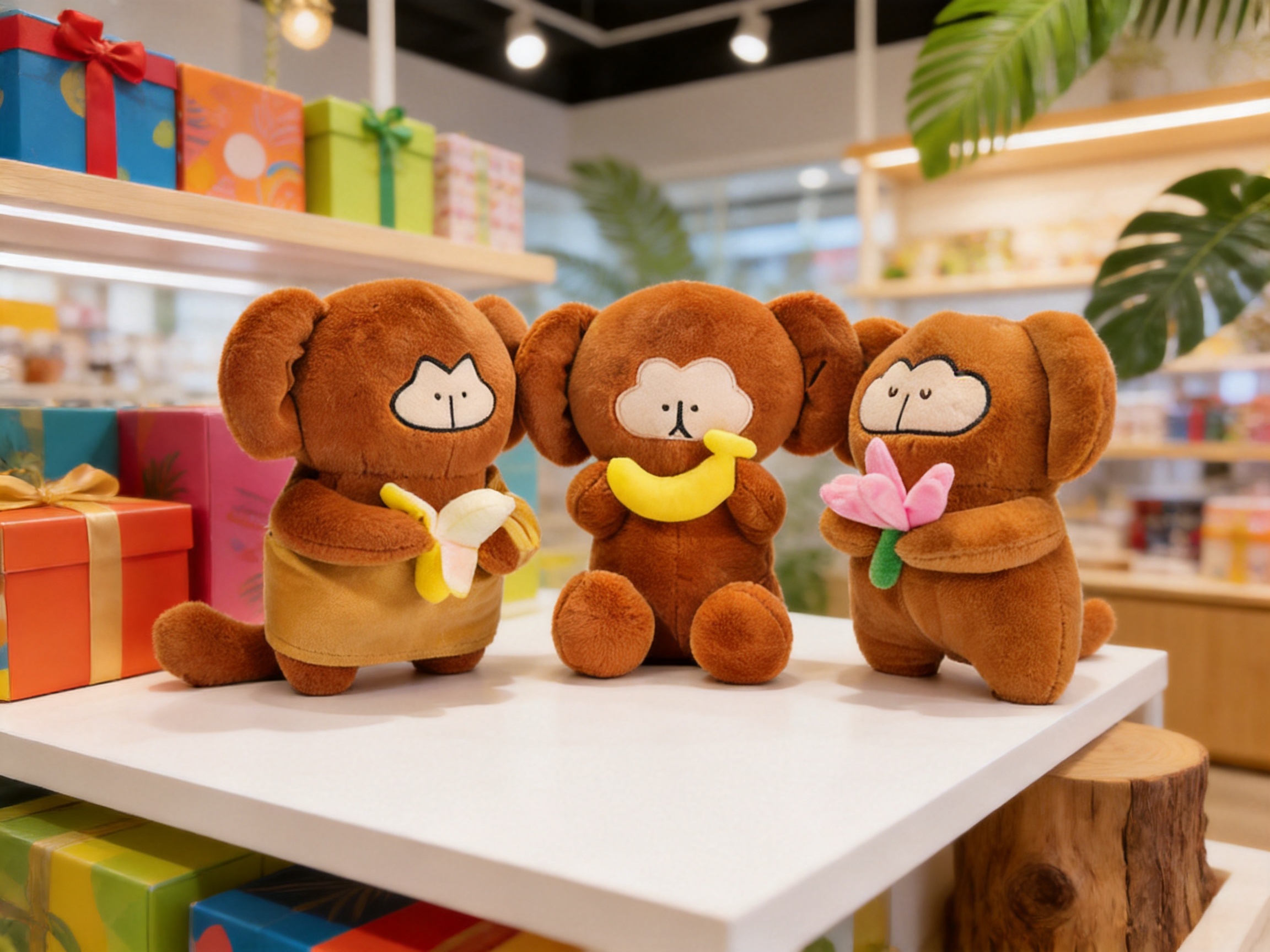
Retailers can arrange the monkeys in different scenes. A shelf display may place the central banana-holding monkey between the other two characters. A gift display may emphasize the flower-holding monkey. A children’s room setting may show all three sitting together on a desk or bookshelf.
Product descriptions can use the characters’ personalities without making unsupported claims. The left monkey may be presented as playful and curious, the middle monkey as cheerful and affectionate, and the right monkey as gentle and thoughtful. These descriptions help consumers distinguish the designs and may encourage collection behavior.
Packaging can include a short story about three monkey friends sharing favorite objects. This narrative approach may be especially useful for gift sets. It turns three small plush toys into a coordinated experience and gives the product additional emotional value.
16. Frequently Asked Questions
Q1: What is the standard size of the stuffed monkey plush toys?
The listed standard size is 13 centimeters. Customized sizes are welcome, subject to design review, material availability, sampling, and order requirements.
Q2: How many monkey designs are included in the collection?
The design features three monkeys in different sitting poses and postures. One holds a yellow item, one hugs a yellow banana, and one holds a small pink flower.
Q3: What materials are used for the toys?
The shell fabric is described as super soft plush, and the filling material is PP cotton. These materials support a soft tactile feel and a lightweight, resilient structure.
Q4: Are the toys sold as a set or individually?
The available design can be arranged according to the buyer’s sales plan. Buyers may request individual packaging, a three-piece set, or another presentation format. Packaging requirements should be confirmed during the quotation and sampling stages.
Q5: Can the color be customized?
OEM and ODM services are welcomed, so buyers may discuss custom colors for the monkey bodies, accessories, facial details, or packaging. Final color choices should be confirmed through an approved sample.
Q6: Can the banana and flower be replaced with other accessories?
Accessory customization may be possible. Buyers can discuss alternative fruits, flowers, gifts, clothing details, seasonal objects, or branded elements with the manufacturer’s design and production teams.
Q7: What is the minimum order quantity?
The listed minimum order quantity is 1,000 pieces. The buyer should confirm whether the quantity applies to one design, a coordinated collection, or a mixed order arrangement.
Q8: What is the sample fee?
The listed sample fee is US$100 per design. Buyers should confirm the number of samples required when the project includes several poses or customized versions.
Q9: How long does sampling take?
The listed sample time is 3–7 working days. Timing may vary depending on artwork, materials, design complexity, revisions, and approval speed.
Q10: How long does mass production take?
The listed delivery time is approximately 45 days. The final schedule should be confirmed after specifications, samples, quantity, packaging, and production arrangements are approved.
Q11: Is the product suitable for promotional campaigns?
Yes. Its compact size, lightweight format, friendly character design, and customization potential make it suitable for promotional gifts, event merchandise, loyalty programs, and branded campaigns.
Q12: What makes the sitting style useful?
The sitting style allows the monkeys to remain upright on flat surfaces. This supports retail displays, desks, shelves, children’s rooms, gift arrangements, and product photography.
Q13: What should buyers check in the sample?
Buyers should review the fabric softness, color, size, facial expression, sitting stability, filling density, seam quality, accessory attachment, labels, and packaging presentation. The approved sample should become the reference for mass production.
The company states that it produces trendy plush toys, children’s plush toys, pet plush toys, promotional gifts, home furnishings, stationery gifts, handicrafts, and cartoon decorations. Buyers can discuss related product development with the sales and design teams.
Q15: Where is the manufacturer located?
Tianchang Bestjoy Craft & Gift Co., Ltd. is located in Jinji Industrial Park, Tianchang City, Anhui Province, China.
17. Conclusion
Adorable stuffed monkeys plush toys with banana and flower offer a strong combination of character appeal, tactile comfort, compact size, and customization value. The three-monkey format creates more variety than a single repetitive plush design, while the banana, flower, and yellow object provide memorable visual details. The brown color, round eyes, soft plush shell, PP cotton filling, and stable sitting posture make the collection suitable for toys, gifts, home décor, promotional programs, and seasonal merchandising.
The product’s 13-centimeter format and approximately 55-gram weight support convenient handling, display, packaging, and distribution. Its OEM and ODM potential allows buyers to develop alternative sizes, colors, accessories, costumes, packaging, and character themes. The minimum order quantity of 1,000 pieces, sample fee of US$100 per design, stated sample period of 3–7 working days, and approximate 45-day delivery schedule provide a clear starting framework for commercial planning.
Beyond the product itself, the supplier offers the advantages of an integrated manufacturing structure. Tianchang Bestjoy Craft & Gift Co., Ltd. combines research and development, design, production, sales, and after-sales service, supported by a factory of more than 10,000 square meters and international export experience. Its broad plush product range and stated experience serving major retail customers make it a suitable partner for buyers seeking scalable production and related product development.
For the best results, buyers should provide clear specifications, confirm target-market requirements, review the sample carefully, and establish packaging and inspection expectations before mass production. With thoughtful planning and professional manufacturing support, this three-monkey collection can become an appealing retail product, a memorable promotional gift, or the foundation of a broader custom plush toy program.
References
1. Product specification sheet for Adorable Stuffed Monkeys Plush Toys with Banana and Flower, including size, weight, materials, customization options, order quantity, sampling, and delivery information.
2. Company profile of Tianchang Bestjoy Craft & Gift Co., Ltd., including company history, factory location, production scope, export markets, customer experience, and integrated manufacturing capabilities.
3. General plush toy product development principles covering pattern construction, fabric selection, stuffing distribution, accessory attachment, finishing, packaging, and quality review.
4. General retail merchandising principles for compact character products, collectible plush toys, promotional gifts, and home lifestyle accessories.
5. General product planning guidance for OEM and ODM stuffed animal development, including sampling, customization, production scheduling, packaging coordination, and buyer approval procedures.