en
 русский
 Español
 عربى

Content
- 1 A Wearable Blanket Designed for Everyday Childhood Comfort
- 2 Material Selection: Softness, Breathability, and Long-Term Use
- 3 Child-Friendly Bear Design and Emotional Appeal
- 4 Advantages Over Basic Throw Blankets and Conventional Children’s Capes
- 5 Applications Across Home, Education, Travel, and Gifting
- 6 Manufacturing Strengths and Integrated Production Capability
- 7 A Structured Quality Inspection Process
- 8 Customization from Concept to Finished Product
- 9 Order Planning and Minimum Quantity Considerations
- 10 Packaging Designed for Retail and International Transportation
- 11 Merchandising Opportunities for Different Sales Channels
- 12 Responsible Product Development and Buyer Due Diligence
- 13 Why This Product Platform Is Competitive
- 14 Recommended Buyer Evaluation Checklist
- 15 Q&A
- 15.1 What is included in the two-pack?
- 15.2 Can children wear the blankets?
- 15.3 What materials are used?
- 15.4 Is the product suitable for young children?
- 15.5 How is the bear face applied?
- 15.6 Does the blanket work only as bedding?
- 15.7 Where can the product be used?
- 15.8 Can the product be customized?
- 15.9 What is the minimum quantity for a fully exclusive custom design?
- 15.10 How are standard products packaged?
- 15.11 Can buyers use their own logistics provider?
- 15.12 What quality inspections are performed?
- 15.13 Why choose a two-color bear set instead of a single blanket?
- 16 Conclusion
- 17 References
- 18 Product: 2-Pack Kids Brown Bear & Gray Bear Hooded Plush Throw Blanket, Soft Wearable Animal Cape Blanket for Children Daily Warmth, Gift & Promotional Merchandise
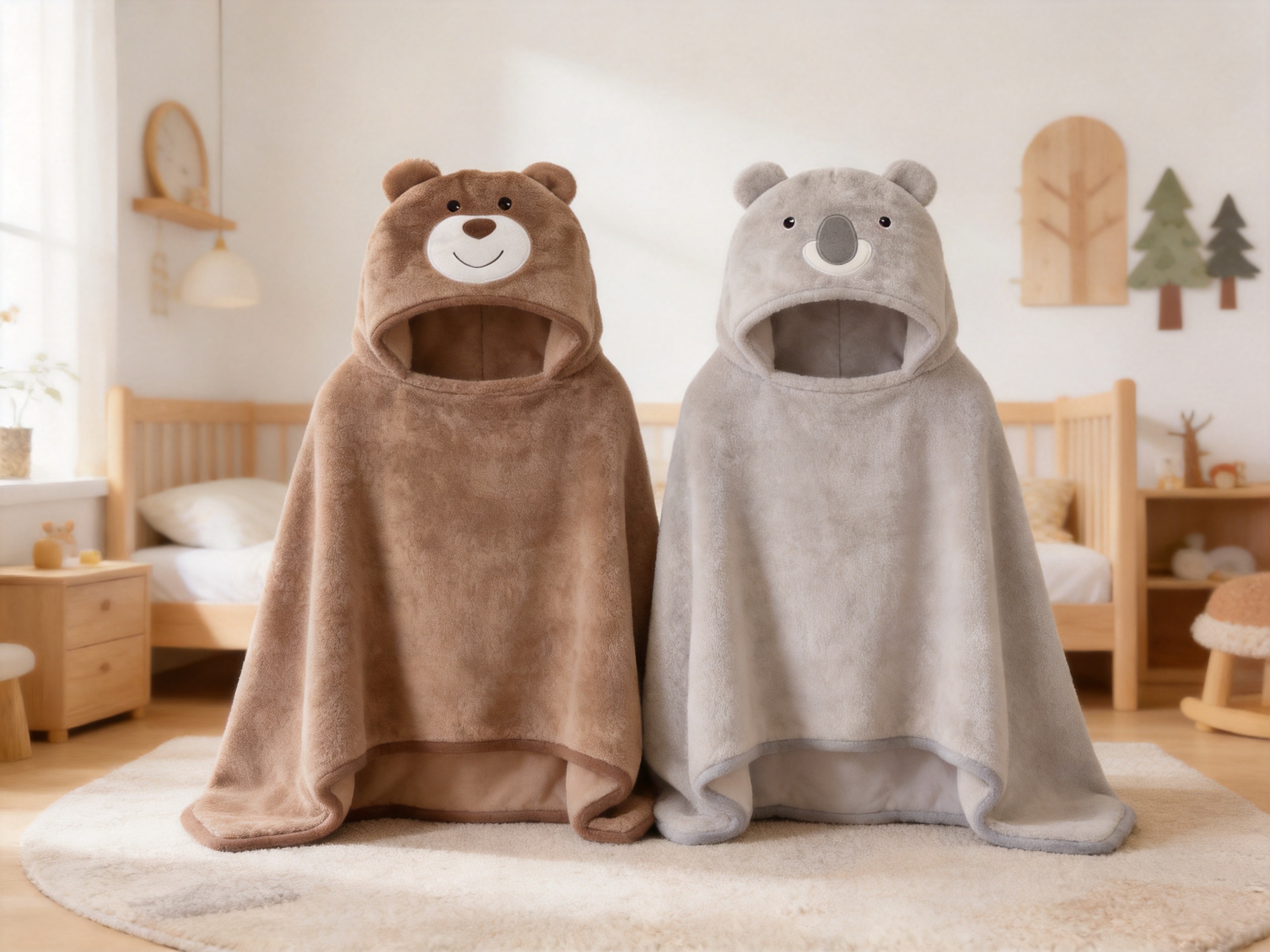
Children’s blankets have evolved far beyond ordinary bedding. Today, parents, retailers, gift buyers, schools, promotional planners, and hospitality businesses increasingly look for products that combine practical warmth with visual appeal, easy handling, reliable safety, and strong customization potential. The 2-Pack Kids Brown Bear and Gray Bear Hooded Plush Throw Blanket meets these expectations by transforming a familiar comfort item into a playful wearable accessory. Each set includes two soft hooded blankets: one in a warm brown bear colorway and one in a neutral gray bear colorway.
Designed for children’s daily comfort, this product can function as a throw blanket, warm shawl, nap cape, travel cover, or cozy homewear accessory. The hood features a friendly rounded bear face embroidery, creating an appealing animal character without making the product overly complicated or uncomfortable. Its lightweight construction allows children to put it on and take it off with minimal assistance, making it practical for home use, kindergarten activities, family travel, and outdoor leisure.
Beyond its consumer appeal, the product is also suitable for retailers, children’s gift programs, promotional campaigns, seasonal merchandise collections, and customized kindergarten or activity-group orders. Its two-color pack offers variety immediately, while the product structure supports further development in colors, animal themes, dimensions, packaging, and special functions.
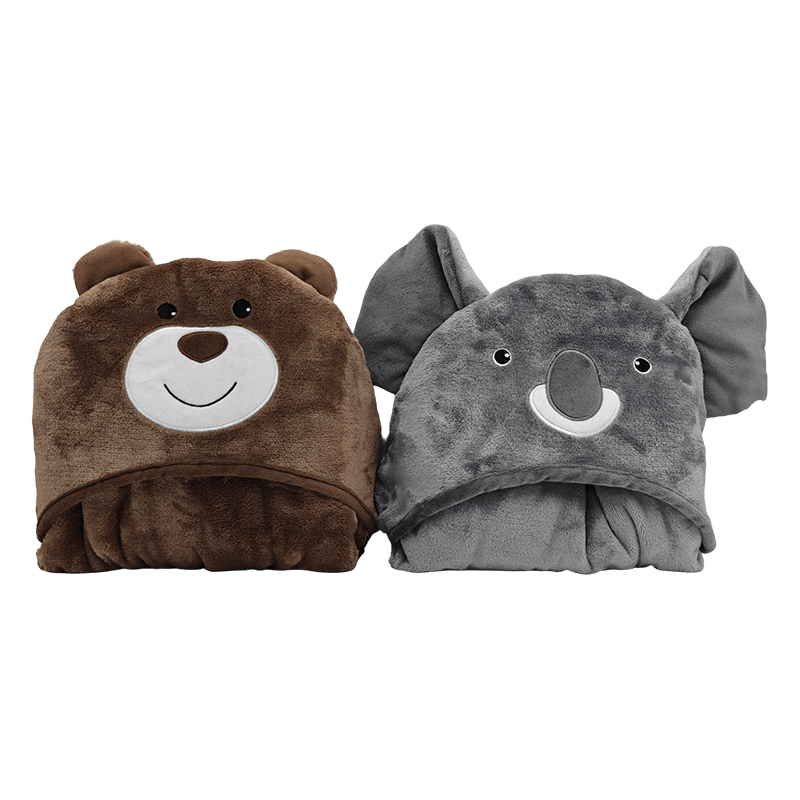
2-Pack Kids Brown Bear & Gray Bear Hooded Plush Throw Blanket, Soft Wearable Animal Cape Blanket for Children Daily Warmth, Gift & Promotional Merchandise
A Wearable Blanket Designed for Everyday Childhood Comfort
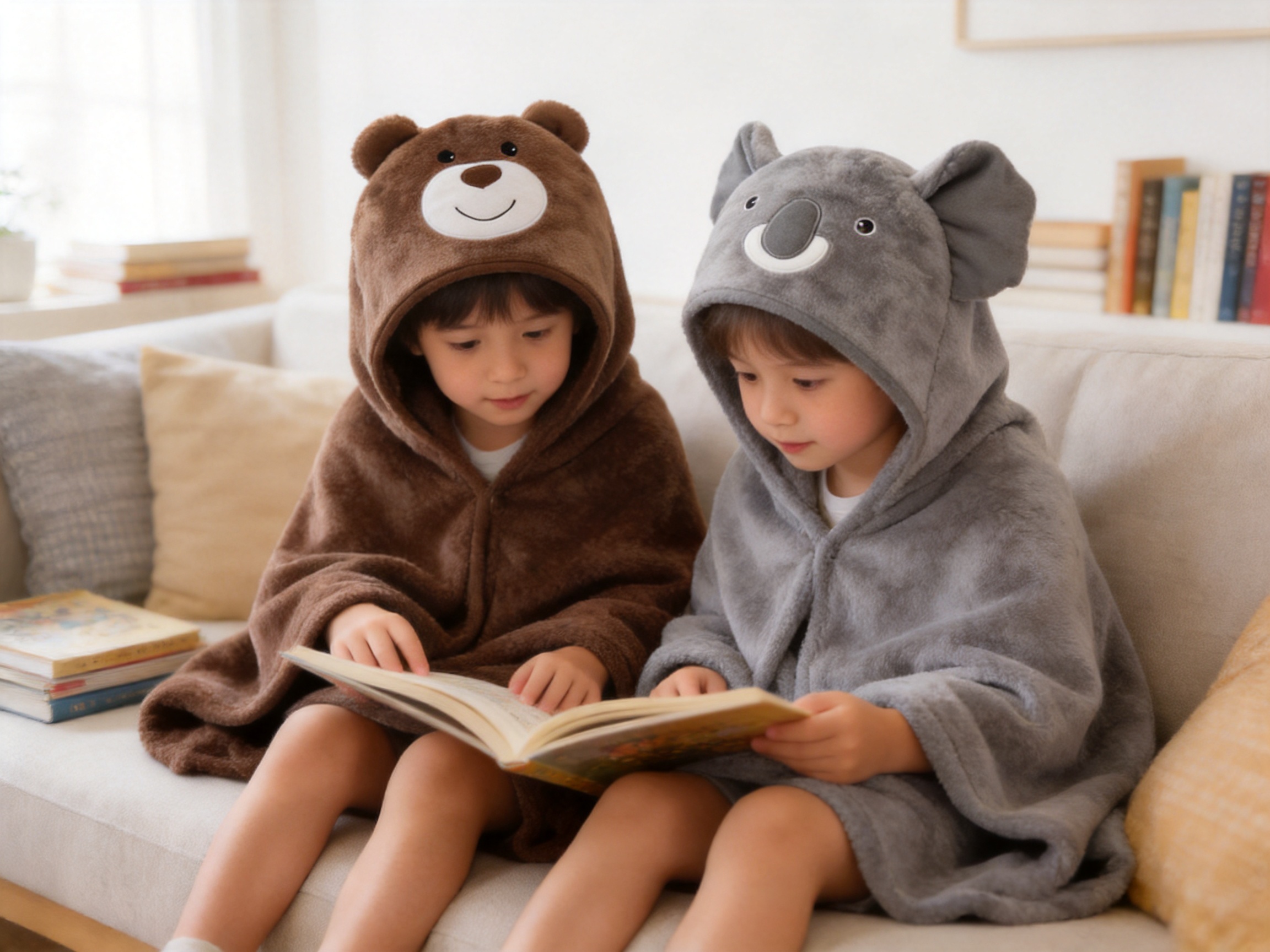
The central advantage of this product is its combination of blanket coverage and wearable convenience. A conventional throw blanket may slide from a child’s shoulders, become tangled around the body, or require frequent adjustment. A hooded plush throw blanket creates a more secure and engaging form of coverage. Children can wrap themselves in soft warmth while still moving around the home, sitting on a sofa, resting during a nap, or participating in quiet play.
The hood adds both function and character. It helps provide additional warmth around the head and neck while giving the blanket a recognizable bear-inspired appearance. The embroidered facial design is intentionally friendly and rounded, making it visually suitable for children. Unlike products that depend on hard plastic decorations, sharp accessories, or loosely attached embellishments, the bear face is integrated into the hood design for a softer and more comfortable experience.
The product is offered as a two-piece set with two different colorways. The brown version delivers a classic woodland appearance, while the gray version provides a modern neutral look that can fit a wider range of interior styles. This pairing also makes the product more attractive for siblings, shared households, gift occasions, or buyers who prefer to offer customers a choice within one retail package.
Why a Two-Pack Format Adds Value
A two-pack format offers several practical benefits compared with a single blanket. For families, two children can use the blankets at the same time. For individual children, one blanket can remain at home while the other travels to a grandparent’s house, daycare, school, or holiday destination. A spare item is also useful when one blanket is being washed or stored.
For retailers, a two-pack can create a stronger perceived value than a single basic throw. The brown-and-gray combination is easy to merchandise as a coordinated set, and the different colors help the product appeal to multiple preferences without requiring the buyer to choose between unrelated designs. For promotional buyers, the two-piece format can support family-oriented campaigns, paired gifting, holiday bundles, or activity-based distribution.
The pack structure may also simplify inventory planning. Instead of stocking multiple individual designs in separate quantities, a buyer can present a coordinated product containing two complementary options. This helps create a clear shelf presentation and supports gift-ready merchandising during winter, holiday, birthday, and back-to-school seasons.
Material Selection: Softness, Breathability, and Long-Term Use
The outer fabric is premium high-density coral fleece. Coral fleece is widely valued in children’s textile products because it offers a soft hand feel, a warm surface, and a relatively lightweight structure. The dense pile provides a plush touch without requiring the blanket to become excessively heavy. This balance is especially important for children, who may find thick or heavy blankets difficult to carry or wear comfortably.
The inner layer uses super-soft short plush. This construction provides a smooth, skin-friendly contact surface and supports comfortable use during naps, quiet time, travel, and indoor relaxation. The short plush structure also helps create a neat appearance and reduces the excessive bulk that may occur with very long-pile materials.
According to the supplied product specifications, the selected materials are designed to resist pilling and fading during long-term use. The product information also states that the inner layer is breathable and does not readily generate static electricity in dry environments. These characteristics contribute to a more comfortable daily-use experience, particularly during colder months when children spend more time wearing or wrapping themselves in soft textile products indoors.
All listed materials are described as non-toxic and odorless, with the supplied specifications indicating compliance with strict skin-safety standards for children under three years old. Buyers should always review the final product documentation, applicable market requirements, labeling obligations, and age-grade instructions before commercial distribution. Nevertheless, the stated material approach demonstrates that safety and comfort are treated as core design priorities rather than secondary features.
Balanced Warmth Without Unnecessary Weight
One of the most important competitive considerations in children’s blankets is the relationship between warmth and portability. A very thick blanket may feel warm but can be difficult for a child to carry, fold, wear, or store. A very thin blanket may be easy to handle but may not provide sufficient comfort during naps, travel, or cool indoor conditions.
The lightweight coral fleece and short plush construction aim to create a middle ground. The blanket provides full-body soft warmth while remaining manageable for children. It can be placed over the shoulders, wrapped around the torso, or used as a nap cover without creating the cumbersome feeling associated with some oversized bedding products.
This versatility gives the product an advantage over single-purpose competitors. It is not restricted to a bed or sofa. It can accompany a child from one setting to another, including the living room, bedroom, classroom, car, campsite, picnic area, or vacation accommodation.
Child-Friendly Bear Design and Emotional Appeal
Children often respond strongly to products that combine function with storytelling and character. A simple blanket provides warmth, but a bear hooded blanket can become part of imaginative play, bedtime routines, family photographs, holiday traditions, and comforting daily rituals. The animal styling helps turn an ordinary textile item into an emotionally engaging product.
The bear theme is broadly appealing and commercially versatile. Bears are familiar across many markets and age groups, and they can be presented as cute, adventurous, cozy, or seasonal characters. The design does not rely on a narrow licensed character, which can make it easier for retailers and promotional buyers to incorporate the blanket into different product ranges.
The brown and gray colors further support broad market suitability. Brown communicates warmth and a classic woodland feeling. Gray creates a calmer, contemporary appearance that can fit modern children’s rooms and neutral home décor. Together, they provide an appealing contrast while preserving a coordinated visual identity.
The rounded embroidered face design is another important detail. Embroidery can provide a clean and durable decorative effect when properly produced, while avoiding the hard edges that may be associated with rigid ornaments. The supplied quality process includes a small-parts tension test with a stated minimum tension of 100N and a plush-shedding test involving 100 friction cycles. These controls are particularly relevant for children’s products because decorative details must remain secure during normal handling.
Advantages Over Basic Throw Blankets and Conventional Children’s Capes
The product occupies a useful position between a conventional throw blanket and a wearable children’s cape. A basic throw may offer softness but lack a hood, character design, or easy wearing structure. A traditional cape may provide visual appeal but may not offer sufficient body coverage or plush comfort. The hooded plush blanket combines elements of both categories.
Compared with a standard throw blanket, it offers:
• A hood that helps provide additional warmth around the head and neck.
• A wearable format that helps keep the blanket in place.
• Bear styling that increases emotional and gift appeal.
• Two coordinated colorways in one set.
• Flexible use for home, kindergarten, travel, outdoor activities, and gifting.
Compared with a lightweight costume cape, it offers:
• A plush blanket construction intended for warmth and comfort.
• Full-body coverage suitable for naps and quiet rest.
• Soft textile surfaces instead of a costume-only structure.
• A practical use beyond dress-up or themed events.
• A product concept that can be used throughout the year in different indoor settings.
Compared with some heavily decorated character blankets, this design also offers a relatively clean construction. Its appeal comes from the hood, color, softness, and embroidered bear face rather than a large number of added components. This can simplify production, reduce unnecessary visual clutter, and support a comfortable user experience.
| Product Feature | Value for Children and Families | Value for Retailers and Buyers |
|---|---|---|
| Two-piece brown and gray set | Provides variety, sharing, and a spare option | Creates a stronger gift and merchandising proposition |
| Hooded wearable design | Helps keep warmth around the head and body | Distinguishes the product from ordinary throws |
| Coral fleece exterior | Soft, warm, lightweight, and pleasant to touch | Supports a premium tactile presentation |
| Short plush inner layer | Offers a smooth and skin-friendly contact surface | Supports comfort-focused product positioning |
| Bear face embroidery | Adds friendly character appeal | Improves gift, seasonal, and children’s merchandise potential |
| Customizable design platform | Allows additional animals, colors, or sizes | Supports private-label and promotional programs |
| Individual OPP packaging | Helps keep each item clean during storage | Provides a neat retail-ready presentation |
Applications Across Home, Education, Travel, and Gifting
Home Leisure
At home, children can use the blanket while watching cartoons, reading, playing quietly, or resting on the sofa. Its wearable format allows a child to remain comfortable without repeatedly pulling up a loose throw. Parents may also find the product useful during cooler mornings, air-conditioned indoor environments, or evening relaxation.
The blanket can support daily routines such as story time, nap preparation, and family movie nights. Because the design is playful without being overly specialized, it can fit naturally into both children’s bedrooms and shared living spaces. The neutral gray and warm brown colors can coordinate with many home interiors, while the bear hood gives the product a distinctive children’s identity.
Kindergarten and Childcare Settings
The product is suitable for kindergarten nap periods and childcare environments where children need a convenient personal cover. Its lightweight construction can make it easier for children to handle independently, while the animal hood can help make rest time more inviting.
For schools and childcare organizations, customized versions can be developed around a particular animal, color palette, group identity, event theme, or seasonal activity. The product may be used as a nap blanket, graduation souvenir, enrollment gift, family-day merchandise item, or special activity keepsake. Buyers should establish their own name-labeling, hygiene, storage, and washing protocols when using blankets in shared institutional settings.
Outdoor Activities and Travel
Although the blanket is designed primarily for comfort rather than technical outdoor protection, it can be useful during picnics, camping trips, road travel, family vacations, and outdoor viewing activities in cool conditions. Its lightweight structure makes it easier to pack than many bulky bedding products. The hood adds warmth and can help the child feel more securely covered while sitting outdoors or relaxing during travel.
For automobile journeys, the blanket can be stored in a travel bag or carried separately for convenient access. It may also be used in hotels, holiday homes, guest rooms, and visiting relatives’ homes where a familiar soft item can help children settle into a new environment.
Gifts and Promotional Merchandise
The product has strong potential in children’s gift markets because it combines practical usefulness with immediate visual charm. It can be positioned as a birthday gift, winter holiday present, newborn-family household gift, sibling gift, or seasonal comfort item. The two-piece format makes the set particularly suitable for families with more than one child.
Promotional buyers may use customized hooded blankets for family-oriented campaigns, retail loyalty programs, children’s events, hotel welcome gifts, amusement venues, educational activities, or community initiatives. A soft wearable product tends to remain visible in the home, which may provide longer-lasting promotional exposure than disposable merchandise.
Manufacturing Strengths and Integrated Production Capability
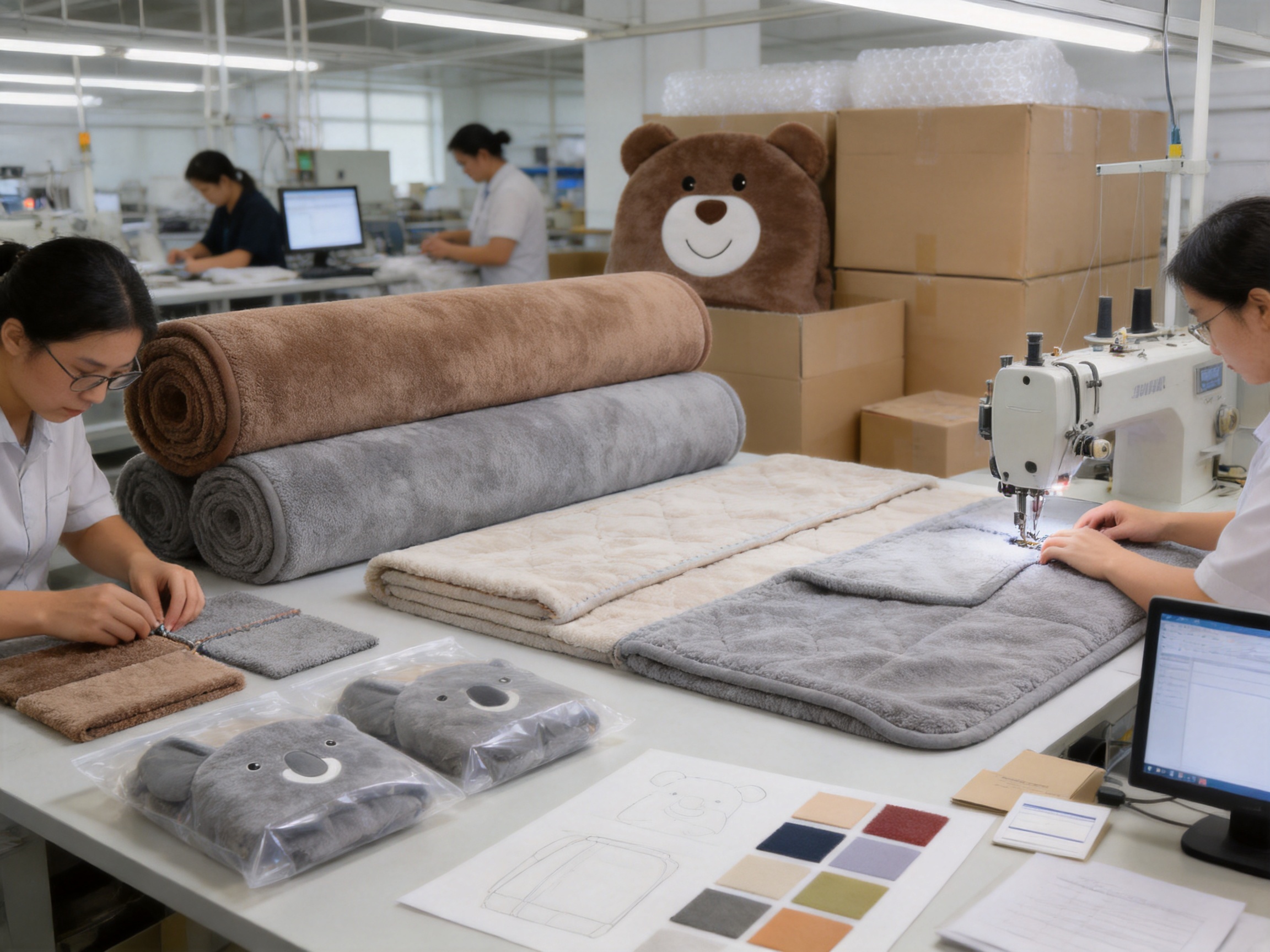
The manufacturer behind this product operates as an integrated plush-products company with capabilities covering research and development, design, production, sales, and after-sales service. The company was established in 2013 and operates in Jinji Industrial Park, Tianchang City, Anhui Province, China. Its factory covers more than 10,000 square meters, and its annual sales are stated to exceed 12 million RMB.
This integrated structure is valuable for buyers seeking more than a simple catalog transaction. Product development, sample preparation, production coordination, quality inspection, packaging, and logistics communication can be managed through a connected supply chain. Such coordination may help reduce delays between design approval and mass production while creating clearer responsibility at each stage.
The company’s product experience extends across trendy plush toys, children’s plush toys, pet plush products, promotional plush gifts, plush home furnishings, plush stationery gifts, plush handicrafts, and plush cartoon decorations. This broad category knowledge supports the development of products that combine textile softness, character design, decorative details, and commercial usability.
The company reports exporting products to Europe, America, Australia, Japan, and South Korea, and serving major clients including Walmart, Target, Albertsons, and Kmart. These stated export markets indicate familiarity with international buyer expectations, although every order remains subject to the specifications, testing, labeling, packaging, and documentation requirements of the destination market.
A Structured Quality Inspection Process
Quality control begins with the incoming inspection of raw materials. The stated process includes testing fabric safety, checking filling-material hygiene, and reviewing other relevant indicators before production begins. This first step is important because material problems can affect appearance, comfort, durability, and regulatory suitability later in the manufacturing process.
Raw-material inspection also helps establish consistency between production batches. For a product such as a two-color blanket set, consistency is especially important. Buyers expect the brown and gray blankets to have comparable softness, construction quality, finishing standards, and overall presentation even though the colors differ.
Semi-Finished Stitching Inspection
During semi-finished production, the manufacturing team checks sewing firmness and structural stability. This stage allows potential issues to be identified before the product reaches final finishing and packing. Stitching quality is essential for a hooded blanket because the hood, edges, seams, and body panels must withstand repeated handling, folding, wearing, and laundering.
Early inspection can also help reduce rework and prevent defective items from progressing through the entire production line. A controlled process is more efficient than discovering all issues only during final packing. It supports more predictable delivery and improves the opportunity to correct construction problems while they remain manageable.
Finished-Product Inspection
The stated finished-product inspection includes appearance checks, a small-parts tension test, and a plush-shedding test. The small-parts test is listed at a minimum tension of 100N with no falling-off parts. The plush-shedding test is described as 100 friction cycles without obvious hair loss.
Appearance inspection may cover color consistency, embroidery quality, seam alignment, edge finishing, surface cleanliness, hood shape, and overall product presentation. These details matter in both direct-to-consumer retail and promotional distribution because visual defects can reduce customer confidence even when the product remains technically functional.
The focus on shedding resistance is also relevant to user comfort and product durability. Plush products are handled frequently by children and may be rubbed against clothing, furniture, car seats, and bedding. A stable surface helps the blanket maintain a more attractive appearance and reduces the likelihood of loose fibers becoming a noticeable concern during use.
Safety Testing and Market Access
The supplied information states that finished products pass international toy-safety tests including CE, CPSIA, and EN71 and are designed to meet import-access requirements for European and American markets. Buyers should request current test reports, declarations, technical files, labeling information, and market-specific documentation for the exact product, material composition, and production batch before importation.
Different countries and regions may classify a hooded plush blanket differently depending on its design, intended age range, decorative elements, packaging, and claims. A professional supplier should therefore work with the buyer to confirm the appropriate compliance pathway instead of relying on a general statement alone. The manufacturer’s stated testing process provides a foundation for that discussion.
Customization from Concept to Finished Product
Customization is one of the strongest commercial advantages of this product platform. The standard brown-and-gray bear set provides a ready-made concept, but the same production capabilities can support additional colors, animal patterns, dimensions, and special functions. This makes the product suitable for private-label programs, seasonal collections, school projects, promotional campaigns, and themed retail lines.
Step One: Demand Confirmation
The customization process begins by clarifying the buyer’s requirements. These may include the preferred color palette, animal design, blanket dimensions, hood shape, decorative details, packaging style, target market, quantity, and any special functional requirements. Early clarification helps ensure that the product concept is practical, visually coherent, and suitable for the intended price range.
Buyers should also define their target age group, expected use environment, delivery schedule, shipping destination, labeling language, and compliance expectations at this stage. Providing these details early helps the design and production teams make better recommendations and reduces the risk of changes after sampling.
Step Two: Digital Design Development
The professional design team provides digital design drafts for buyer review and modification. This stage allows the buyer to evaluate the overall appearance before physical sampling. Color changes, animal expressions, hood details, embroidery placement, packaging graphics, and branding elements can be discussed more efficiently in a digital format.
Digital review is especially helpful for promotional merchandise because the product may need to align with an established visual identity. A business can review how a mascot, campaign color, educational theme, or seasonal graphic will appear on a soft textile surface before approving a sample.
Step Three: Prototype Proofing
After the digital concept is accepted, a physical sample is produced. Sample photos or actual samples can be sent for final confirmation. Physical proofing is important because colors, softness, proportions, embroidery scale, hood depth, and overall drape are not always fully represented in digital drawings.
A sample also gives buyers an opportunity to review handling and usability. They can check whether the blanket feels light enough for the intended child, whether the hood sits comfortably, whether the edges are properly finished, and whether the packaging concept protects the product adequately.
Step Four: Mass Production
Formal production begins after the sample is approved. The production team can then organize materials, cutting, stitching, embroidery, inspection, finishing, and packing according to the confirmed specifications. Production progress is synchronized regularly, allowing the buyer to remain informed about the order status.
For customized programs, written approval of the final sample and artwork is particularly important. It provides a clear reference for color, design, dimensions, and construction throughout the production process. This helps protect consistency between the approved prototype and the delivered goods.
Step Five: Final Inspection and Delivery
Before shipment, the finished goods undergo final quality inspection. Approved products are then packed and arranged for logistics. The company can cooperate with designated logistics providers and provide tracking information after shipment. This flexibility is useful for international buyers with established freight relationships, warehouse arrangements, or consolidated shipping plans.
Order Planning and Minimum Quantity Considerations
The stated minimum order quantity for fully exclusive custom designs is 3,000 pieces. This level is appropriate for buyers planning a private-label launch, large promotional campaign, national retail program, or multi-location distribution project. It allows the customized design, artwork, material preparation, and production setup to be distributed across a commercially meaningful quantity.
Small-batch trial orders are also supported according to the supplied information. This option can help buyers evaluate market response before committing to a larger exclusive design program. A trial may be useful for testing color preferences, online customer response, retail sell-through, seasonal demand, packaging effectiveness, or the performance of a new animal theme.
Buyers should discuss the exact quantity structure for standard products, trial orders, custom colors, custom packaging, and exclusive designs. The final quotation may depend on material selection, size, embroidery complexity, accessories, packaging requirements, testing needs, and shipping arrangements.
Packaging Designed for Retail and International Transportation
Each standard product is individually packed in a dust-proof transparent OPP bag. Individual packaging helps protect the plush surface from dust and handling during storage, transportation, and retail presentation. The transparent format also allows buyers and end customers to see the product without opening the package.
For bulk orders, products are packed in thick export-grade corrugated cartons with shockproof bubble padding inside. This approach is intended to reduce compression, friction, and deformation during long-distance transportation. Plush products can be affected by excessive pressure, moisture, and rough handling, so appropriate carton strength and internal protection are important parts of the supply chain.
Packaging can also be customized for promotional and retail programs. Buyers may request branded labels, printed inserts, customized cartons, barcode placement, bilingual instructions, seasonal graphics, or other presentation elements, subject to production feasibility and order quantity. Packaging requirements should be confirmed early because they can affect artwork approval, material purchasing, assembly time, carton dimensions, and freight calculations.
Merchandising Opportunities for Different Sales Channels
Online Retail
For e-commerce, the product offers several strong visual selling points: a two-pack format, contrasting bear colors, a recognizable hood, a soft plush surface, and multiple use scenarios. Product images can show the blanket folded, worn over the shoulders, placed on a sofa, or packed for travel. Online descriptions should explain the material composition, size, care instructions, safety information, intended age range, and packaging contents clearly.
The two-pack structure also creates opportunities for gift-set keywords and seasonal promotions. Retailers can position the product for winter comfort, children’s birthdays, family gifting, holiday shopping, indoor movie nights, and travel preparation. Accurate photography and transparent specifications are important because customers want to understand the scale, coverage, hood design, and thickness before purchase.
Department Stores and Specialty Gift Shops
In physical stores, the product can be displayed in children’s home-textile sections, seasonal gift areas, toy departments, baby and toddler sections, or family-lifestyle collections. A packaged two-piece set can be stacked or hung depending on the packaging design. The brown and gray color combination can create a cohesive visual block on the shelf.
Specialty gift shops may emphasize the emotional aspects of the product, including its bear theme, softness, and suitability for family occasions. Department stores may highlight its practical home-use function and two-piece value. The product can therefore be adapted to more than one merchandising narrative without changing its basic construction.
Institutional and Promotional Distribution
Organizations can customize the blanket for events in which children and families are central participants. Examples include community festivals, school anniversaries, educational campaigns, family wellness programs, hotel family packages, amusement attractions, and charity initiatives. A soft item with a useful daily function can create stronger long-term engagement than a disposable promotional object.
Promotional buyers should consider how logos and artwork will be placed so that the blanket remains attractive and comfortable. Subtle embroidery, a custom label, a printed packaging insert, or a coordinated hood design may be preferable to excessive decoration. The manufacturer’s design team can help determine a suitable balance between brand visibility and child-friendly aesthetics.
Responsible Product Development and Buyer Due Diligence
Children’s products require careful communication. Buyers should confirm the final age grading, care instructions, flammability requirements, fiber-content labeling, packaging warnings, and applicable chemical restrictions for the destination market. They should also review whether any hood, tie, loop, decorative feature, or packaging component requires special evaluation.
The supplied product information emphasizes non-toxic materials, safety testing, tension testing, and shedding resistance. These are positive elements in the product-development process, but responsible commercialization requires current documentation for the exact order. A buyer should request and retain relevant reports, approvals, inspection records, artwork confirmations, and packing specifications.
Clear user instructions also contribute to safe use. The final product should identify appropriate washing and drying methods, storage recommendations, and any restrictions related to sleeping, active play, or unsupervised use if required by the destination market. Retailers should avoid making claims that exceed the verified specifications.
Why This Product Platform Is Competitive
The product’s competitiveness comes from the way several advantages work together. Soft materials alone are common in the blanket market. Animal designs are also common in children’s merchandise. Customization is available from many suppliers. However, the combination of a two-pack format, wearable hood, lightweight construction, friendly bear embroidery, structured safety inspection, international production experience, and end-to-end customization creates a more complete commercial proposition.
It is a practical product because children can use it for warmth and rest. It is a giftable product because the bear design and two-color set create immediate visual appeal. It is a promotional product because the blanket can be customized for events and organizations. It is a scalable product because the supplier supports digital design, prototype proofing, mass production, quality inspection, packaging, and logistics coordination.
The product also avoids being limited to one season or one type of customer. Winter is the most obvious sales period, but indoor air conditioning, travel, kindergarten naps, family gifting, and year-round home comfort create additional opportunities. This wider use range can help retailers reduce dependence on a single holiday or temperature cycle.
Recommended Buyer Evaluation Checklist
Before placing an order, buyers may review the following points with the supplier:
• Confirm the blanket dimensions, hood dimensions, weight, and folded packing size.
• Verify the exact fiber composition of the outer and inner fabrics.
• Request current compliance and safety documents for the target market.
• Confirm the intended age range and required product warnings.
• Review the brown and gray color standards and acceptable production tolerances.
• Approve embroidery artwork, placement, thread colors, and dimensions.
• Discuss washing, drying, storage, and care-label requirements.
• Confirm the sample approval procedure before mass production.
• Establish inspection standards for seams, embroidery, surface appearance, and shedding.
• Confirm individual packaging, carton specifications, labeling, and barcode needs.
• Review the minimum order quantity, trial-order options, production lead time, and payment terms.
• Agree on shipping arrangements, designated logistics providers, and tracking procedures.
This checklist does not replace formal technical specifications, but it helps ensure that the final product matches the buyer’s intended market, price position, and distribution plan.
Q&A
What is included in the two-pack?
The set includes two children’s hooded plush throw blankets. One uses a warm brown bear colorway, and the other uses a neutral gray bear colorway. Both feature a friendly bear-inspired hood design.
Can children wear the blankets?
Yes. The hooded format allows the blanket to be worn as a warm shawl, nap cape, or casual homewear accessory. Its lightweight construction is intended to make putting it on and taking it off easier for children.
What materials are used?
The outer fabric is described as high-density coral fleece, while the inner layer uses soft short plush. The materials are selected for softness, warmth, breathability, and comfortable contact with the skin.
Is the product suitable for young children?
The supplied specifications state that the materials meet strict skin-safety standards for children under three years old. Buyers should confirm the final age grading, safety documentation, labels, and destination-market requirements for the exact product before sale.
How is the bear face applied?
The bear face is created through embroidery on the hood. The stated quality process includes appearance checks and a small-parts tension test intended to help verify that decorative components remain secure.
Does the blanket work only as bedding?
No. It can be used as a sofa throw, nap cover, wearable shawl, travel blanket, outdoor comfort item, or children’s homewear accessory. Its design supports both stationary rest and light movement indoors.
Where can the product be used?
Common applications include home leisure, kindergarten nap periods, family travel, picnics, camping, indoor relaxation, birthday gifting, holiday gifting, and promotional activities for children and families.
Can the product be customized?
Yes. Customization can include colors, animal patterns, sizes, special functions, packaging, and other design elements. The supplier provides digital design drafts, prototype proofing, mass production, final inspection, and logistics coordination.
What is the minimum quantity for a fully exclusive custom design?
The stated minimum order quantity for a fully exclusive custom design is 3,000 pieces. Small-batch trial orders are also supported according to the supplied information, subject to confirmation of the specific project.
How are standard products packaged?
Each single product is individually packed in a dust-proof transparent OPP bag. Bulk orders are placed in thick export-grade corrugated cartons with internal bubble padding intended to help reduce transportation damage and deformation.
Can buyers use their own logistics provider?
Yes. The company can cooperate with designated logistics providers and provide tracking information after shipment. Shipping arrangements should be confirmed during order planning.
What quality inspections are performed?
The stated process includes raw-material incoming inspection, semi-finished stitching inspection, finished-product appearance inspection, small-parts tension testing, plush-shedding testing, and sampling safety tests. Buyers should request current inspection documentation for their specific order.
Why choose a two-color bear set instead of a single blanket?
The two-color set offers more variety, supports sibling sharing, provides a spare blanket, and creates a stronger gift presentation. For retailers, it also offers a coordinated product with a clear value proposition.
Conclusion
The 2-Pack Kids Brown Bear and Gray Bear Hooded Plush Throw Blanket is a versatile children’s comfort product that combines softness, warmth, mobility, character appeal, and commercial flexibility. Its coral fleece exterior, short plush inner layer, wearable hood, friendly bear embroidery, and two-color presentation distinguish it from ordinary throw blankets and single-purpose costume capes.
For families, it offers a practical way to keep children comfortable during home rest, naps, travel, and outdoor leisure. For schools and childcare organizations, it can serve as a convenient nap blanket or customized activity item. For retailers, it provides a giftable product with strong seasonal and year-round applications. For promotional buyers, it offers a soft, visible, and customizable merchandise platform.
The manufacturing system further strengthens the product’s market potential. Integrated research and development, design, production, inspection, packaging, export experience, and after-sales coordination allow buyers to move from a standard catalog concept to a customized commercial program. With a stated factory area of more than 10,000 square meters, experience dating from 2013, international market coverage, and a structured quality-control process, the supplier is positioned to support both standard orders and larger custom projects.
When combined with careful product documentation, responsible age grading, destination-market compliance, and clear order specifications, this hooded plush blanket set can become a dependable addition to children’s gift, home-lifestyle, seasonal, educational, and promotional merchandise collections.
References
1. Product specification sheet for the 2-Pack Kids Brown Bear and Gray Bear Hooded Plush Throw Blanket.
2. Supplier-provided material safety and quality inspection information.
3. Supplier-provided customization and prototype development process.
4. Supplier-provided packaging, transportation, and logistics information.
5. General principles of children’s textile product design, soft-goods manufacturing, and quality assurance.
6. General guidance concerning international children’s product safety, labeling, and market-access documentation.