en
en  русский
 Español
 عربى
عربى
Content
- 1 1. Product Concept and Market Appeal
- 2 2. Key Design Features
- 3 3. Material Selection and Comfort-Oriented Construction
- 4 4. Advantages Over Standard Plush Hats and Similar Novelty Products
- 5 5. Manufacturing Capabilities Behind the Product
- 6 6. Recommended Manufacturing Process for the Bunny Hat
- 7 7. Quality Control Priorities
- 8 8. Customization and OEM/ODM Opportunities
- 9 9. Commercial Specifications
- 10 10. Order Planning and Supply Chain Considerations
- 11 11. Retail, Promotional, and Lifestyle Applications
- 12 12. Why an Integrated Factory Matters to Buyers
- 13 13. Responsible Product Development
- 14 14. Product Positioning Against Competitors
- 15 15. Suggested Buyer Evaluation Checklist
- 16 16. Frequently Asked Questions
- 16.1 What is the main appeal of this bunny plush hat?
- 16.2 What materials are used?
- 16.3 What is the standard size and weight?
- 16.4 Can the colors be customized?
- 16.5 Can the bunny design be customized?
- 16.6 What is the minimum order quantity?
- 16.7 How much is the sample fee?
- 16.8 How long does sample development take?
- 16.9 What is the production delivery time?
- 16.10 What types of businesses may purchase this product?
- 16.11 How is the product different from a standard animal hat?
- 16.12 Is the product suitable for children?
- 16.13 How is the product packed?
- 16.14 Can the hat be part of a larger plush collection?
- 17 17. Conclusion
- 18 References
- 19 Product: Multicolor moving-ear bunny plush hat
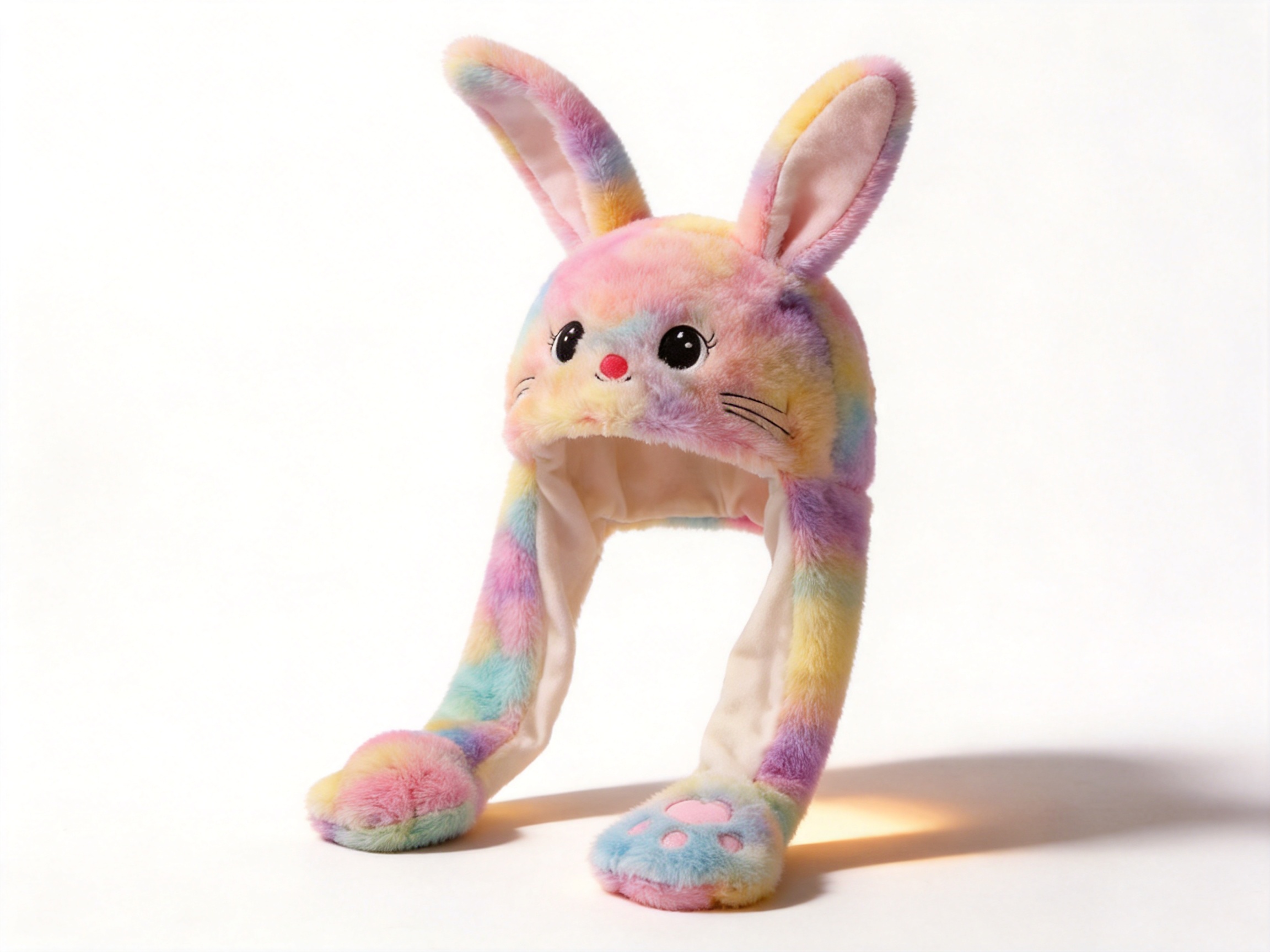
The multicolor moving-ear bunny plush hat combines the emotional appeal of a soft toy with the practical visibility of a wearable accessory. Designed in the shape of an adorable rabbit, it brings together a rainbow-inspired color palette, soft plush materials, expressive facial details, and playful side feet that create a lively three-dimensional appearance. Its most distinctive feature is the moving-ear concept, which adds an interactive element to the traditional novelty hat and makes the product especially suitable for seasonal promotions, character merchandising, family entertainment, social events, gift collections, and trendy plush toy retail.
Unlike a standard winter hat or a conventional stuffed animal, this product is designed to attract attention when worn. The upright ears, round black eyes, rosy nose, and soft dangling feet create an immediately recognizable silhouette. The combination of wearable function and character design gives retailers and promotional buyers more opportunities to present the product: it can be displayed as a plush accessory, sold as a novelty gift, included in event campaigns, or used as part of a themed character collection.
Manufactured by Tianchang Bestjoy Craft & Gift Co., Ltd., the product benefits from an integrated development and production model. The company combines research and development, product design, manufacturing, sales, and after-sales service in one organization. This structure can help buyers coordinate design approval, material selection, sampling, production, quality management, and delivery more efficiently than when these stages are divided among unrelated suppliers.
For distributors, importers, gift companies, retailers, and promotional agencies, the multicolor moving-ear bunny plush hat offers a balanced combination of visual differentiation, customization potential, soft-touch appeal, and scalable production. Its 30-centimeter size, approximately 150-gram weight, multiple color options, and OEM/ODM availability make it suitable for both ready-to-develop collections and customized product programs.
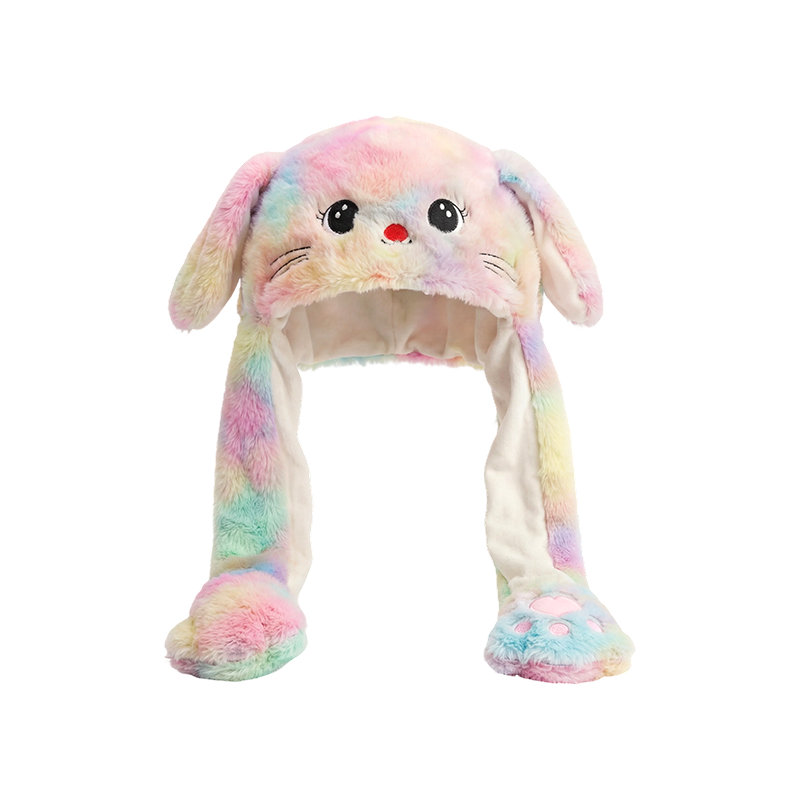
Multicolor moving-ear bunny plush hat
1. Product Concept and Market Appeal
The product is built around a simple but powerful idea: transform a familiar cute animal into an engaging wearable form. Bunny imagery has broad appeal because it is associated with gentleness, playfulness, springtime, celebration, and childhood imagination. By shaping the entire hat like a bunny and adding long ears and hanging feet, the design creates a character rather than merely decorating an ordinary hat with animal details.
The multicolor surface strengthens this character effect. Pink, yellow, blue, and purple are interwoven in a gradient-like arrangement that resembles a blooming spring garden or a soft rainbow. This palette communicates sweetness and energy while avoiding the visual limitation of a single-color product. It can appeal to children, teenagers, families, costume enthusiasts, social media users, and shoppers looking for expressive accessories.
Color variety also supports merchandising flexibility. A retailer can position the hat within a spring collection, a festival display, a children’s gift assortment, a fantasy-themed range, or a colorful winter accessory program. A promotional agency can adapt the color direction to match an event, campaign identity, school activity, amusement venue, or holiday theme. Since the supplied specification lists multiple color options and OEM/ODM availability, buyers can discuss alternative color combinations or develop a coordinated series.
The product’s visual language is especially useful in environments where products need to communicate their purpose quickly. A customer can understand that the item is a bunny-themed novelty accessory simply by viewing it from a distance. The upright ears provide height, the face creates emotional recognition, and the dangling feet add movement to the silhouette. These details help the product stand out in gift shops, pop-up displays, costume areas, online product galleries, and seasonal end caps.
2. Key Design Features
Rainbow-Inspired Multicolor Plush Construction
The multicolor design gives the bunny hat a distinctive identity compared with plain animal hats. Pink introduces warmth and sweetness, yellow adds brightness, blue contributes freshness, and purple creates a sense of fantasy. Together, these colors form a playful visual transition that can attract buyers seeking something more expressive than a basic novelty hat.
For product developers, a multicolor base also creates opportunities for collection planning. The same pattern can be adjusted into softer pastel shades, brighter carnival tones, seasonal colorways, or brand-approved combinations. A buyer may choose a gentle palette for a children’s lifestyle collection or a more saturated version for festivals and promotional events. The use of several colors also makes the item naturally photogenic, which can support online merchandising and social media campaigns.
Recognizable Bunny Silhouette
The hat is carefully shaped into a bunny form instead of relying only on printed decoration. Long ears stand upright to establish the animal identity, while the rounded face and soft body proportions create a friendly appearance. This three-dimensional construction is important because it allows the product to remain recognizable from different viewing angles.
The bunny silhouette also makes the hat a natural conversation piece. When worn, it can become part of a costume, a group activity, or a themed photo opportunity. When displayed on a shelf or hook, it still reads as a character plush accessory rather than an ordinary garment. This dual role can increase its commercial value because the item can be marketed both as something to wear and as something to collect.
Expressive Facial Details
Round black eyes provide a clear focal point and give the bunny a gentle, attentive expression. The rosy nose adds contrast and prevents the face from appearing flat. These small details have a significant effect on emotional appeal. In plush product design, simple facial features often perform better across age groups because they are easy to understand and create an approachable character.
The face can also serve as a foundation for a broader character program. Buyers developing a private-label plush range may retain the basic bunny expression while changing the color arrangement, ear treatment, facial embroidery, accessories, or seasonal details. This makes the current product suitable as a standalone item and as a starting point for a coordinated series of character products.
Hanging Plush Feet
Two fluffy feet hang naturally on the sides, adding a playful dimensional feature. These feet make the product appear as though a small bunny is resting on the wearer’s head or happily hopping along. They also create additional motion and texture when the hat is moved or worn.
Compared with a flat printed image, side-mounted plush feet contribute to a more tactile and memorable experience. They give customers another feature to touch and examine, which is valuable in physical retail environments. For online sales, the feet provide a recognizable visual detail that can be emphasized in product photography and short-form video content.
Moving-Ear Interaction
The moving-ear concept is the product’s strongest novelty feature. Bunny ears already attract attention because of their height and recognizable shape; an interactive movement effect increases that attention by turning a static accessory into an engaging character experience. Depending on the final approved construction, the movement mechanism can be reviewed during the sampling and engineering stages to ensure that it is appropriate for the intended market and usage conditions.
This interactive quality can help distinguish the hat from competing plush headwear that only offers softness or decorative animal ears. It can encourage wearers to demonstrate the product, participate in photos, and create memorable moments at parties, festivals, exhibitions, and promotional events. For retailers, an interactive feature can provide a stronger reason for customers to choose this product over a simpler animal hat.
3. Material Selection and Comfort-Oriented Construction
The specified shell fabric is soft plush fabric, a material choice that supports the product’s primary emotional promise: softness, warmth, and tactile comfort. Plush fabric provides a fuzzy surface that is visually associated with stuffed animals and cozy accessories. It also helps the hat feel more substantial than a lightweight novelty cap made from smooth synthetic fabric.
PP cotton is specified as the filling material. This type of filling is widely used in plush manufacturing because it can create a lightweight, rounded form while helping maintain the product’s soft character. In this design, the filling supports the bunny face, ears, side feet, and other padded areas. The approximately 150-gram product weight suggests a lightweight format that can be practical for display, gifting, and general novelty use.
The 30-centimeter size provides a substantial character presence without making the item excessively large for retail packaging. Because the specification also allows customization, buyers can discuss size adjustments for different target users, display formats, or campaign requirements. A larger version could create a more dramatic costume effect, while a smaller format might suit children’s gift sets, mascot collections, or compact promotional packaging.
Material selection should always be matched to the intended market, age grade, and applicable compliance requirements. During product development, buyers can confirm fabric composition, colorfastness, seam construction, filling distribution, attachment security, labeling, packaging, and testing needs. This review is particularly important for products intended for children or for markets with specific requirements governing plush toys and wearable accessories.
4. Advantages Over Standard Plush Hats and Similar Novelty Products
A More Distinctive Product Identity
Many plush hats compete through similar animal ears, simple faces, and single-color fabrics. The multicolor moving-ear bunny plush hat adds several layers of differentiation: a rainbow-like surface, a complete bunny character shape, hanging feet, and an interactive ear concept. These features work together to create a more complete visual story.
A distinctive identity can reduce the difficulty of merchandising. Products with a strong silhouette and clear theme often require less explanation in a store or online listing. A customer can quickly recognize the rabbit character and understand that it is intended to be playful and interactive. This clarity may help buyers create stronger product pages, display arrangements, and campaign visuals.
Wearable and Collectible at the Same Time
A standard plush toy is usually displayed, held, or collected, while a hat is usually worn for warmth, costume, or style. This product combines both categories. It can be worn as an accessory, photographed as part of an outfit, displayed as a character item, or purchased as a gift. The dual positioning expands the range of potential sales channels.
Retailers can place the hat near plush toys, costume accessories, children’s products, seasonal displays, or gift items. Promotional companies can distribute it as an event accessory or use it to encourage participation in a themed activity. Online sellers can present it through lifestyle photography, character-focused product pages, and short videos showing the moving-ear feature.
High Visual Impact Without Excessive Product Complexity
The product creates visual impact through shape, color, and soft components rather than through an overly complicated exterior. The bunny face, ears, and feet are easy for customers to understand. This balance is beneficial for commercial development because the item can appear elaborate and entertaining while remaining based on a clear plush construction.
From a production perspective, a clearly defined design can support repeatability. Once the pattern, material specification, color placement, facial details, and ear mechanism have been approved, the product can be manufactured according to a controlled sample. This provides a foundation for consistent production across larger orders and future color variations.
Strong Suitability for Seasonal and Promotional Programs
Bunnies are especially relevant to springtime, Easter-related merchandising, family celebrations, and children’s events, but the product is not limited to one holiday. Its bright colors and playful shape can also suit festivals, birthdays, amusement venues, photo booths, campus activities, retail promotions, and themed parties.
Promotional buyers can further customize the product through color, labels, packaging, hangtags, or coordinated accessories, subject to design review and order requirements. The 500-piece minimum order quantity is practical for many promotional campaigns and medium-scale retail programs, while the OEM/ODM service allows the product to be adapted for a more specific market position.
5. Manufacturing Capabilities Behind the Product
Tianchang Bestjoy Craft & Gift Co., Ltd. operates as an integrated plush product manufacturer with capabilities covering research and development, design, production, sales, and after-sales service. This integrated structure is important for buyers who need to move from a product idea to a commercially finished item through a coordinated process.
The company was established in 2013 as a joint venture involving Hong Kong Jintong International Co., Ltd. and Tianyuan Enterprise Investment Management Co., Ltd. Its factory is located in Jinji Industrial Park, Tianchang City, Anhui Province, China, and covers more than 10,000 square meters. The company reports annual sales exceeding 12 million RMB and exports products to Europe, America, Australia, Japan, and South Korea.
Its customer experience includes work with major retail clients such as Walmart, Target, Albertsons, and Kmart. This background indicates experience with organized purchasing, product consistency, delivery coordination, and the expectations associated with international retail supply chains. While every order requires its own quality and compliance confirmation, an established export background can give buyers greater confidence when planning overseas distribution.
The company’s product range includes trendy plush toys, children’s plush toys, pet plush toys, promotional gifts, plush home furnishings, plush stationery gifts, plush handicrafts, and plush cartoon decorations. This broad category experience is relevant to the bunny hat because the product sits at the intersection of plush character design, wearable novelty goods, gifts, and promotional merchandise.
Research and Development Support
A dedicated research and development and design team can help convert an initial concept into a production-ready plush item. For the moving-ear bunny hat, this may involve reviewing the overall silhouette, determining how the ears stand upright, balancing the hanging feet, placing facial features, selecting suitable plush fabric, and confirming how the hat maintains its form during handling.
Development work also involves practical decisions that are not always visible in the finished product. Pattern pieces must be arranged to support efficient cutting, color transitions need to be planned, seams must be positioned carefully, and stuffed sections need to achieve the intended roundness. The interaction between appearance, comfort, durability, packaging, and cost must be considered before bulk production.
Sample Development and Approval
The stated sample fee is 100 dollars per design, with a sample lead time of 3 to 7 working days. This gives buyers a defined starting point for evaluating the product before placing a production order. Sampling is a critical stage for confirming color appearance, proportions, face placement, plush feel, ear posture, side-foot positioning, and overall presentation.
A well-managed approval process can reduce the risk of differences between the buyer’s expectation and the bulk-production result. Buyers should provide clear artwork, color references, measurements, logo requirements, packaging instructions, and target-market information at the beginning of development. After receiving the sample, they can review the product under natural and artificial lighting, inspect seams and attachments, test the fit concept, and request revisions where necessary.
Production Organization
Plush manufacturing involves multiple coordinated stages, including material preparation, pattern cutting, sewing, filling, shaping, facial application, component attachment, trimming, inspection, and packing. An integrated factory structure can help these stages communicate more effectively because design and production teams work within the same operational system.
For the bunny hat, production control is especially relevant to the consistency of multicolor panels and character details. If color sections vary from unit to unit, the rainbow-inspired appearance may become uneven. If facial features are placed inconsistently, the character expression can change. If the ears or feet are not attached at consistent positions, the product silhouette may lose its intended balance. Production planning and inspection therefore play an important role in protecting the design’s commercial appeal.
Equipment and Professional Production Teams
The company reports professional production equipment, an innovative design team, an experienced sales team, and a comprehensive after-sales service team. These resources support a process in which product development, manufacturing, communication, and customer support are treated as connected activities rather than separate responsibilities.
Professional equipment can contribute to accurate cutting, reliable sewing, consistent stuffing, and efficient finishing. Skilled workers are also important because plush products contain curved sections, layered materials, small facial components, and padded shapes that require careful handling. The quality of the finished item depends not only on machinery but also on workmanship, process supervision, and final inspection.
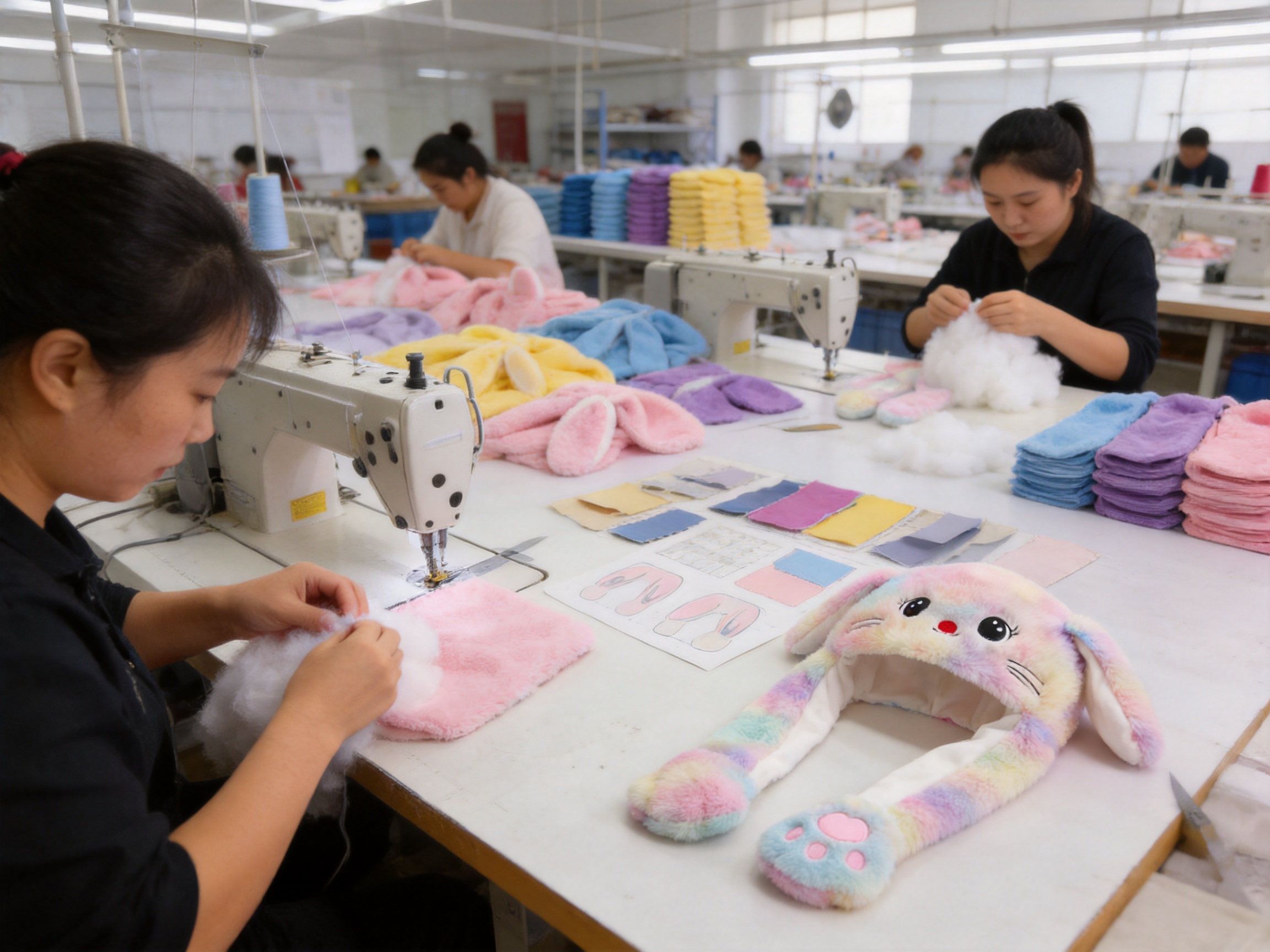
6. Recommended Manufacturing Process for the Bunny Hat
Design Confirmation and Technical Review
The process begins with the confirmation of the product concept. The buyer and manufacturer review the intended size, color arrangement, face design, ear shape, side-foot dimensions, fabric type, filling material, packaging, labeling, and target market. If the product includes a moving-ear feature, the movement concept and operating method should be evaluated during this stage.
Technical review helps identify potential production challenges before material purchasing and bulk manufacturing. The team can examine whether the ears require internal support, whether the plush pile affects the movement of components, whether the face can be applied consistently, and whether the finished item can be packed without damaging the silhouette.
Pattern and Material Preparation
After the design is confirmed, pattern pieces are prepared for the face, crown, ears, side feet, and other components. The patterns determine the final shape and influence fabric consumption, seam placement, stuffing volume, and assembly efficiency. Because the product uses multiple colors, the pattern plan must also identify which sections use pink, yellow, blue, purple, or other approved shades.
Material preparation includes checking the plush fabric, PP cotton filling, thread, facial components, labels, packaging materials, and any mechanism-related parts. Buyers may request fabric swatches or color standards before production. This is particularly useful for multicolor products because the perceived relationship between colors can change according to fabric pile, lighting, dye lot, and finishing.
Cutting and Sewing
Fabric pieces are cut according to approved patterns. Accurate cutting supports consistent dimensions and helps ensure that the color arrangement remains visually balanced. The pieces are then sewn into the required three-dimensional sections. Curved seams and small components require attention because uneven stitching can affect the shape of the face, ears, or feet.
The sewing stage should also consider the product’s use as a wearable accessory. Seams need to be sufficiently secure for ordinary handling, display, and wearing. The inner construction should be reviewed for comfort and neatness, while the outer surface should maintain a clean and attractive appearance after turning and stuffing.
Filling and Shaping
PP cotton is inserted into the sewn sections to create the intended volume. Even distribution is important. Too little filling may cause the face or feet to look flat, while excessive filling may distort the pattern or make the product unnecessarily rigid. The ears require particular attention because they must retain their upright appearance while remaining visually soft.
After filling, workers shape the product by adjusting the distribution of material and checking symmetry. The bunny face should appear balanced, the feet should hang naturally, and the hat should maintain a recognizable silhouette. This hand-finishing stage can have a strong effect on the final character quality.
Facial Assembly and Feature Attachment
The eyes, nose, and other facial elements are placed according to the approved sample. Placement accuracy is essential because even a small difference can change the expression. Components must also be evaluated for attachment security and suitability for the intended market and age group.
The rosy nose creates a bright central detail, while the black eyes provide contrast against the multicolor plush. These elements should be checked for clean edges, consistent positioning, and visual alignment. If a buyer requires embroidered details or alternative facial treatments, those specifications should be confirmed during sampling.
Ear Mechanism and Functional Inspection
If the moving-ear system is included in the approved product configuration, the mechanism should be assembled according to the selected technical design. The engineering review should consider movement consistency, component security, ease of operation, safety, and resistance to ordinary handling. The final method may vary depending on the buyer’s market requirements and target price.
Functional inspection should confirm that the ears move as intended, return to their designed position where applicable, and do not interfere with the wearer’s comfort or the product’s appearance. The mechanism should also be reviewed during packaging tests to ensure that compression or carton loading does not cause unnecessary damage.
Trimming, Cleaning, and Final Finishing
After assembly, loose threads and excess fibers are removed. The plush surface is brushed or arranged so that the color transitions and character details appear clean. Workers can inspect the product for sewing defects, uneven filling, marks, fabric damage, misplaced components, and incorrect dimensions.
Final finishing is especially important for colorful products because stray fibers or stains can be more visible against contrasting shades. A careful finishing process helps the product present well in retail packaging and in customer photographs.
7. Quality Control Priorities
Quality control for a plush hat should address both appearance and function. Visual inspection can review the multicolor pattern, facial expression, ear posture, side-foot position, shape, stitching, and surface condition. Dimensional checks can confirm the 30-centimeter specification or any customized size approved by the buyer.
Material checks should verify that the shell fabric and PP cotton filling match the approved sample and purchase specification. Buyers may also request relevant testing for colorfastness, flammability, mechanical properties, chemical safety, and other requirements based on the destination market. The necessary testing plan should be established before bulk production rather than after the goods are completed.
Packaging inspection is another important step. The product should be packed in a way that protects its shape, keeps the plush surface clean, and allows the moving-ear or other interactive feature to remain in suitable condition. Carton loading should be checked against the agreed packing plan, including the stated quantity of 12 pieces per carton.
A pre-shipment inspection can provide an additional opportunity to verify quantity, workmanship, packaging, carton markings, and product configuration. For customized orders, the inspection should compare the finished products with the approved sample, artwork, color references, and written specifications.
8. Customization and OEM/ODM Opportunities
The product is available for OEM/ODM development, allowing buyers to adapt it for their own brand, collection, event, or sales channel. Customization may include colors, size, facial details, packaging, labels, hangtags, accessories, and coordinated character elements. Each option should be reviewed for feasibility, cost, minimum order quantity, and lead time.
Color customization is one of the most natural opportunities for this design. Buyers may choose pastel shades for a soft lifestyle collection, bright colors for a festival program, or a specific palette for a promotional campaign. The existing pink, yellow, blue, and purple concept can be preserved as a recognizable base while adjusting saturation or color placement.
Size customization can help serve different user groups and product categories. A smaller version may be suitable for children’s gift assortments or compact seasonal displays. A larger version may create a stronger visual effect for costume use, stage activities, or mascot-style promotions. Any size change should be evaluated alongside weight, packaging, comfort, pattern efficiency, and movement performance.
Packaging customization can increase shelf impact and support brand communication. Buyers can discuss printed cartons, individual polybags, paper tags, instruction cards, event inserts, or coordinated gift packaging. Packaging should remain suitable for protecting the plush form and should be reviewed for the destination market’s labeling and environmental requirements.
OEM/ODM development is most effective when buyers provide a complete project brief. Useful information includes target customer, sales channel, preferred size, color references, estimated order volume, required compliance standards, delivery destination, packaging expectations, and desired launch date. Clear information helps the manufacturer prepare an accurate sample and commercial quotation.
9. Commercial Specifications
| Product Name | Multicolor Moving-Ear Bunny Plush Hat |
| Product Category | Plush Hats |
| Approximate Size | 30 centimeters, or customized |
| Approximate Weight | 150 grams |
| Color | Multiple options |
| Shell Fabric | Soft plush fabric |
| Filling Material | PP cotton |
| OEM/ODM | Available |
| Minimum Order Quantity | 500 pieces |
| Sample Fee | 100 dollars per design |
| Sample Lead Time | 3 to 7 working days |
| Production Delivery Time | 45 days |
| Carton Packing | 12 pieces per carton |
| Carton Size | 43L × 25W × 18H |
| Gross Weight | 3 kilograms |
| Net Weight | 2 kilograms |
The stated specifications provide a practical foundation for quotation and planning. Before order confirmation, buyers should verify the unit of measurement for carton dimensions, the final customized size, packaging configuration, mechanism specification, labeling requirements, and any applicable testing. Customized products may differ from the standard version in weight, carton quantity, sample timing, and final production schedule.
10. Order Planning and Supply Chain Considerations
The listed minimum order quantity is 500 pieces, which can suit independent retailers, regional distributors, promotional campaigns, online sellers, and seasonal purchasing programs. Buyers should estimate demand carefully because plush accessories often perform best when launched with coordinated marketing and timely seasonal placement.
The sample lead time of 3 to 7 working days offers a relatively focused period for initial development. However, the complete project schedule should also include artwork review, material confirmation, sample shipping, feedback, revisions, testing, packaging approval, production booking, inspection, and international transportation. The stated delivery time is 45 days, but the exact schedule should be reconfirmed for each order.
For seasonal products, early planning is particularly important. A bunny-themed item may be linked to spring promotions, holiday campaigns, school activities, or specific retail calendars. Buyers should allow time for customs clearance, domestic distribution, warehouse receiving, and merchandising preparation after the factory delivery date.
Carton packing of 12 pieces per carton provides a basic reference for warehouse planning. With a gross carton weight of 3 kilograms and a net weight of 2 kilograms, buyers can begin estimating handling requirements and freight calculations. Final logistics information should be confirmed after packaging is approved, especially if customized packaging or altered product dimensions are requested.
11. Retail, Promotional, and Lifestyle Applications
Gift and Novelty Retail
The bunny hat can be placed in gift shops, novelty stores, toy departments, lifestyle boutiques, and seasonal accessory sections. Its colorful appearance and character shape make it suitable for impulse-oriented displays where customers are drawn to expressive, tactile products.
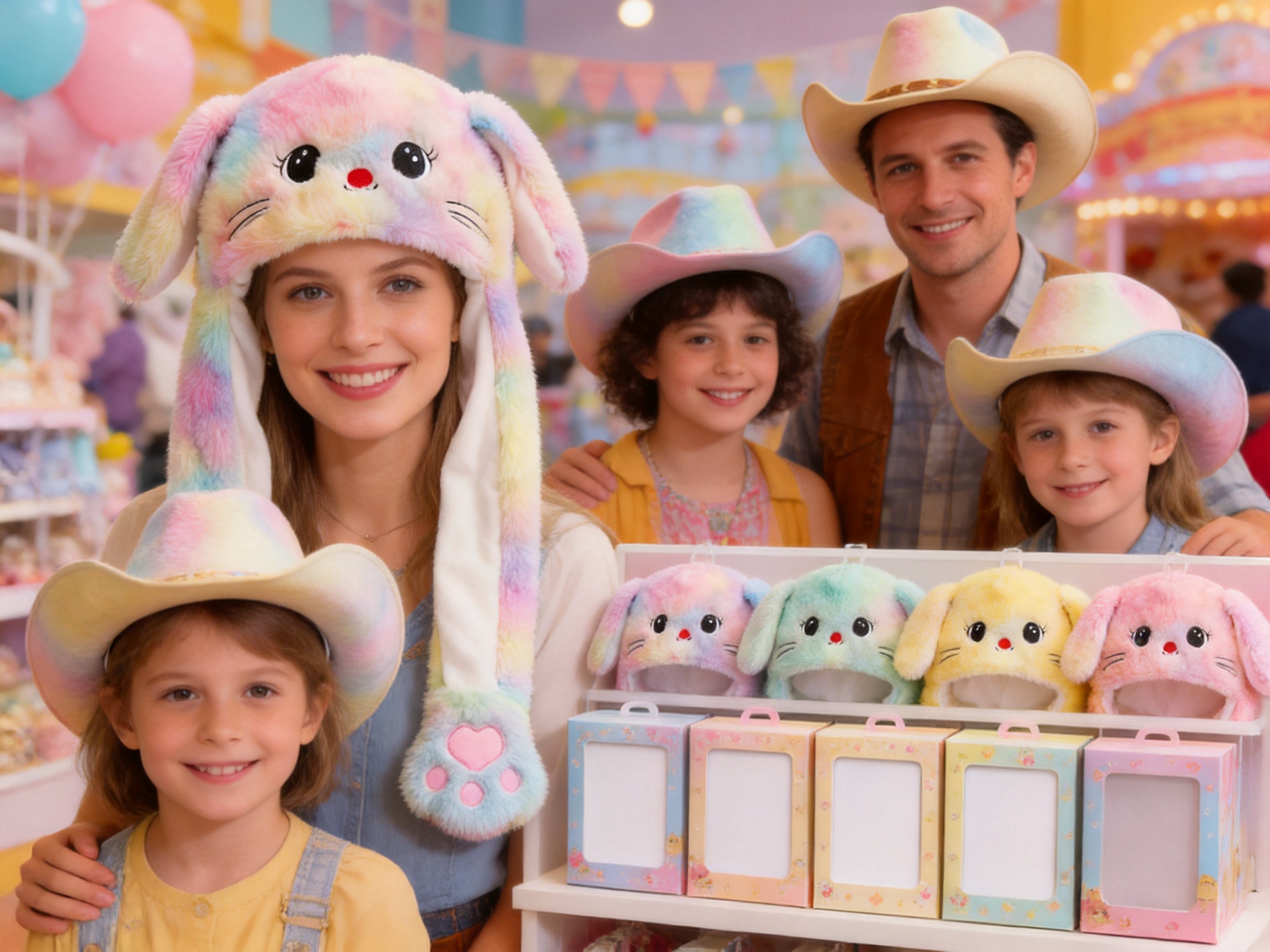
Retailers can present it beside bunny plush toys, spring decorations, children’s accessories, costume items, or colorful home gifts. Cross-merchandising can help communicate that the product is both wearable and collectible. A display featuring several color options may also encourage customers to compare designs or purchase matching items for friends and family.
Promotional Campaigns
The product can support promotional events that require a memorable visual item. It may be used for store openings, themed campaigns, family days, festival activities, charity events, entertainment venues, or social media activations. Participants wearing matching bunny hats can create a unified group appearance and generate recognizable event photographs.
Because OEM/ODM services are available, a promotional buyer can explore customized colorways, event tags, packaging inserts, or a related character design. The 500-piece minimum order can be appropriate for regional campaigns or coordinated multi-location promotions.
Seasonal Collections
The rabbit theme has clear relevance to spring, Easter-related merchandise, and garden-inspired collections. The multicolor design can be positioned as a cheerful seasonal accessory, especially when paired with pastel packaging, floral decorations, or other spring-themed plush products.
At the same time, the hat can be offered outside the spring season. Its soft construction may suit winter novelty displays, while its bright colors can work for summer festivals, birthday parties, costume events, and family entertainment programs. This broader usability can help reduce dependence on one selling period.
Online and Social Commerce
The product’s movement and three-dimensional silhouette make it suitable for demonstration videos. Online sellers can show the hat from multiple angles, highlight the ears and side feet, and present the color transitions in close-up images. Short videos can communicate the interactive concept more effectively than a static product photograph alone.
Product descriptions should state the size, materials, customization options, order quantity, and intended use clearly. Buyers should also provide accurate information about the moving-ear feature and any operating requirements after the final design is approved. Clear presentation helps reduce customer uncertainty and supports better purchasing decisions.
12. Why an Integrated Factory Matters to Buyers
Working with an integrated manufacturer can simplify communication. Instead of coordinating separately with a designer, sampling workshop, production factory, packaging supplier, and export agent, a buyer can work with one organization that manages several connected stages. This can reduce repeated explanations and make it easier to track revisions.
Integrated operations can also support better problem-solving. If a color arrangement creates a sewing difficulty, the design team and production team can discuss an adjustment directly. If a packaging format compresses the ears, the factory can review both the product construction and the packaging method. If a target price requires a material revision, the supplier can evaluate the effect on appearance and production efficiency.
The company’s reported factory area of more than 10,000 square meters provides a substantial production base for plush product development. Its range of categories demonstrates experience with different shapes, sizes, functions, and market applications. This diversity can be useful when developing a bunny hat because the product requires knowledge of both soft toy construction and accessory presentation.
International export experience is another important strength. Products shipped to Europe, America, Australia, Japan, and South Korea may require careful attention to documentation, packaging, quality expectations, and delivery coordination. Buyers should still confirm the specific compliance responsibilities for their order, but an established export-oriented operation can provide a useful foundation.
13. Responsible Product Development
Responsible development begins with selecting materials and construction methods that match the product’s intended use. Buyers should communicate the target age group, market, and sales channel so that the manufacturer can review appropriate requirements. A product sold as a child-oriented accessory may require different testing and labeling from one sold as an adult novelty item.
Durability should also be considered. Ears, feet, facial details, labels, and seams are all visible or functional parts of the design. Their attachment methods should be reviewed for the intended handling conditions. Packaging should protect the item while avoiding unnecessary compression or damage to the plush surface.
Color management is another responsibility. A multicolor product should be checked for shade consistency, colorfastness, and visual harmony. Buyers can use approved color references and retain a signed sample or documented standard for comparison during bulk production.
Clear communication between buyer and factory helps prevent misunderstandings. Written specifications, approved artwork, sample comments, packaging drawings, inspection criteria, and delivery instructions should be organized as part of the order record. This is particularly important for OEM/ODM products that differ from the standard design.
14. Product Positioning Against Competitors
The strongest competitive advantage of the multicolor moving-ear bunny plush hat is its combination of multiple attention-generating features. A basic plush hat may offer softness and animal ears. This design adds a complete character form, rainbow-inspired coloring, side feet, expressive facial details, and an interactive ear concept.
It also competes effectively through emotional design rather than technical complexity alone. Customers often select novelty plush products because they create happiness, amusement, and a sense of personal expression. The bunny’s friendly appearance and colorful surface make the product easy to associate with positive occasions and memorable experiences.
Another advantage is customization. Some competing novelty products are available only in a fixed style, leaving retailers with limited control over color and presentation. OEM/ODM availability gives buyers the option to develop a more exclusive version, align the product with an existing collection, or create a promotional item that reflects a specific event.
The manufacturer’s broader plush expertise is also valuable. A company that produces trendy toys, children’s plush products, pet toys, promotional gifts, home furnishings, stationery gifts, handicrafts, and cartoon decorations can draw on experience across multiple product formats. This may help buyers develop future complementary products rather than treating the hat as an isolated purchase.
15. Suggested Buyer Evaluation Checklist
Before placing an order, buyers should confirm the final product size and determine whether the standard 30-centimeter format meets their intended use. They should also clarify whether the final item is designed primarily for display, costume wear, promotional distribution, or a specific age group.
Color references should be approved in writing. Since plush fabric can reflect light differently from printed paper or digital screens, physical swatches or an approved sample are recommended where color accuracy is important.
The buyer should request confirmation of the moving-ear mechanism, including how the feature operates, whether batteries or other components are required, and how the mechanism affects packaging and testing. The final technical details should be included in the product specification.
Packaging should be reviewed for individual protection, carton quantity, labeling, barcodes, warning information, and shipping requirements. The listed carton packing is 12 pieces per carton, but customized packaging may change the final arrangement.
Finally, the buyer should confirm sample approval, minimum order quantity, payment terms, production lead time, inspection arrangements, shipping documents, and destination-market compliance. A detailed purchase specification can help ensure that the finished products meet commercial expectations.
16. Frequently Asked Questions
What is the main appeal of this bunny plush hat?
Its main appeal is the combination of a soft wearable accessory and a colorful bunny character. The rainbow-inspired plush surface, upright ears, expressive face, side feet, and moving-ear concept give it stronger visual and interactive appeal than a conventional plain plush hat.
What materials are used?
The shell fabric is soft plush fabric, and the filling material is PP cotton. Buyers should confirm the final material composition, component specifications, and applicable testing requirements for their destination market before mass production.
What is the standard size and weight?
The listed size is 30 centimeters, with customization available. The approximate weight is 150 grams. Customized dimensions or packaging may affect the final product weight.
Can the colors be customized?
Yes. The product specification states that multiple color options are available, and OEM/ODM services are offered. Buyers can discuss alternative color combinations, pastel or bright palettes, and collection-specific color standards during the sampling stage.
Can the bunny design be customized?
OEM/ODM development is available. Depending on the project, buyers may discuss changes to size, colors, facial details, packaging, labels, and other design elements. The factory should evaluate the feasibility and cost of each requested modification.
What is the minimum order quantity?
The listed minimum order quantity is 500 pieces. Buyers should confirm whether the MOQ applies per design, colorway, or combined order, particularly when requesting several customized versions.
How much is the sample fee?
The stated sample fee is 100 dollars per design. The final sample arrangement should be confirmed with the factory, including whether the fee is refundable or can be credited toward a bulk order.
How long does sample development take?
The listed sample lead time is 3 to 7 working days. Additional time may be required for shipping the sample, buyer feedback, revisions, testing, and approval.
What is the production delivery time?
The stated delivery time is 45 days. The actual schedule should be reconfirmed after design approval, material confirmation, packaging approval, order placement, and any required testing.
What types of businesses may purchase this product?
Potential buyers include plush toy distributors, gift retailers, children’s product companies, lifestyle stores, promotional agencies, event organizers, amusement venues, online sellers, seasonal merchandise suppliers, and companies developing custom character collections.
How is the product different from a standard animal hat?
It offers a fuller character presentation. Instead of only adding ears to a basic hat, it uses a multicolor plush design, bunny facial details, hanging feet, and a moving-ear concept. These features can improve shelf visibility and create more opportunities for interactive marketing.
Is the product suitable for children?
The product has a child-friendly visual style, but suitability depends on the final construction, intended age grade, market regulations, and completed safety testing. Buyers should identify the target age group and confirm all required compliance measures before sale.
How is the product packed?
The listed carton packing is 12 pieces per carton. The stated carton size is 43L × 25W × 18H, with a gross weight of 3 kilograms and a net weight of 2 kilograms. Buyers should confirm the measurement unit and final packing configuration before shipment.
Can the hat be part of a larger plush collection?
Yes. The bunny character can serve as the first item in a coordinated collection involving plush toys, seasonal decorations, accessories, promotional gifts, or matching character products. The manufacturer’s broad plush product experience may support the development of related items.
17. Conclusion
The multicolor moving-ear bunny plush hat is a highly expressive product that blends plush craftsmanship, character design, wearable novelty, and interactive entertainment. Its rainbow-inspired color arrangement gives it an immediate visual advantage, while the upright bunny ears, black eyes, rosy nose, and hanging feet create a recognizable three-dimensional character. The moving-ear concept adds another layer of engagement, helping the item stand apart from standard plush hats and static animal accessories.
Its commercial flexibility is equally important. The product can be sold through gift, toy, lifestyle, seasonal, costume, promotional, and online channels. The 30-centimeter standard size, approximately 150-gram weight, soft plush shell, PP cotton filling, multiple color options, OEM/ODM availability, and 500-piece MOQ provide a practical starting point for different purchasing programs.
Behind the product is an integrated manufacturer with experience in research and development, design, production, sales, and after-sales service. The company’s more than 10,000-square-meter factory, international export background, professional equipment, and wide plush product range support a structured approach to sampling and bulk manufacturing. These strengths can be especially valuable for buyers who need customized products, consistent production, organized communication, and international delivery coordination.
For the best result, buyers should treat the project as a complete product-development program. Clear artwork, approved colors, confirmed dimensions, mechanism details, packaging requirements, target-market information, and quality standards should be established before bulk production. With careful sampling and production control, this bunny plush hat can become a memorable seasonal item, a high-visibility promotional gift, or a distinctive addition to a modern plush accessory collection.
References
1. Product specification sheet: Multicolor Moving-Ear Bunny Plush Hat, including size, weight, materials, MOQ, sampling, delivery, and packaging information.
2. Manufacturer profile: Tianchang Bestjoy Craft & Gift Co., Ltd., including company history, factory capacity, export markets, product categories, and integrated manufacturing services.
3. General principles of plush toy product development, including pattern construction, filling distribution, seam quality, facial feature placement, finishing, and packaging inspection.
4. General guidance for textile and plush product quality management, including material verification, color consistency, workmanship inspection, labeling review, and destination-market compliance.