en
en  русский
 Español
 عربى
عربى
Content
- 1 Product Overview
- 2 Key Product Specifications
- 3 Why Plush Key Rings Stand Out From Conventional Promotional Products
- 4 Design Possibilities for OEM and ODM Projects
- 5 Manufacturing Process and Production Strengths
- 6 Advantages of an Integrated Plush Manufacturing Partner
- 7 Promotional Applications
- 8 Quality and Durability Considerations
- 9 Commercial Benefits for Buyers
- 10 Order Development and Project Workflow
- 11 Packaging, Logistics, and Storage
- 12 How to Build a Strong Product Collection
- 13 Competitive Positioning
- 14 Best Practices for Buyers
- 15 Q&A
- 15.1 What are fuzzy animal shaped key rings used for?
- 15.2 What material is used for the outer shell?
- 15.3 What is the filling material?
- 15.4 What is the standard size?
- 15.5 How much does one key ring weigh?
- 15.6 Can the product be customized with a company mascot?
- 15.7 What is the minimum order quantity?
- 15.8 What is the sample fee?
- 15.9 How long does sampling take?
- 15.10 How long is the production lead time?
- 15.11 What are the standard carton details?
- 15.12 Are multiple colors available?
- 15.13 Can the product be used for children?
- 15.14 What makes this product different from a plastic keychain?
- 15.15 Can the product be combined with other plush items?
- 16 Conclusion
- 17 References
- 18 Product: Fuzzy animal shaped key rings
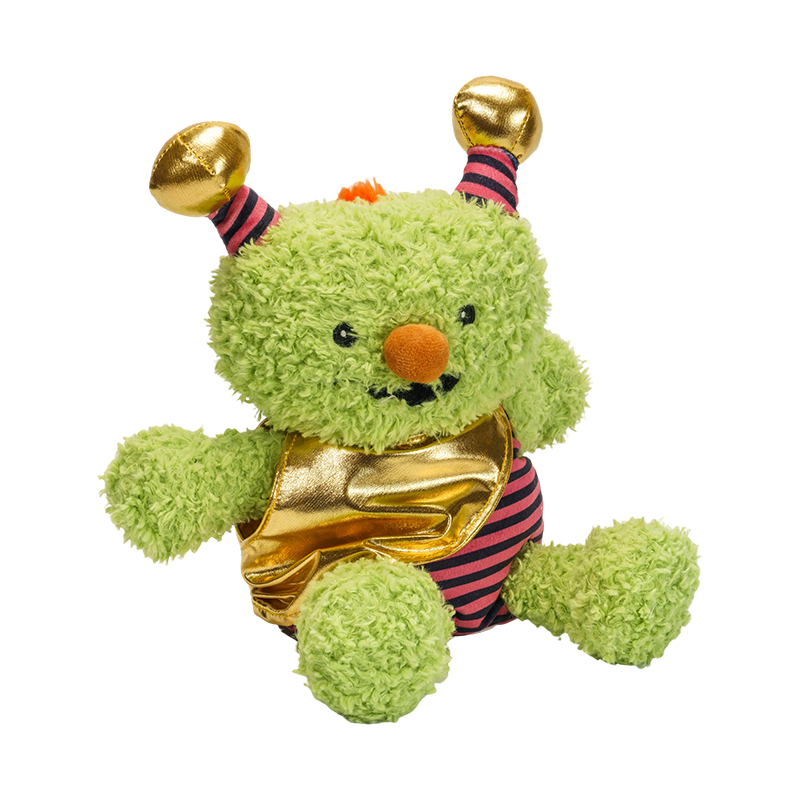
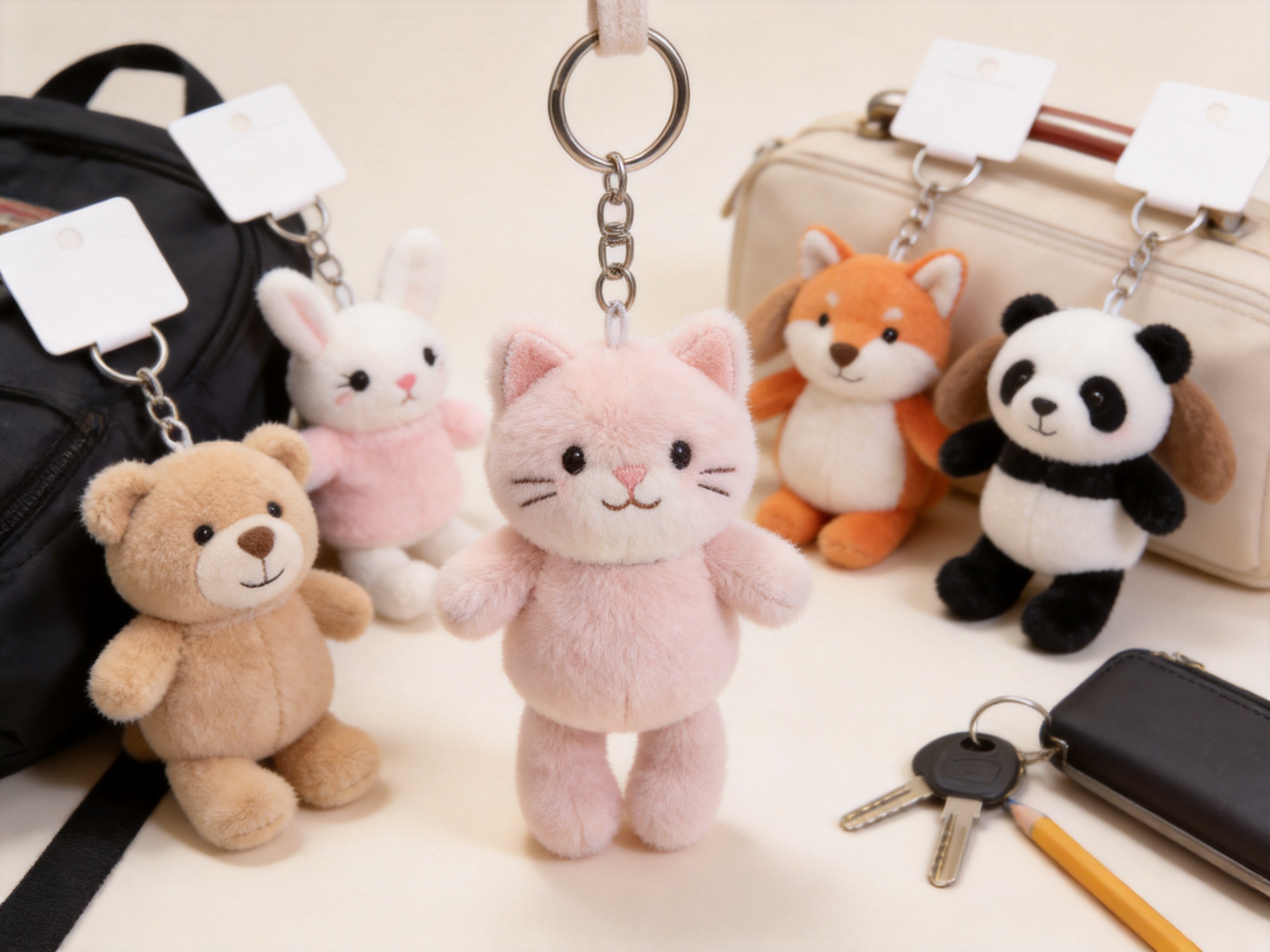
Fuzzy animal shaped key rings combine the emotional appeal of a plush toy with the practical value of a portable accessory. Their compact size, soft texture, recognizable animal forms, and flexible branding potential make them suitable for promotional campaigns, retail collections, seasonal gifts, event merchandise, and everyday lifestyle accessories. Unlike many conventional promotional items that are quickly discarded or placed in a drawer, a well-designed plush key ring can remain in regular use for months or even years.
These small products can be attached to house keys, vehicle keys, backpacks, handbags, luggage, pencil cases, and travel accessories. Every time the user carries the item, the design becomes visible to other people. This gives businesses a promotional product with repeated exposure and a strong emotional connection. The item is not simply a printed advertising object; it is a soft, tactile companion that adds personality to daily routines.
Fuzzy animal shaped key rings are especially effective because animal imagery is widely understood and appeals to children, teenagers, adults, families, and collectors. A bear, rabbit, cat, dog, panda, fox, bird, or imaginative creature can communicate friendliness, warmth, playfulness, environmental awareness, or seasonal emotion. Through customized colors, facial expressions, accessories, labels, and packaging, the same basic product concept can be adapted for very different markets.
This article examines the product’s construction, applications, customization opportunities, manufacturing considerations, quality advantages, packaging requirements, and commercial value. It also explains how an experienced plush manufacturer can support product development from the first concept through sampling, mass production, inspection, and delivery.
Fuzzy animal shaped key rings
Product Overview
A fuzzy animal shaped key ring is a miniature stuffed accessory produced in an animal-inspired form and fitted with a key ring or attachment component. The outer shell is made from soft plush fabric, while PP cotton provides the internal filling. The product is designed to be lightweight enough for everyday carrying while still offering a rounded, substantial appearance that resembles a small plush toy.
The standard product size is approximately 15 centimeters, although the dimensions can be customized according to the intended application. Size customization may be useful when a buyer wants a smaller accessory for retail multipacks, a larger character for a collectible series, or a specific proportion that matches an existing mascot. Because the item is soft and compressible, its final packed dimensions can differ from its displayed dimensions, making careful sampling important.
The listed product weight is approximately 150 grams. This provides a noticeable and premium-feeling item without making a bag or key set unnecessarily heavy. For large promotional distributions, buyers may request a lighter structure, simplified accessories, or a smaller body. For boutique retail products, additional details, embroidered features, denser filling, and decorative clothing may be added to create a higher-value version.
Multiple color options are available. Color selection can follow a corporate identity system, a seasonal theme, a licensed character palette, a school or sports team identity, or a retailer’s private-label collection. A product line may use one animal in several colors or several animals in a coordinated color family. This makes the key rings suitable for blind-box concepts, loyalty campaigns, gift-with-purchase programs, and collectible promotions.
The primary materials are soft plush fabric and PP cotton filling. Plush fabric creates the fuzzy hand feel that differentiates the product from rubber, acrylic, metal, or hard plastic key accessories. PP cotton offers a soft and resilient interior that helps the miniature animal retain its shape during normal handling. The selection of fabric pile, density, stretch, and color fastness influences the finished appearance and tactile quality.
Key Product Specifications
The following specifications describe the standard configuration supplied for this product concept. Buyers should confirm final specifications during the quotation and sample approval stages, particularly when requesting customized dimensions, materials, hardware, packaging, or accessories.
| Item | Standard Information | Customization Considerations |
|---|---|---|
| Product type | Fuzzy animal shaped key ring | Animal form, character style, accessories, and packaging can be adapted |
| Category | Promotional plush toys | Suitable for retail, events, campaigns, and seasonal gifting |
| Approximate size | 15 centimeters | Custom dimensions available according to design requirements |
| Approximate weight | 150 grams | Can vary with size, filling density, fabric, and accessories |
| Outer material | Soft plush fabric | Color, pile length, texture, and fabric composition may be reviewed |
| Filling | PP cotton | Filling quantity and firmness can be adjusted during sampling |
| Colors | Multiple options | Custom color matching may be discussed for qualified projects |
| OEM and ODM | Available | Suitable for original designs, mascots, logos, and private-label collections |
| Minimum order quantity | 500 pieces | Final MOQ may depend on the number of designs and materials |
| Sample fee | 100 US dollars per design | Sampling fees and revisions should be confirmed before development |
| Sample lead time | 3 to 7 working days | Timing may vary with complexity and approval feedback |
| Production lead time | Approximately 45 days | Schedule depends on order quantity, materials, and packaging |
The specification table demonstrates why this product can serve both small promotional campaigns and larger commercial programs. The 500-piece minimum order quantity allows businesses to test a design without committing to an extremely large first order. At the same time, the manufacturing model can support larger volumes when a campaign requires broad distribution across stores, events, regions, or markets.
Why Plush Key Rings Stand Out From Conventional Promotional Products
Promotional products compete for attention in crowded environments. Pens, paper cards, printed bags, silicone bands, and low-cost plastic accessories can be useful, but they often have limited emotional appeal. Fuzzy animal shaped key rings stand apart because they combine visibility, usefulness, and emotional warmth in one item.
Emotional and Tactile Appeal
Soft materials naturally encourage people to touch and hold the product. This tactile interaction can create a stronger memory than viewing a flat printed logo. The fuzzy surface, rounded body, and friendly animal face make the item feel approachable. For many users, the product becomes more than a branded object; it becomes a small personal accessory with a distinctive character.
The emotional response is particularly valuable for promotional campaigns connected with children’s products, family services, pet brands, entertainment properties, tourism destinations, educational programs, charitable organizations, and lifestyle businesses. A soft animal can communicate friendliness without requiring a complicated message. Its visual language is immediate and broadly accessible.
Repeated Brand Visibility
A key ring is carried through multiple environments. It may be seen at a workplace, school, airport, gym, shopping center, or public event. When attached to a backpack or handbag, the product is displayed at eye level or close to the user’s body. This creates repeated organic impressions that are difficult to achieve with a one-time paper advertisement.
The promotional value increases when the animal design is distinctive. A recognizable silhouette, contrasting ears, unusual color combination, embroidered expression, or branded accessory can make the item memorable even when the logo is small. The design should therefore balance brand visibility with attractive character styling. A product that looks desirable is more likely to be used continuously.
Practical Everyday Function
The metal or durable attachment component allows the product to be connected to keys and bags. This practical function encourages regular use and reduces the risk that the item will be stored away. The plush component adds decoration while the key ring provides utility. For promotional distribution, this combination gives the recipient a reason to keep the product.
Compared with a decorative plush item that must remain on a shelf, a key ring travels with its owner. Compared with a purely functional metal key holder, it offers greater visual distinction and a more personal style. This balance between utility and decoration is one of the product’s main commercial advantages.
Flexible Audience Coverage
Animal-themed accessories can be adapted for different age groups and consumer preferences. A simple rounded design in pastel colors may appeal to children and young families. A minimalist cat, fox, or bear may suit adult lifestyle retailers. A humorous expression can support a social media campaign, while a premium embroidered design may fit a museum, hotel, or specialty gift shop.
The product is also suitable for gender-neutral marketing. A carefully selected animal form and coordinated color range can appeal to a broad audience without relying on narrowly defined themes. Retailers can create a complete display with multiple animal designs, encouraging customers to choose a favorite or purchase more than one.
Design Possibilities for OEM and ODM Projects
OEM and ODM availability gives buyers the flexibility to develop a product that matches a specific identity rather than selecting only from standard stock designs. OEM production is useful when a buyer already has approved artwork, character files, mascot guidelines, or packaging specifications. ODM development is helpful when the buyer wants assistance converting an idea into a manufacturable plush accessory.
Animal Silhouette and Character Proportion
The silhouette is one of the first visual decisions. A compact body with prominent ears may create a rabbit or bear impression, while a long tail and pointed ears can suggest a fox or cat. Large heads and small bodies often create a cute, youthful appearance. More balanced proportions may be appropriate for a realistic or premium collection.
Designers should consider how the silhouette will look from the front, side, and back. Because a key ring may rotate while attached to a bag, all visible surfaces should be planned. The attachment point should also be positioned carefully so the product hangs naturally rather than tilting awkwardly.
Facial Features
Facial features strongly influence the character’s personality. Embroidery is often suitable for eyes, mouths, noses, whiskers, and small decorative marks because it provides a clean appearance and avoids adding rigid components to the face. The size, spacing, and expression of the features should be checked on a physical sample, as details that look balanced on a digital drawing may appear different on a small plush surface.
Simple features can improve production consistency and durability. A design with too many tiny components may require additional assembly steps and create greater variation between pieces. Experienced product development teams can help simplify the design while preserving its intended personality.
Fabric and Surface Texture
Soft plush fabric is central to the product’s appeal. Different pile lengths can create different moods. Short plush may provide a neat, clean look, while longer fibers create a more visibly fuzzy appearance. Smooth or velvety fabrics may be preferred for modern character designs, whereas shaggy textures can support bear, sheep, or woodland animal themes.
Fabric selection should account for color consistency, sewing behavior, shedding resistance, printing or embroidery compatibility, and the visual scale of the final product. A material that appears attractive on a large sample may overwhelm the details of a 15-centimeter key ring. Sampling helps confirm whether the fabric supports the intended shape and facial expression.
Accessories and Decorative Details
Additional features may include scarves, hats, bows, clothing, embroidered badges, printed patches, miniature bags, seasonal ornaments, or branded tags. These details can strengthen a campaign theme and create a more premium appearance. However, every additional component affects cost, production time, inspection, and safety review.
Accessories should be securely attached and proportionate to the product. The attachment method may involve sewing, embroidery, or carefully controlled hardware depending on the design. For children’s products, buyers should request an appropriate safety assessment of small parts and attachments according to the regulations of the intended market.
Manufacturing Process and Production Strengths
High-quality plush key rings depend on controlled production at every stage. The product may be small, but its size does not eliminate manufacturing challenges. Small deviations in facial position, filling density, seam alignment, or hardware placement can noticeably affect the final appearance. A professional manufacturing process therefore combines design review, material preparation, precision cutting, sewing, filling, finishing, inspection, and packaging.
Research, Development, and Design Preparation
The process begins with an evaluation of the proposed design. The development team reviews the animal silhouette, dimensions, fabric direction, facial details, attachment points, accessories, and packaging requirements. The goal is to transform a visual concept into a practical production pattern.
Pattern development is especially important for miniature plush products. A shape that works on a large stuffed toy may need to be simplified for a smaller key ring. Curves must be adjusted so the fabric can be sewn smoothly, while seam allowances must be sufficient to maintain strength without making the product bulky. The development team also considers how the filled form will look after turning and stuffing.
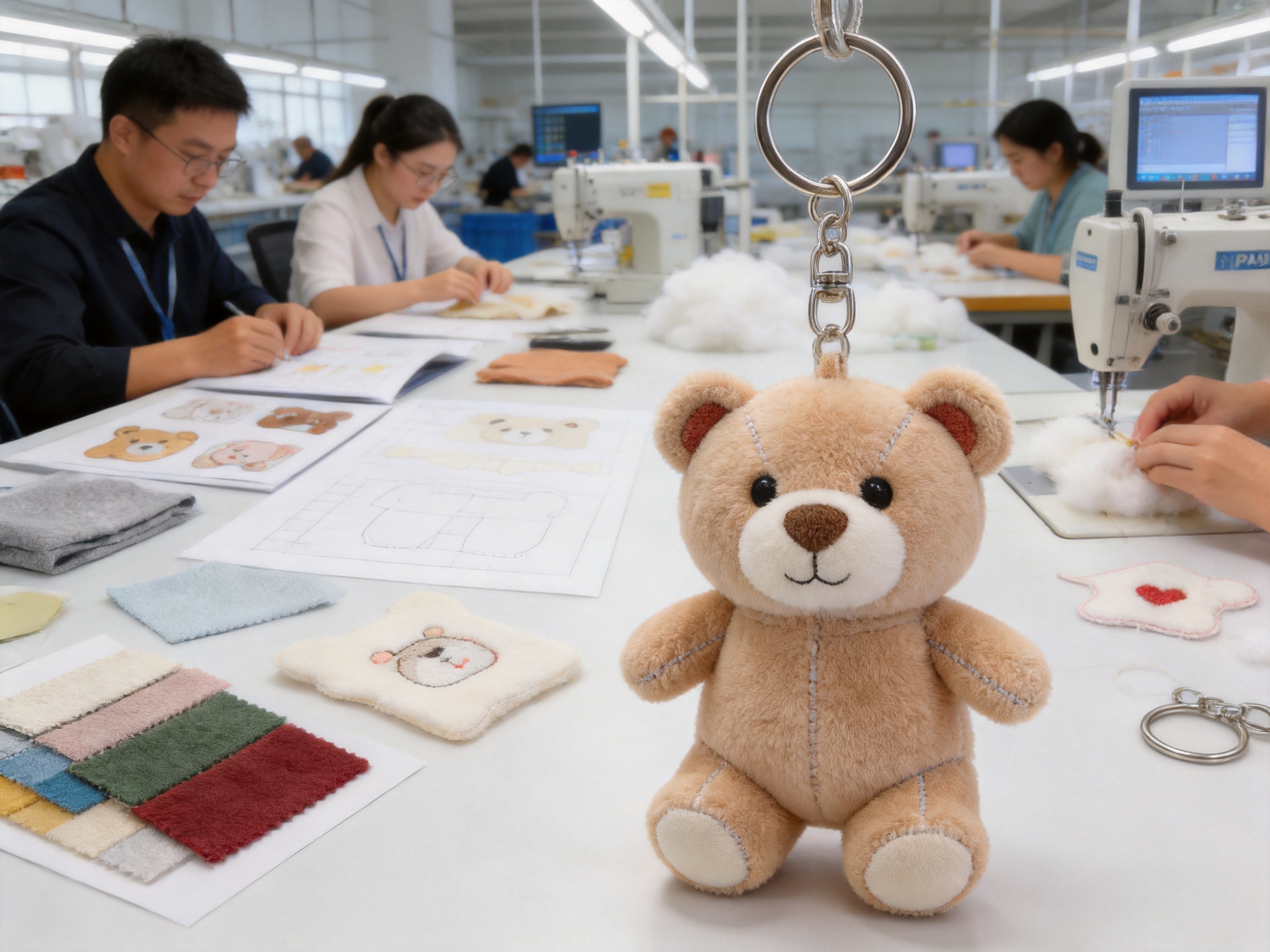
As an integrated manufacturer specializing in research and development, design, production, and sales, Tianchang Bestjoy Craft & Gift Co., Ltd. can coordinate these stages within one organization. This integrated structure can reduce communication gaps between designers, production staff, and sales teams. It also enables design feedback to be based on actual manufacturing experience rather than appearance alone.
Material Selection and Preparation
Once the design is approved, the required plush fabrics, threads, filling, hardware, labels, and packaging materials are prepared. Material preparation includes checking colors, textures, quantities, and specifications against the approved sample. Consistent preparation is essential when an order includes multiple animal designs or several color variations.
PP cotton filling must be distributed evenly to achieve a stable shape. Too little filling can make the product appear flat or weak, while excessive filling may distort the seams or make the key ring unnecessarily heavy. The appropriate filling quantity is normally established during sampling and then used as a production reference.
Hardware inspection is also important. The key ring and connecting loop must be appropriate for the product’s weight and intended use. The hardware should be fitted securely and positioned so that repeated movement does not place excessive stress on a single seam. A balanced attachment point contributes to both appearance and function.
Precision Cutting and Sewing
Fabric pieces are cut according to approved patterns. Accurate cutting helps maintain symmetry between paired components such as ears, feet, wings, or facial panels. For multi-design orders, clear organization and identification of cut pieces reduce the chance of mixing colors or components.
Sewing follows the pattern structure. Curved areas require careful handling to prevent puckering, while small openings must be left for turning and filling. The seam should be strong enough to withstand ordinary handling, attachment to a bag, and repeated movement. Neat stitching also improves the perceived quality of the product, particularly when the item is intended for retail sale.
Manufacturing personnel must work with the characteristics of plush fabric. The pile direction can affect how light reflects from the surface and how the completed animal appears. Consistent alignment helps ensure that a group of products has a uniform visual finish. For designs using contrasting panels, accurate positioning is equally important.
Filling and Shaping
After sewing, the plush shell is turned and filled with PP cotton. Filling is distributed into the head, body, limbs, and other sections to create the intended form. Operators shape the product manually or with suitable production methods to remove uneven areas and maintain consistency.
For a key ring, shaping must account for the product’s hanging position. The finished item should retain a recognizable animal form while remaining compact and comfortable to carry. The filling level also influences softness. A promotional product intended for frequent handling should feel pleasant without being so loose that it loses its shape.
Embroidery, Assembly, and Finishing
Facial features and other decorative elements are added after the basic body has been prepared, according to the approved production sequence. Embroidery placement is checked for alignment and expression. Components such as ears, tails, bows, and clothing must be attached securely and consistently.
The key ring assembly is fitted during the finishing stage. The connection should be stable, visually tidy, and proportionate to the plush body. The finished item is then checked for loose threads, surface irregularities, misplaced details, and other visible defects. Any necessary trimming or light finishing is completed before final inspection.
Quality Inspection
Quality control should cover both appearance and function. Visual inspection can review color consistency, seam neatness, facial symmetry, filling distribution, accessory placement, and overall shape. Functional review can examine the attachment point, key ring connection, seam strength, and resistance to ordinary handling.
For products intended for children or international retail, buyers should clarify the applicable safety and compliance requirements before production. Depending on the destination market and product positioning, testing may involve materials, colorants, small parts, mechanical properties, flammability, or other applicable standards. Compliance requirements should be addressed during design rather than after production is complete.
Packaging and Carton Preparation
Packaging protects the key rings during storage and transportation while also contributing to the product’s retail presentation. Individual packaging may include a paper card, polybag, printed box, recyclable sleeve, or customized display solution. Promotional orders may use simple bulk packaging when speed and cost efficiency are the primary priorities.
The standard carton information provided for this product includes a carton size of approximately 43 centimeters in length, 25 centimeters in width, and 18 centimeters in height. The standard carton packing is 12 pieces per carton, with a gross weight of approximately 3 kilograms and a net weight of approximately 2 kilograms. These figures should be reconfirmed when the product size, packaging, or accessories are changed.
Advantages of an Integrated Plush Manufacturing Partner
A supplier’s capabilities influence the result as much as the product concept itself. An integrated manufacturer can support the full path from idea to finished shipment, reducing the need for a buyer to coordinate multiple companies for design, sewing, filling, decoration, packaging, and export preparation.
R&D and Design Coordination
Product development frequently involves revisions. A customer may request a different ear shape, a softer fabric, a more visible logo, a smaller size, or a modified package after reviewing the first sample. When development and production are closely connected, feedback can be evaluated more quickly and realistically.
The manufacturer can identify potential problems such as overly narrow seams, fragile decorative pieces, difficult fabric combinations, or an attachment position that does not support the product correctly. Solving these issues before mass production reduces rework, delays, and unnecessary material consumption.
Experience With Multiple Product Categories
A company experienced in trendy plush toys, children’s plush toys, pet plush products, promotional gifts, home furnishings, stationery gifts, plush handicrafts, and cartoon decorations can bring knowledge from one category to another. For example, character design experience can improve a promotional mascot, while home textile experience can support fabric selection and finishing quality.
This broad product background is useful for buyers developing a complete collection rather than a single item. A fuzzy animal key ring can be coordinated with larger plush toys, cushions, pencil cases, ornaments, pet toys, or seasonal gift products. Consistent materials, colors, and character details can help create a unified product family.
Production Capacity and Export Experience
The manufacturer was established in 2013 as a joint venture between Hong Kong Jintong International Co., Ltd. and Tianyuan Enterprise Investment Management Co., Ltd. Its factory covers more than 10,000 square meters, and annual sales exceed 12 million RMB. These company characteristics indicate an established operational base rather than a short-term trading arrangement.
The company’s products are exported to Europe, America, Australia, Japan, and South Korea. International market experience can help a buyer communicate requirements relating to packaging, documentation, labeling, product presentation, and delivery planning. The company has also served major clients including Walmart, Target, Albertsons, and Kmart, demonstrating experience with demanding commercial supply environments.
Professional Production and Service Teams
An effective plush project requires cooperation among designers, sample makers, sewing operators, quality personnel, sales representatives, packaging workers, and after-sales staff. The company maintains an innovative R&D and design team, professional production equipment, an experienced sales team, and a comprehensive after-sales service team.
For international buyers, communication and follow-up are important parts of manufacturing quality. Questions about artwork, samples, colors, quantities, packaging, and delivery need timely responses. A complete service structure can support clearer project management from the first inquiry through final shipment and future replenishment.
In-Stock and Custom Development Options
In-stock services can be useful when a buyer requires a quick promotional item or wants to evaluate product quality before starting a customized project. Custom OEM and ODM development is more appropriate when the campaign depends on a specific mascot, brand color, character style, or packaging concept.
The combination of available products and custom development provides commercial flexibility. A customer may begin with an existing animal design for a short-term event and later develop an exclusive collection. Alternatively, a retailer may proceed directly to custom designs for long-term private-label distribution.
Promotional Applications
Fuzzy animal shaped key rings can support a wide range of promotional strategies. Their relatively compact size makes them practical for distribution, while their visual appeal encourages recipients to keep and display them.
Brand Events and Trade Shows
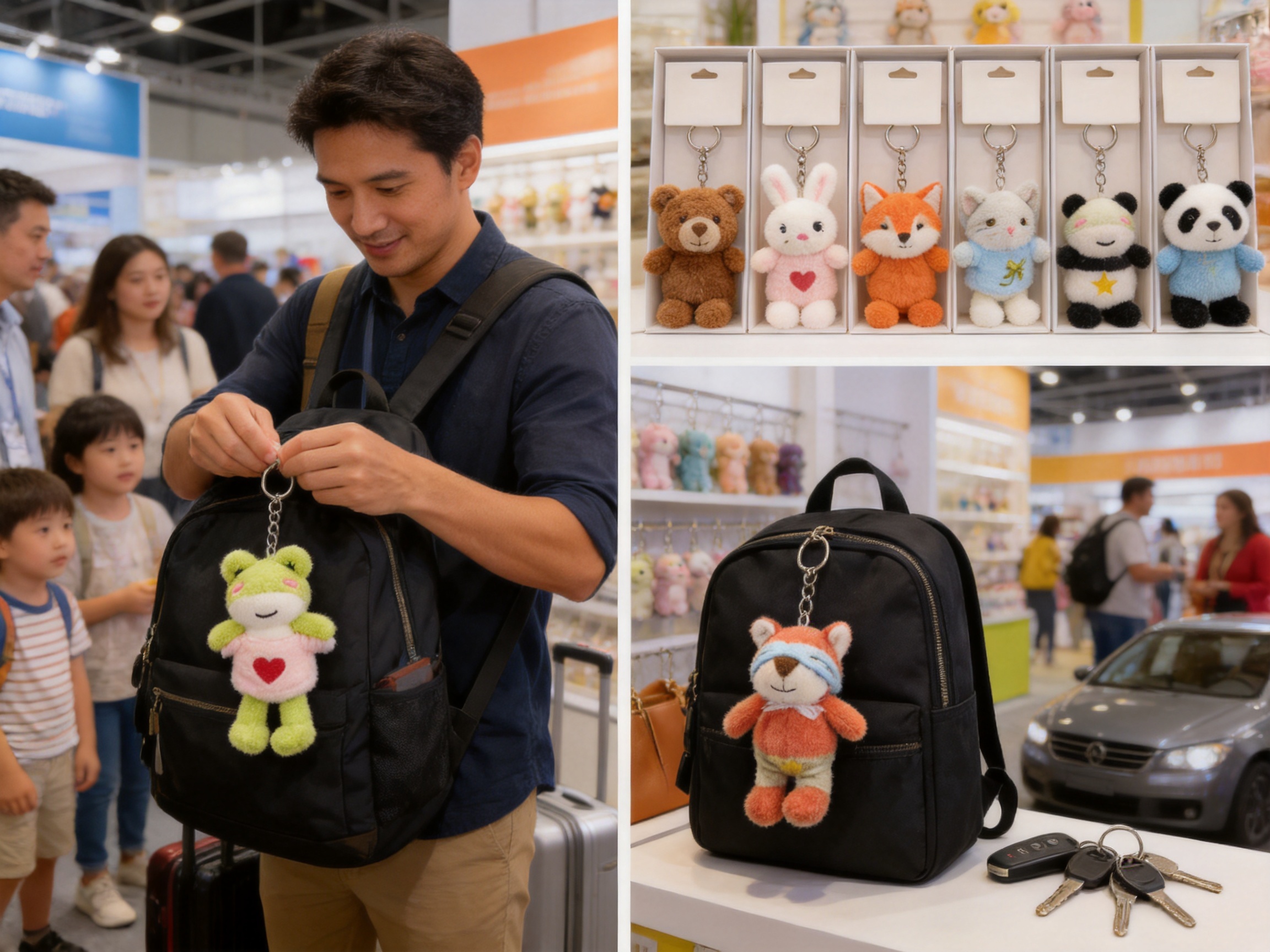
At trade shows, a plush key ring can attract visitors to a booth more effectively than a plain brochure. The product can be presented as a gift for completing a survey, subscribing to a newsletter, scheduling a meeting, or participating in a demonstration. A customized animal can also serve as a conversation starter that helps sales staff introduce the company’s products or services.
Because trade show attendees often carry bags, the key ring can be attached immediately and remain visible throughout the event. This extends brand exposure beyond the booth and can create additional conversations between attendees.
Retail Promotions
Retailers can use the key rings as gifts with purchase, loyalty rewards, limited-edition collectibles, or add-on accessories. A series of animal designs encourages repeat purchases and gives customers a reason to return for a new style. Retail packaging can include product information, a campaign message, a barcode, or a story about the character.
For supermarkets and department stores, the product can be connected to seasonal displays or family-oriented promotions. Specialty stores can use higher-detail designs with carefully selected fabrics and accessories to support premium pricing.
Schools and Educational Programs
Schools, tutoring organizations, libraries, museums, and educational campaigns can use animal key rings as participation rewards or commemorative gifts. A mascot-based design can reinforce school identity, while different animals can represent classes, teams, reading levels, or achievement categories.
The soft form is suitable for positive recognition programs because it feels personal and celebratory. Buyers should ensure that the selected product design and packaging meet the requirements for the intended age group.
Tourism and Destination Marketing
Animal key rings can represent a local species, regional symbol, natural attraction, or cultural theme. Their small size is suitable for gift shops, visitor centers, hotels, and travel campaigns. A destination-specific color palette or embroidered label can transform a general animal shape into a souvenir with local meaning.
Charity and Awareness Campaigns
Animal imagery can support campaigns related to wildlife protection, pet adoption, environmental conservation, medical fundraising, and community activities. The product may be sold to raise funds or distributed to participants as a reminder of the cause. A thoughtful design can communicate warmth and optimism while remaining practical for everyday use.
Corporate Gifts and Employee Programs
Companies can use customized plush key rings for onboarding kits, employee appreciation, internal events, family days, and customer loyalty programs. A company mascot or friendly character can make an internal campaign feel more approachable. The product can also be paired with a printed message explaining the campaign or celebrating a milestone.
Quality and Durability Considerations
Although plush key rings are soft, they should be produced to withstand normal daily movement. The product may be pulled, rotated, compressed, placed in a pocket, or exposed to contact with other objects. Quality therefore depends on more than appearance at the time of delivery.
Seams should be appropriately closed, especially around areas that experience tension. The key ring attachment should be secured to a reinforced part of the product rather than relying on a weak decorative seam. Filling should be contained evenly, and the outer fabric should not show excessive loose fibers or visible damage.
Facial features should remain aligned and securely attached. Embroidery should be clean, with thread ends controlled. If the product includes ribbons, hats, buttons, or other additions, these parts should be reviewed for secure attachment and suitability for the target market.
Packaging should prevent excessive compression, moisture exposure, and surface contamination during transit. If the product arrives compressed, it should be allowed to recover its shape according to the agreed handling instructions. Buyers may request pre-shipment photos, carton details, inspection reports, or sample comparisons as part of their quality assurance process.
Commercial Benefits for Buyers
The product offers several advantages for distributors, retailers, promotional agencies, and brand owners. First, it has a broad market appeal. Second, it can be adapted to different campaign themes. Third, its practical attachment function supports continued use. Fourth, its compact format simplifies storage and distribution compared with larger plush products.
The 500-piece minimum order quantity is suitable for many regional campaigns, event programs, pilot retail launches, and multi-location promotions. A buyer can allocate several hundred pieces to one campaign or divide an order among multiple designs after confirming the production terms. For larger orders, the same design can be scaled for national or international distribution.
Customization can also improve perceived value. A standard generic key ring may compete mainly on price, while a custom character with coordinated packaging can compete on uniqueness and relevance. When the design reflects the buyer’s identity, the product becomes more difficult to substitute with an unrelated promotional item.
In addition, the product can be incorporated into a broader marketing system. A QR code may be placed on the packaging, a campaign message may be printed on a tag, or the animal can be connected with online content, loyalty points, or a social media challenge. The plush product remains useful on its own while supporting additional communication channels.
Order Development and Project Workflow
A clear project workflow helps buyers control quality, timing, and cost. The process generally begins with an inquiry that includes the intended quantity, animal designs, target market, preferred materials, colors, packaging, delivery destination, and required date.
The manufacturer then reviews the concept and provides feedback about feasibility, estimated pricing, sample requirements, and production timing. For a custom project, the buyer should provide artwork in a clear format whenever possible. Reference images, sketches, dimensions, color codes, logo files, and packaging ideas can improve communication.
A sample is developed for approval. The listed sample fee is 100 US dollars per design, and the sample lead time is approximately 3 to 7 working days. The sample stage allows the buyer to evaluate the actual fabric, shape, size, expression, filling, attachment, and overall appearance. Changes should be recorded clearly so that the approved version becomes the production reference.
After sample approval, the buyer and manufacturer confirm the order quantity, unit specifications, packaging, shipping marks, payment terms, and delivery schedule. The stated production delivery time is approximately 45 days, although the final schedule may depend on material availability, the number of designs, order volume, and packaging complexity.
Before shipment, the goods should undergo agreed quality checks. Carton quantities, gross weight, net weight, dimensions, labels, and shipping marks should be verified. The buyer may also request production photographs or arrange an independent inspection where appropriate.
Packaging, Logistics, and Storage
Because the product is lightweight and compressible, packaging can be planned for efficient transportation. The correct packing method depends on whether the key rings are intended for retail display, event distribution, or bulk warehouse storage. Individual retail packaging provides presentation and product information, while bulk packing can reduce material use and simplify handling.
The standard carton configuration of 12 pieces per carton provides a reference for logistics planning. Buyers should calculate the total number of cartons based on the final quantity and confirm whether mixed designs are permitted within a carton. If several designs are packed together, clear internal separation and carton markings can reduce warehouse errors.
Carton dimensions and weights are also important for freight quotations. The listed carton size is approximately 43 centimeters by 25 centimeters by 18 centimeters, with a gross weight of approximately 3 kilograms and a net weight of approximately 2 kilograms. These figures should be treated as standard reference data until the final package is approved.
During storage, plush key rings should be kept in a clean, dry, and ventilated environment. Prolonged exposure to moisture, direct sunlight, strong odors, dust, or excessive pressure may affect the fabric and packaging. Retailers should rotate inventory when necessary and avoid placing heavy cartons on top of products that may be compressed for a long period.
How to Build a Strong Product Collection
A single animal key ring can perform well, but a coordinated collection often creates stronger commercial results. Buyers can develop a family of related characters using consistent fabric quality, packaging structure, label placement, and visual language.
One collection strategy is to offer several animal species with different personalities. A cheerful rabbit, adventurous fox, calm bear, playful cat, and friendly dog can appeal to different preferences. Another strategy is to use one mascot in several seasonal versions, such as a winter scarf, spring flower, summer accessory, or autumn colorway.
Color planning is important for collection management. A balanced range may include neutral, pastel, bright, and natural colors. If the products are sold in a display, the colors should be easy to distinguish while still looking cohesive together. For a corporate campaign, the entire collection may follow the company’s official palette.
Packaging can help customers understand the collection. Numbered cards, character names, short stories, or collectible icons can encourage engagement. If a product series is intended for children, packaging should be designed with age-appropriate information and any required safety notices.
Competitive Positioning
Fuzzy animal shaped key rings compete with hard accessories, printed promotional items, low-cost novelty gifts, and larger plush toys. Their strongest position is between function and emotion. They are more expressive than a conventional key holder, more portable than a standard stuffed animal, and more memorable than a flat promotional object.
The soft plush surface is a clear point of differentiation. It creates a sensory experience and gives the product a warm, friendly identity. The animal shape creates immediate recognition, while the key ring adds everyday usefulness. These qualities are difficult to achieve simultaneously with acrylic, silicone, metal, or paper products.
Customization provides another competitive advantage. A business can use its own mascot, create a campaign-specific animal, or request a completely original character. This supports stronger brand alignment than a generic item purchased from an open catalog. The ability to adjust size, colors, decoration, and packaging also helps buyers target different price points.
Manufacturing integration further strengthens the product offer. R&D, design, production, sales, and after-sales support are coordinated within an established plush manufacturing company. The factory’s more than 10,000-square-meter facility, international export experience, professional equipment, and customer base across major global markets provide a foundation for handling both custom development and recurring orders.
Best Practices for Buyers
Buyers should begin with a clear product brief. The brief should identify the target audience, use scenario, desired animal, dimensions, colors, branding elements, packaging style, estimated quantity, destination market, and required delivery date. Clear information helps the manufacturer provide more accurate recommendations.
It is advisable to approve a physical sample rather than relying only on digital images. Texture, softness, color, scale, filling, and hanging position are best evaluated in person. If revisions are required, buyers should consolidate feedback into one detailed document to reduce confusion and shorten the approval process.
Buyers should also consider the complete landed cost. In addition to the unit price, the budget may include sample fees, customized packaging, labels, testing, inspection, freight, import charges, and warehouse handling. Early discussion of these items helps prevent unexpected expenses.
For campaigns with a fixed launch date, production planning should begin well in advance. The stated delivery time is approximately 45 days after order confirmation, but buyers should allow additional time for sample approval, material preparation, packaging production, inspection, and transportation. Early approval is especially important when several designs are included.
Finally, buyers should establish a quality reference. The approved sample, specification sheet, packaging artwork, color references, and inspection criteria should be retained for comparison during mass production. This is particularly useful for repeat orders, where consistency between batches is commercially important.
Q&A
What are fuzzy animal shaped key rings used for?
They are used as promotional gifts, retail accessories, event giveaways, loyalty rewards, seasonal gifts, tourism souvenirs, school items, corporate gifts, and collectible character products. They can be attached to keys, bags, luggage, backpacks, and other personal accessories.
What material is used for the outer shell?
The standard outer shell is made from soft plush fabric. The precise fabric texture, pile length, color, and finish can be reviewed during custom product development.
What is the filling material?
PP cotton is used as the standard filling material. The amount and distribution of filling can be adjusted to control softness, shape retention, and product weight.
What is the standard size?
The listed standard size is approximately 15 centimeters. Custom dimensions are available, but the final size should be confirmed through a product sample because changes in proportion can affect the appearance, filling, packaging, and weight.
How much does one key ring weigh?
The listed product weight is approximately 150 grams. Actual weight may vary according to the final design, size, fabric, filling amount, key ring hardware, and decorative accessories.
Can the product be customized with a company mascot?
Yes. OEM and ODM services are available. Buyers can submit original artwork, mascot files, sketches, logos, color requirements, and packaging concepts for evaluation and sample development.
What is the minimum order quantity?
The listed minimum order quantity is 500 pieces. Buyers should confirm whether the MOQ applies per design, per color, or across a combined order containing multiple designs.
What is the sample fee?
The listed sample fee is 100 US dollars per design. The final sampling arrangement should be confirmed according to the complexity of the design and the number of revisions required.
How long does sampling take?
The sample lead time is approximately 3 to 7 working days. Complex designs, special materials, additional accessories, or delayed artwork approvals may affect the actual schedule.
How long is the production lead time?
The listed delivery time is approximately 45 days. The final schedule depends on order quantity, the number of designs, material preparation, packaging, inspection, and shipping arrangements.
What are the standard carton details?
The listed carton size is approximately 43 centimeters long, 25 centimeters wide, and 18 centimeters high. The standard carton packing is 12 pieces per carton. The gross weight is approximately 3 kilograms, and the net weight is approximately 2 kilograms. These details should be reconfirmed after final packaging approval.
Are multiple colors available?
Yes. Multiple color options are available. Buyers can discuss color combinations for campaigns, private-label collections, seasonal themes, mascots, and other promotional requirements.
Can the product be used for children?
The product may be positioned for children depending on its final design, accessories, packaging, and destination-market requirements. Buyers should discuss age grading, small parts, labeling, and applicable safety testing before placing an order for children’s distribution.
What makes this product different from a plastic keychain?
The plush key ring provides a soft tactile surface, a three-dimensional animal form, and greater emotional appeal. It can function as a practical accessory while also serving as a small character or decorative companion. This combination encourages repeated use and stronger visibility.
Can the product be combined with other plush items?
Yes. It can be developed as part of a collection that includes larger plush toys, cushions, pet products, plush stationery, home decorations, seasonal products, or other character merchandise. Coordinated colors, fabrics, and artwork can create a unified product family.
Conclusion
Fuzzy animal shaped key rings are compact promotional products with unusually strong emotional and practical value. Their soft plush construction, PP cotton filling, animal-inspired designs, portable format, and customization potential make them suitable for a wide range of commercial and promotional programs.
They offer clear advantages over conventional promotional items by combining tactile appeal, repeated visibility, everyday usefulness, broad audience relevance, and character-based memorability. A well-designed key ring can become part of the user’s personal belongings rather than a disposable advertisement.
The product is supported by OEM and ODM capabilities, multiple color options, a standard size of approximately 15 centimeters, a sample lead time of approximately 3 to 7 working days, a minimum order quantity of 500 pieces, and an estimated production delivery time of 45 days. Final details should always be confirmed during quotation and sample approval.
Tianchang Bestjoy Craft & Gift Co., Ltd. provides an integrated manufacturing platform covering R&D, design, production, sales, and after-sales service. Established in 2013, with a factory exceeding 10,000 square meters and export experience across Europe, America, Australia, Japan, and South Korea, the company is positioned to support both promotional orders and customized plush product programs.
For businesses seeking a promotional product that is useful, visually attractive, emotionally engaging, and adaptable to different campaigns, fuzzy animal shaped key rings provide a practical and distinctive solution. With careful design planning, controlled manufacturing, appropriate quality inspection, and effective packaging, these small plush accessories can deliver long-lasting brand exposure and strong customer appeal.
References
1. Product specification information supplied for the fuzzy animal shaped key ring product, including size, weight, materials, MOQ, sampling, delivery, and packaging details.
2. Company profile information supplied for Tianchang Bestjoy Craft & Gift Co., Ltd., including its establishment history, factory scale, product categories, export markets, customer experience, and organizational capabilities.
3. General principles of plush toy product development, including pattern engineering, fabric selection, filling distribution, sewing quality, accessory attachment, and finished-product inspection.
4. General promotional merchandise planning practices, including audience targeting, brand visibility, product utility, retail presentation, campaign integration, and inventory management.
5. General international product development considerations for plush accessories, including sample approval, packaging review, market-specific safety requirements, quality documentation, and shipment preparation.