en
en  русский
 Español
 عربى
عربى
Content
- 1 1. Product Overview
- 2 2. Why the Round Shape Creates a Competitive Advantage
- 3 3. Material Comfort and Tactile Appeal
- 4 4. Lightweight Functionality for Children and Promotional Use
- 5 5. Customization Potential Through OEM and ODM Services
- 6 6. Manufacturing Strengths and Integrated Production Support
- 7 7. A Structured Manufacturing Process for Plush Knapsacks
- 8 8. Quality and Consistency Considerations
- 9 9. Commercial Applications Across Several Market Segments
- 10 10. Comparison with Conventional Backpacks and Standard Plush Toys
- 11 11. Sustainability and Responsible Product Planning
- 12 12. Ordering and Development Process
- 13 13. Product Presentation and Marketing Strategy
- 14 14. The Manufacturer’s Broader Product Capabilities
- 15 15. Key Benefits for Different Buyers
- 16 16. Frequently Asked Questions
- 16.1 What is the Round Yellow Animal Plush Knapsack?
- 16.2 What is the standard product size?
- 16.3 How much does one product weigh?
- 16.4 What materials are used?
- 16.5 Are different colors available?
- 16.6 Can the animal design be customized?
- 16.7 What is the minimum order quantity?
- 16.8 What is the sample fee?
- 16.9 How long does sampling take?
- 16.10 How long is the production delivery time?
- 16.11 How many pieces are packed in one carton?
- 16.12 Is the product suitable for heavy items?
- 16.13 Can the product be used as a promotional gift?
- 16.14 Can the manufacturer produce matching plush products?
- 16.15 What should buyers prepare before requesting a quotation?
- 17 17. Conclusion
- 18 References
- 19 Product: Round yellow animal plush knapsack
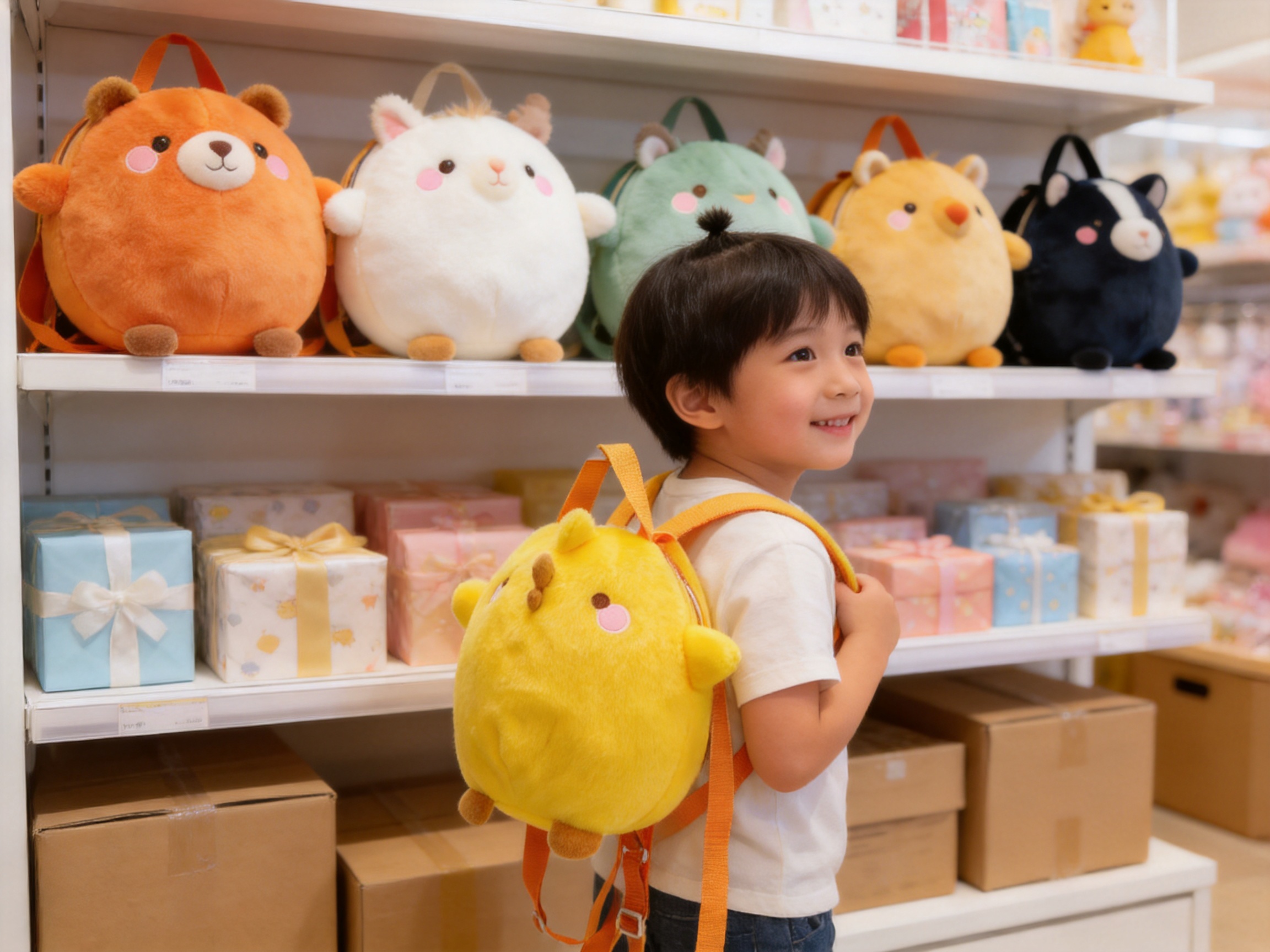
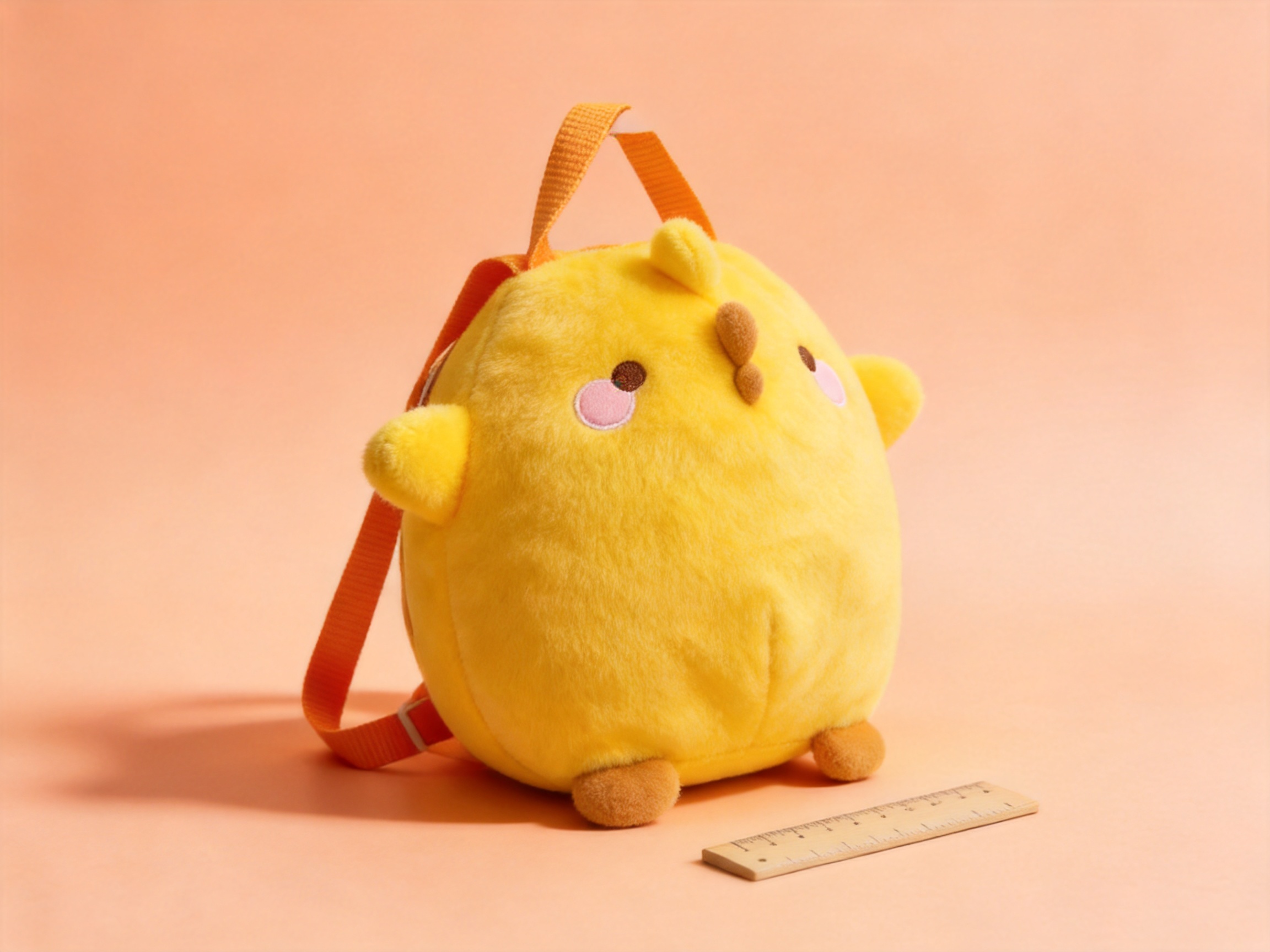
The Round Yellow Animal Plush Knapsack is a compact plush backpack designed to combine visual charm, practical carrying function, and the comforting softness expected from a high-quality stuffed animal. With its bright yellow color, rounded silhouette, small expressive eyes, and soft-touch construction, it is positioned as more than an ordinary bag. It is a portable companion, a playful accessory, a children’s gift, and a versatile promotional product suitable for retailers, wholesalers, event organizers, toy brands, and lifestyle companies.
At approximately 10 centimeters in size and 150 grams in weight, this plush knapsack is small enough for young children to carry comfortably while still offering a distinctive character-driven appearance. Its compact scale also makes it suitable for gift sets, seasonal campaigns, party favors, store displays, character merchandise programs, and promotional distributions. Although the standard concept features a round yellow animal design, the product can be customized through OEM and ODM services, allowing buyers to adjust colors, shapes, character details, materials, packaging, and other specifications according to their market requirements.
The product is manufactured by Tianchang Bestjoy Craft & Gift Co., Ltd., an integrated plush product manufacturer with experience in research and development, design, production, sales, and after-sales support. Established in 2013, the company operates from a factory covering more than 10,000 square meters in Tianchang City, Anhui Province, China. Its products are exported to Europe, America, Australia, Japan, and South Korea, and its customer base includes major retail names such as Walmart, Target, Albertsons, and Kmart.
This combination of appealing design, soft materials, flexible customization, and organized manufacturing support gives the Round Yellow Animal Plush Knapsack strong potential in several competitive markets. It can serve as a children’s plush accessory, a collectible character bag, a seasonal gift, a promotional giveaway, or a small lifestyle product for customers who value both utility and emotional appeal.
1. Product Overview
The Round Yellow Animal Plush Knapsack is built around a simple but powerful product idea: transform a functional backpack into a friendly animal character. Rather than presenting a conventional rectangular bag, the design uses a round and plump body that resembles a cheerful balloon or a soft, animated creature. This distinctive shape immediately separates it from ordinary children’s backpacks and gives it strong shelf appeal.
The bright yellow exterior creates a warm and energetic visual impression. Yellow is commonly associated with sunshine, happiness, optimism, creativity, and playfulness, making it particularly appropriate for children’s products and cheerful promotional campaigns. The color also stands out in retail displays and online product photography, where visual recognition is essential. A yellow plush character can attract attention quickly, especially when presented among darker or more conventional bags.
Two small eyes provide the character with a simple facial identity. The design does not rely on complicated decoration to create emotional appeal. Instead, it uses a minimal expression that allows customers and children to imagine their own personality for the plush animal. This simplicity is valuable for customization because the basic concept can be adapted into many different animal themes, mascots, fictional characters, or seasonal designs without losing the recognizable round form.
The outer shell is made from soft plush fabric, while PP cotton is used as the filling material. Together, these materials create a lightweight, cushioned, and tactile product. The surface is intended to feel smooth and gentle against the skin, which is an important consideration for products designed for children. The padded construction also gives the bag a more toy-like appearance than a standard fabric backpack.
With a listed standard size of 10 centimeters, the product is deliberately compact. It is not designed to replace a full-size school backpack. Instead, its small dimensions support uses such as carrying lightweight personal items, storing small toys, holding accessories, or functioning as a decorative mini bag. The size is also practical for promotional campaigns because it can be packed efficiently, displayed in groups, and included in gift packages.
| Product Attribute | Specification | Commercial Value |
|---|---|---|
| Product Type | Plush backpack or plush knapsack | Combines toy appeal with carrying functionality |
| Design | Round yellow animal character | Strong recognition and cheerful visual identity |
| Standard Size | 10 centimeters, customizable | Suitable for compact gifts, promotions, and children’s accessories |
| Weight | Approximately 150 grams | Lightweight and easy to carry |
| Shell Fabric | Soft plush fabric | Comfortable, tactile, and visually appealing |
| Filling Material | PP cotton | Supports a soft, rounded, padded shape |
| Color | Multiple choices | Supports different branding and market preferences |
| OEM and ODM | Available | Enables custom character and product development |
| Minimum Order Quantity | 500 pieces | Accessible for organized wholesale and promotional programs |
2. Why the Round Shape Creates a Competitive Advantage
Many children’s bags are designed primarily around storage efficiency. They use rectangular bodies, flat panels, ordinary zippers, and conventional straps. These products can be useful, but their appearance often resembles many other bags in the market. The Round Yellow Animal Plush Knapsack takes a different approach by making the character itself the central design feature.
The rounded silhouette is one of the product’s strongest competitive advantages. A round shape is visually soft, approachable, and easy to recognize. It communicates friendliness before a customer even examines the material or construction. In a retail environment, distinctive shape can help a product stand apart on a crowded shelf. In an online store, it can make the product more memorable in thumbnail images and search results.
The rounded body also supports the emotional expectations of plush products. Stuffed animals are traditionally associated with soft curves, padded forms, and comforting shapes. By using a round plush body for a knapsack, the product maintains the emotional appeal of a plush toy while adding a practical function. This hybrid category can attract customers who might not be looking specifically for a backpack but are interested in character gifts, novelty accessories, or collectible plush items.
Compared with a flat fabric bag, the padded round form offers greater dimensionality. The product can be viewed from multiple angles and still retain its character identity. This helps it work well in visual merchandising, display baskets, themed booths, and promotional installations. It also gives manufacturers more design options for future variations, including different ears, tails, facial expressions, color combinations, and seasonal accessories.
The round shape may also strengthen gifting value. A conventional bag can appear practical but ordinary, while a soft animal knapsack can feel more personal and emotionally expressive. It can be presented as a birthday gift, holiday item, travel accessory, party favor, or reward product. This broader gifting potential allows retailers and distributors to target several buying occasions instead of relying on a single seasonal period.
3. Material Comfort and Tactile Appeal
Material selection is central to the success of any plush product. Customers generally expect a plush item to be soft, pleasant to touch, and visually consistent with its intended character. The Round Yellow Animal Plush Knapsack uses soft plush fabric for its shell, creating a surface that supports both comfort and visual warmth.
Soft plush fabric has several advantages over hard or highly structured exterior materials. It gives the product a gentle texture that can be appealing to children and adults alike. It also reflects light in a way that adds depth to the yellow color, helping the bag appear more lively than a plain woven or plastic surface. When properly cut and sewn, plush fabric can create a smooth, rounded finish that reinforces the product’s friendly appearance.
PP cotton filling contributes to the product’s volume and softness. The filling helps the body maintain its plump form while keeping the overall weight low. At approximately 150 grams, the knapsack remains easy to handle and suitable for small users. The combination of a light filling material and a compact body supports portability without making the product feel rigid or heavy.
The tactile experience may also increase repeat engagement. Children often interact with plush products through touch, hugging, squeezing, and carrying. A plush backpack can therefore function as an accessory during use and as a soft toy during rest. This dual role can extend the product’s emotional lifespan and encourage children to keep it nearby rather than treating it as a disposable promotional item.
For buyers, the use of plush fabric and PP cotton also creates opportunities for product line expansion. The same materials can be used to develop matching plush toys, keychains, pencil cases, home accessories, pet toys, or seasonal decorations. A retailer can therefore build a coordinated collection around the round yellow animal concept or request a broader family of related designs.
4. Lightweight Functionality for Children and Promotional Use
The compact scale of the Round Yellow Animal Plush Knapsack is a practical advantage for targeted applications. A small bag is easier for children to carry, especially when it contains only lightweight objects such as tissues, small toys, snacks, cards, or personal accessories. Its 150-gram product weight leaves more room for the contents without creating unnecessary burden.
The item can also be used as a decorative storage accessory. In a bedroom, playroom, nursery, or children’s activity space, it can hold small items while adding a cheerful character accent. The product’s plush exterior makes it more visually engaging than a plain storage pouch. It can hang from a hook, be placed with other toys, or become part of a themed room display.
For promotional applications, a lightweight product is often easier to distribute. Event organizers can include it in gift bags, brand activations, children’s campaigns, educational events, store-opening packages, or holiday promotions. Its small size can help reduce storage requirements and simplify carton handling. The product may also be useful for businesses seeking a promotional gift that remains visible after an event rather than being discarded immediately.
The mini format supports merchandising in multiple channels. It can be sold near checkout counters, included in toy bundles, displayed in gift shops, or offered as part of a limited-edition campaign. It may also be paired with larger plush toys, children’s books, apparel, stationery, or themed accessories. Such bundle possibilities can increase perceived value while encouraging cross-category sales.
Because the bag is designed as a character product rather than a technical outdoor backpack, buyers should position it according to its intended role. Its greatest value lies in portability, charm, gifting, and visual identity. Clear product communication can help customers understand that it is ideal for small personal belongings and imaginative play rather than heavy school loads or extended outdoor use.
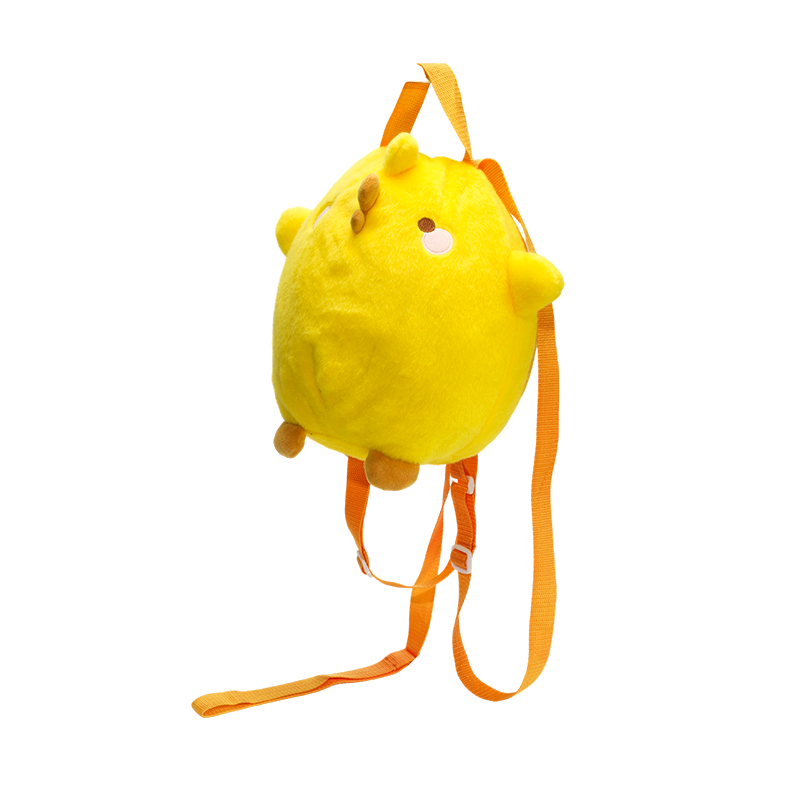
Round yellow animal plush knapsack
5. Customization Potential Through OEM and ODM Services
One of the most important advantages for wholesale buyers is the availability of OEM and ODM services. OEM production allows a buyer to develop a product according to its own specifications, brand requirements, or character guidelines. ODM support can help a buyer use the manufacturer’s design and development capabilities to create a new product concept based on a general theme, target audience, or commercial objective.
The standard round yellow animal design provides a starting point rather than a limitation. Buyers may request alternative colors, facial expressions, animal identities, embroidered details, printed elements, accessories, or packaging presentations. A yellow character could become a chick, bear, duck, fantasy creature, mascot, or abstract cheerful animal. Changing the color could create a series of blue, pink, green, orange, or seasonal characters.
Customization may also support brand storytelling. A company can design a mascot that reflects its identity, create a character connected to a product launch, or develop a limited-edition plush bag for a special event. Schools, museums, amusement venues, sports organizations, restaurants, and family-oriented businesses may use plush knapsacks to turn a visual symbol into a tangible product.
For retailers, customized designs can help reduce direct comparison with competing products. A generic plush backpack may compete mainly on price, while a distinctive proprietary design can compete through exclusivity, character recognition, and emotional connection. Customization can also support private-label programs, allowing buyers to build a consistent product family across different categories.
Packaging can be adapted as part of the customization process. Buyers may request branded hangtags, printed cartons, product cards, color boxes, themed packaging, or retail-ready presentations. Packaging is especially important for plush accessories because it communicates the product’s story, intended age range, features, and gift value before purchase.
Customization should be managed through a clear development process. A buyer typically begins by sharing sketches, references, dimensions, color preferences, target markets, and packaging expectations. The manufacturer can then review the concept, prepare a sample, adjust the design, and confirm production details. The listed sample fee is 100 dollars per design, with a sample lead time of approximately three to seven working days. This provides a defined starting point for evaluating prototypes before mass production.
Potential Customization Areas
Appearance customization may include the main body color, eye placement, facial expression, animal features, fabric selection, decorative patches, embroidery, printed patterns, and additional plush components. Small changes can create a completely different personality while preserving the recognizable knapsack format.
Functional customization may include strap adjustments, pocket arrangements, closure details, lining choices, attachment points, and carrying configurations. Any functional revision should be evaluated carefully to maintain the product’s soft appearance and lightweight character.
Brand customization may include logos, labels, mascots, slogans, color systems, and campaign-specific graphics. When branding is integrated thoughtfully, the product can function as both a character item and a long-term reminder of the buyer’s organization.
Packaging customization may include individual bags, paper cards, retail boxes, display cartons, seasonal sleeves, gift packaging, and promotional inserts. The correct packaging format depends on the sales channel and the required balance between presentation, protection, and shipping efficiency.
6. Manufacturing Strengths and Integrated Production Support
The manufacturer’s integrated business structure is a significant strength for buyers seeking consistent communication and coordinated product development. Tianchang Bestjoy Craft & Gift Co., Ltd. specializes in research and development, design, production, sales, and after-sales service. Having these functions connected within one organization can help reduce gaps between creative planning and factory execution.
An integrated manufacturer can review product ideas from both design and production perspectives. This is important for plush backpacks because appearance, softness, dimensional shape, stitching, filling, straps, and packaging must work together. A design that looks attractive in a drawing may require adjustments to remain stable, comfortable, manufacturable, and cost-effective. Early production feedback can help identify these issues before mass manufacturing begins.
The company was established in 2013 as a joint venture between Hong Kong Jintong International Co., Ltd. and Tianyuan Enterprise Investment Management Co., Ltd. This background combines manufacturing activity with enterprise investment and international commercial experience. Over time, the company has developed a product range covering trendy plush toys, children’s plush toys, pet plush toys, promotional plush gifts, plush home furnishings, plush stationery gifts, plush handicrafts, and plush cartoon decorations.
The factory covers more than 10,000 square meters. A facility of this scale can support organized production areas, material handling, sampling, sewing, filling, finishing, inspection, packing, and shipment preparation. For buyers, factory scale can be relevant when placing repeat orders or developing several related products, since a broader production environment may offer more room for coordinated scheduling and product expansion.
The company reports annual sales exceeding 12 million RMB and serves international markets across Europe, America, Australia, Japan, and South Korea. This export experience is valuable because international customers often require careful communication regarding specifications, packaging, documentation, lead times, product consistency, and shipment preparation. Familiarity with different markets can support smoother cooperation during the development and ordering process.
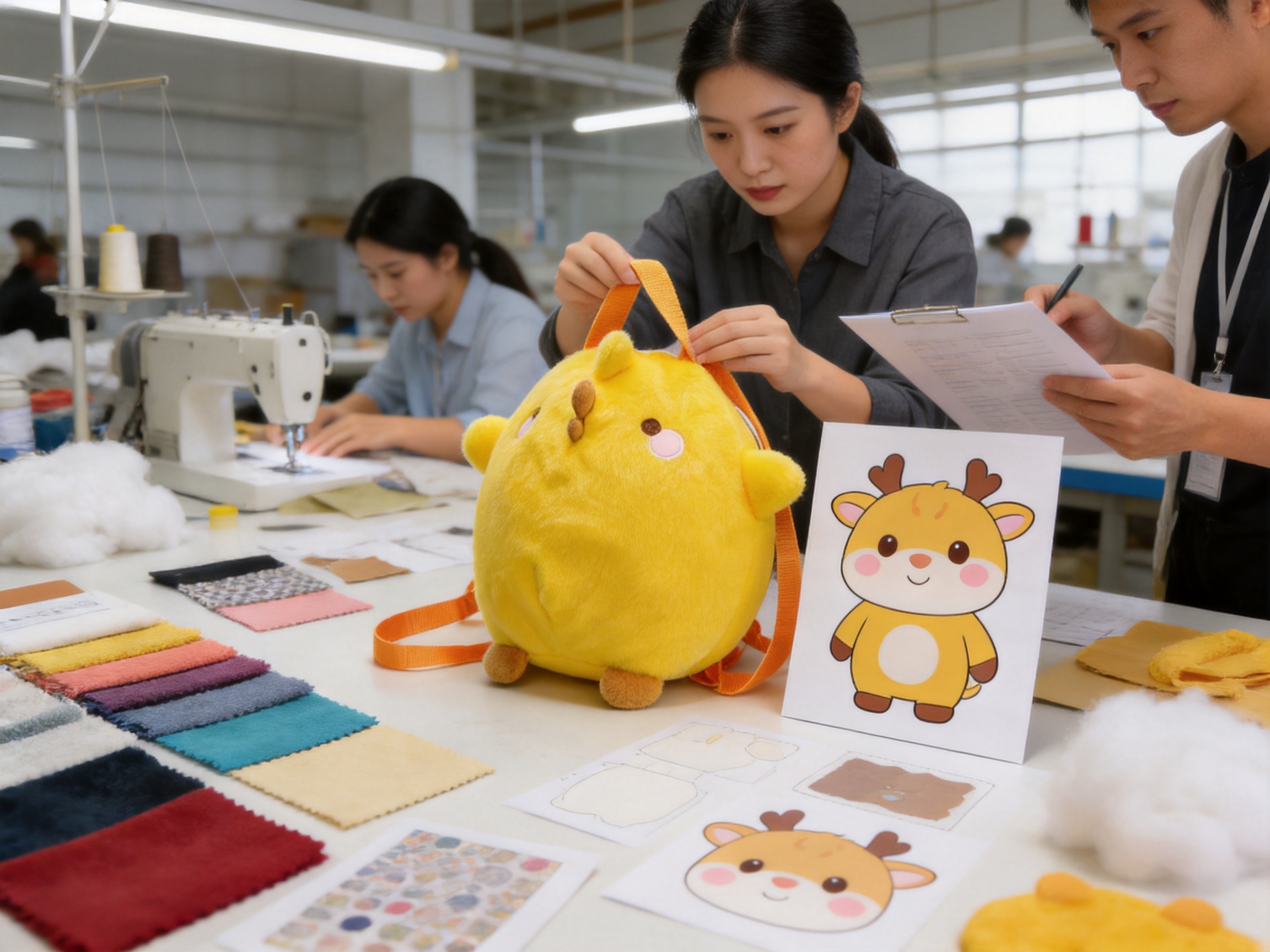
Professional production equipment and an innovative research and development team further support product creation. For a character product such as the Round Yellow Animal Plush Knapsack, the development process may involve pattern preparation, material matching, sample assembly, shape correction, expression placement, filling adjustment, and finishing review. The ability to perform these steps within a coordinated manufacturing system can help transform a concept into a repeatable product.
7. A Structured Manufacturing Process for Plush Knapsacks
A successful plush knapsack requires more than sewing several fabric pieces together. Its rounded form, soft filling, straps, facial details, and functional construction must be balanced carefully. A structured manufacturing process helps protect the product’s appearance and usability from the first prototype through mass production.
Design Review and Product Engineering
The process begins with a review of the product concept. Designers and production specialists examine the intended dimensions, character proportions, color arrangement, surface details, strap position, opening method, and packaging needs. At this stage, the product is evaluated for visual appeal as well as manufacturing feasibility.
Design engineering is particularly important for a rounded plush backpack. The pattern must create a balanced three-dimensional form rather than an uneven or excessively flat body. The position of the eyes and other features must be consistent across units. The straps must be attached in a way that supports ordinary carrying while preserving the appearance of the character.
Material Selection
Material selection involves matching the plush fabric, thread, filling, lining, accessories, and packaging materials to the design requirements. The shell fabric must provide the desired softness and visual finish. PP cotton must create a suitably full shape without making the product excessively heavy. If custom colors are requested, the fabric must be matched to approved color references before production.
Material planning also supports supply consistency. For larger orders, the manufacturer must coordinate sufficient quantities of fabric, filling, thread, labels, packaging, and other components. A coordinated material plan can help reduce delays and support more uniform production results.
Pattern Making and Cutting
Patterns define the shape and proportions of the plush knapsack. The pattern-making stage determines how the front, back, side, facial, strap, and detail pieces will fit together. Accurate cutting is essential because even small differences in fabric dimensions can affect symmetry, fullness, and seam alignment.
For a round animal design, the cutting process should preserve smooth curves. Uneven curves may create unwanted folds or distortions once the parts are sewn and filled. Careful preparation helps maintain the plump, cheerful silhouette that forms the product’s main visual identity.
Sewing and Assembly
During sewing, individual components are joined according to the approved sample. The order of assembly can influence the final appearance. Facial details may need to be positioned before the body is fully closed, while straps and closures must be attached at appropriate structural points.
Consistent stitching supports product durability and appearance. Seams should be aligned, thread ends managed, and stress points reviewed. Since the item is both a plush product and a small bag, the construction must balance softness with sufficient stability for ordinary use.
Filling and Shaping
PP cotton is inserted after the relevant shell sections have been prepared. The filling process determines how round, firm, or soft the finished body will appear. Too little filling may result in a weak or collapsed silhouette, while too much may make the product rigid or place unnecessary pressure on seams.
Shaping is therefore an important finishing step. Workers may distribute the filling so the body remains balanced and the character retains its intended proportions. Consistent filling helps ensure that products in the same order look like members of one coherent product series.
Detail Finishing and Inspection
After assembly, the product can be reviewed for loose threads, uneven features, surface marks, incomplete seams, filling irregularities, and packaging readiness. Facial details should be checked for position and consistency. The yellow exterior should be inspected for visible discoloration or unacceptable variation.
For customized products, inspection should also compare the finished item with the buyer’s approved sample. This includes reviewing colors, logo placement, character features, dimensions, labels, straps, and packaging. A documented approval process can help align expectations between the buyer and manufacturer.
Packing and Shipment Preparation
Once finished products pass the required inspection, they are packed into cartons for shipment. The listed carton size is 30 centimeters in length, 25 centimeters in width, and 18 centimeters in height. Each carton contains 12 pieces, with a gross weight of approximately 3 kilograms and a net weight of approximately 2 kilograms.
Efficient packing helps buyers plan warehouse space, freight arrangements, and distribution schedules. Carton-level information is also useful for import planning and logistics coordination. The listed delivery time is approximately 45 days, although the actual schedule may depend on order specifications, sample approval, material preparation, production capacity, packaging requirements, and shipping conditions.
8. Quality and Consistency Considerations
Quality in plush knapsack production involves more than softness. Buyers should consider visual consistency, structural integrity, material reliability, character accuracy, packaging condition, and suitability for the intended market. An attractive product that varies significantly from one unit to another can weaken consumer confidence, especially when it is sold as a collectible or branded item.
The Round Yellow Animal Plush Knapsack benefits from a design that is comparatively simple and visually clear. Its main quality points can be identified easily: the round silhouette, yellow color, eye placement, plush surface, filling level, strap attachment, and overall finish. Simple designs can be easier to inspect consistently because the main visual elements are clearly defined.
Quality planning should begin before production. The buyer and manufacturer can agree on an approved sample, color references, size tolerances, material requirements, packaging standards, and inspection expectations. This reduces uncertainty and provides a practical reference for the production team.
For plush products intended for children, buyers should also review the regulatory and safety requirements of the destination market. Requirements may vary according to the product’s classification, intended age, materials, components, labeling, and sales channel. The buyer is responsible for identifying the applicable standards and confirming the documentation needed for the destination market.
Good communication is another aspect of quality assurance. The manufacturer’s sales and after-sales teams can help address questions about specifications, samples, production schedules, packing, and delivery. Clear communication is especially valuable when the buyer requests custom colors or character details, since small misunderstandings can become more costly after mass production begins.
9. Commercial Applications Across Several Market Segments
The Round Yellow Animal Plush Knapsack can be adapted to a wide range of commercial applications. Its combination of plush softness and backpack functionality enables it to move between toy, gift, accessory, and promotional categories.
Children’s Retail
Children’s stores can position the product as a small character bag for young shoppers. Its bright color and animal identity make it suitable for displays near plush toys, children’s accessories, or seasonal gift sections. It can also be sold alongside matching plush toys or other products featuring the same character.
Gift Shops
Gift shops can use the knapsack as a cheerful novelty item. Its compact size is convenient for gift presentation, while its soft exterior creates a more emotional impression than a standard utility pouch. It may appeal to customers looking for birthday gifts, travel souvenirs, or small presents for children.
Promotional Campaigns
Companies can customize the product with mascots, colors, logos, or campaign themes. A plush knapsack can be distributed at family events, product launches, retail activations, charity programs, educational activities, and community celebrations. Because it remains useful after the event, it may create longer-lasting brand visibility than paper-based promotional materials.
Seasonal Programs
The design can be adapted for spring, summer, school-opening periods, harvest themes, winter holidays, or special celebrations. Seasonal colors, accessories, packaging, and character details can help create limited-edition versions. A basic round form is suitable for many themes because it can be transformed through color and decoration.
Entertainment and Character Merchandise
Theme parks, family entertainment centers, museums, aquariums, and licensed character programs may use customized plush knapsacks as merchandise. The design can be developed around a mascot or fictional figure, provided the relevant intellectual property rights are properly managed.
Home and Lifestyle Collections
Although primarily designed as a children’s accessory, the product can also contribute to a broader lifestyle collection. Matching plush cushions, decorative items, stationery, keychains, and storage products can be developed around the same animal concept. This allows a buyer to create a consistent visual family across multiple product categories.
10. Comparison with Conventional Backpacks and Standard Plush Toys
The Round Yellow Animal Plush Knapsack occupies a middle position between a conventional backpack and a traditional stuffed animal. Understanding this position helps buyers communicate its value accurately.
Compared with a conventional backpack, it offers a softer appearance, stronger character identity, and greater emotional appeal. A standard backpack may provide more capacity and structure, but it may not deliver the same tactile comfort or visual distinctiveness. The plush knapsack is better suited to small loads, casual carrying, gifting, and imaginative use.
Compared with a standard stuffed animal, it offers added functionality. Children can carry small belongings in it, and retailers can market it as both a toy and an accessory. The backpack format may encourage more active use, allowing the character to accompany a child during outings rather than remaining only as a display or comfort toy.
Compared with low-cost novelty bags, the product’s plush construction and character-driven design can offer stronger perceived value. Buyers may also benefit from organized OEM and ODM support, allowing them to develop a product that is more closely aligned with a particular brand or campaign.
The product’s strongest market position is therefore not based solely on storage capacity. Its advantage comes from the combination of softness, character, portability, customizability, and gift appeal. This combination creates a differentiated offering for customers seeking something more memorable than an ordinary mini bag.
11. Sustainability and Responsible Product Planning
Responsible product planning should consider the entire product lifecycle, including material selection, production quantities, packaging, shipping, use, and end-of-life handling. Buyers can discuss these issues with the manufacturer when preparing a custom program.
Because the knapsack is compact and lightweight, it may require fewer shipping resources per unit than a large, heavily structured backpack. Efficient carton packing can also help reduce unused space during transportation. The listed carton configuration of 12 pieces per carton provides a starting point for logistics planning.
Buyers may also consider durable construction and timeless character design. A product that remains attractive beyond one short campaign has a better chance of being used for a longer period. Simple character styling can support this goal because it is less dependent on a rapidly changing trend.
Packaging decisions can influence material consumption. Depending on the sales channel, a buyer may select a simple protective bag, a printed hangtag, a retail box, or a more elaborate gift presentation. The best option should balance product protection, shelf presentation, customer expectations, and responsible material use.
Any sustainability claims should be based on verified materials, production practices, or documentation. Buyers should request specific information before making environmental statements in marketing materials. Clear and accurate communication protects both the buyer and the manufacturer.
12. Ordering and Development Process
Wholesale buyers can improve project efficiency by preparing detailed information before requesting a sample. Useful information includes the desired quantity, target market, product dimensions, color references, character artwork, logo files, packaging requirements, intended age group, delivery destination, and expected launch date.
The minimum order quantity for the listed product is 500 pieces. This quantity is appropriate for many organized retail launches, promotional campaigns, seasonal programs, and private-label orders. Buyers should evaluate expected demand, inventory capacity, campaign duration, and possible repeat orders before confirming the final quantity.
The sample fee is listed as 100 dollars per design. The sample stage allows the buyer to review the physical appearance and identify adjustments before mass production. Buyers should examine the sample under suitable lighting and assess color, softness, size, shape, eye placement, strap construction, closure details, labels, and packaging presentation.
The estimated sample lead time is three to seven working days. After sample approval, the listed delivery time for production is approximately 45 days. These times should be treated as planning estimates rather than automatic guarantees. Custom materials, complex packaging, revisions, holidays, order volume, and shipping arrangements may affect the schedule.
Written confirmation is recommended for all important specifications. The final order documentation should identify the approved materials, measurements, colors, artwork, packaging, carton requirements, quantity, inspection expectations, and delivery terms. This creates a shared reference for the buyer, sales team, design staff, and production team.
Recommended Buyer Checklist
First, confirm whether the standard 10-centimeter size meets the intended use. If the product needs to hold specific items, provide the approximate dimensions and weight of those items.
Second, select the desired color system. For a branded program, provide standardized color references instead of relying only on screen images.
Third, clarify whether the product will be sold as a toy, accessory, promotional gift, or lifestyle item. This may influence labeling, packaging, testing, and market documentation.
Fourth, provide complete artwork for customized faces, logos, labels, and packaging. Vector files or high-resolution artwork may help reduce interpretation errors.
Fifth, review the physical sample carefully and list all requested revisions in one organized document whenever possible.
Sixth, confirm carton quantities, gross weight, net weight, delivery timing, and destination requirements before production begins.
13. Product Presentation and Marketing Strategy
The product’s marketing should emphasize its hybrid identity. Calling it only a backpack may cause customers to compare it with larger, more practical bags. Calling it only a stuffed animal may hide its carrying function. A stronger presentation describes it as a soft character knapsack that combines a playful companion with a lightweight mini bag.
Visual merchandising should highlight the round body and bright yellow color. The product can be displayed at child-friendly eye level, arranged with other yellow or animal-themed products, or presented in a group with different customized versions. A group display can communicate collectibility and encourage customers to consider more than one character.
Online product photography should show the front character view, side profile, rear straps, scale, material texture, and interior capacity where appropriate. Since the product is small, photographs should include a familiar reference object or a child-safe lifestyle setting to communicate its dimensions accurately.
Marketing copy can focus on emotional and functional benefits, including cheerful design, soft plush texture, lightweight carrying, compact storage, customization options, and suitability for gifts or promotions. Claims should remain accurate and should not imply that the product is intended for heavy loads or uses beyond its design.
For seasonal campaigns, buyers can use storytelling. The yellow animal might be introduced as a sunshine companion, a travel friend, a small treasure keeper, or a cheerful gift character. This type of narrative can increase emotional engagement without requiring a complex product structure.
14. The Manufacturer’s Broader Product Capabilities
The manufacturer’s experience extends beyond one plush knapsack design. Its product categories include trendy plush toys, children’s plush toys, pet plush toys, plush promotional gifts, plush home furnishings, plush stationery gifts, plush handicrafts, and plush cartoon decorations.
This broader capability can benefit buyers who want to develop a complete product family. A customer may begin with the Round Yellow Animal Plush Knapsack and later request matching plush toys, decorative cushions, stationery accessories, seasonal ornaments, or promotional items. Working with one experienced plush supplier can help maintain consistency across fabrics, colors, character proportions, and packaging concepts.
The company’s R&D and design team can support trend-oriented products as well as traditional plush categories. This is relevant for buyers who need products that fit current gift, lifestyle, or character merchandising trends while still meeting practical production requirements.
Its in-stock services may also be useful for customers seeking available products rather than fully customized development. Buyers should confirm current stock status, available colors, order quantities, packaging, and delivery conditions directly with the company. In-stock availability can provide a faster route for testing a market or preparing a short-term promotional activity.
The combination of custom development and in-stock support gives buyers flexibility. A company may choose a standard design for immediate use while developing a customized version for a later campaign. This staged approach can reduce initial development time and provide an opportunity to evaluate customer response.
15. Key Benefits for Different Buyers
For Importers and Wholesalers
Importers and wholesalers can benefit from a product with a clear visual identity, compact carton configuration, and broad application range. The 500-piece minimum order quantity allows a structured trial order while remaining suitable for larger distribution programs. Multiple color choices and customization options can support different regional preferences.
For Retail Chains
Retail chains can use the product as a seasonal accessory, impulse gift, character item, or exclusive private-label product. The unusual shape may create strong shelf differentiation, while the soft surface supports a premium emotional presentation compared with ordinary mini bags.
For Promotional Agencies
Promotional agencies can use OEM and ODM services to create branded mascots and campaign gifts. The product remains visible and useful after distribution, giving the promotional message a longer potential life. Agencies can also adapt the same basic format for different clients and events.
For Toy and Gift Brands
Toy and gift brands can add the knapsack to a character collection. It can function as a companion product for a plush toy, an exclusive bundle item, or a collectible version in a series of colors and animal personalities.
For Family-Oriented Businesses
Restaurants, entertainment venues, education providers, and family activity centers can customize the product around their mascots or visual symbols. A soft character bag can help make a brand more tangible and memorable for children and parents.
16. Frequently Asked Questions
What is the Round Yellow Animal Plush Knapsack?
It is a compact plush backpack featuring a round yellow animal design, small eyes, a soft plush shell, and PP cotton filling. It combines the appearance of a stuffed animal with the basic function of a small knapsack.
What is the standard product size?
The listed standard size is 10 centimeters. Custom dimensions may be available according to the buyer’s requirements and production review.
How much does one product weigh?
The listed product weight is approximately 150 grams. The final weight may vary if the size, fabric, filling, straps, or accessories are customized.
What materials are used?
The shell is made from soft plush fabric, and the filling material is PP cotton. Buyers should confirm any additional materials, lining, labels, closures, or accessories required for a customized version.
Are different colors available?
Yes. Multiple color choices are available. Buyers can request alternative colors for retail collections, brand programs, seasonal campaigns, or character series.
Can the animal design be customized?
Yes. OEM and ODM services are available. Buyers may discuss customized characters, facial details, colors, sizes, materials, branding, packaging, and other specifications with the manufacturer.
What is the minimum order quantity?
The listed minimum order quantity is 500 pieces. The final quantity should be confirmed according to the selected design, customization level, packaging, and production requirements.
What is the sample fee?
The listed sample fee is 100 dollars per design. Buyers should confirm whether additional charges apply for special materials, complex artwork, shipping, or multiple revision stages.
How long does sampling take?
The listed sample lead time is three to seven working days. The timing may depend on design complexity, material availability, artwork confirmation, and sample revisions.
How long is the production delivery time?
The listed delivery time is approximately 45 days. Buyers should confirm the production schedule after the design, sample, quantity, packaging, and shipping arrangements have been finalized.
How many pieces are packed in one carton?
Each carton is listed as containing 12 pieces. The carton size is 30 centimeters by 25 centimeters by 18 centimeters, with a listed gross weight of 3 kilograms and net weight of 2 kilograms.
Is the product suitable for heavy items?
The Round Yellow Animal Plush Knapsack is a compact, lightweight character accessory. It is best suited for small and light personal items, toys, accessories, or promotional contents rather than heavy loads.
Can the product be used as a promotional gift?
Yes. Its compact size, cheerful appearance, and customization potential make it suitable for promotional campaigns, family events, store activities, seasonal programs, and branded gift packages.
Can the manufacturer produce matching plush products?
The manufacturer produces a broad range of plush categories, including children’s plush toys, trendy plush toys, pet plush toys, promotional gifts, home furnishings, stationery gifts, handicrafts, and cartoon decorations. Buyers can discuss coordinated product development.
What should buyers prepare before requesting a quotation?
Buyers should prepare the desired quantity, product size, color references, artwork, character concept, packaging requirements, destination market, delivery location, and expected timeline. Clear information helps the manufacturer evaluate the project more efficiently.
17. Conclusion
The Round Yellow Animal Plush Knapsack offers a distinctive combination of character design, soft tactile appeal, lightweight portability, and customization flexibility. Its bright yellow color and rounded animal form create immediate visual recognition, while the plush fabric and PP cotton filling provide the comforting quality associated with stuffed products.
Its greatest competitive strength is the way it connects several product categories. It can be presented as a plush toy, a mini backpack, a children’s accessory, a gift item, a collectible character, or a promotional product. This versatility gives buyers more opportunities to place it in retail, gifting, seasonal, entertainment, and branded merchandise programs.
The product is supported by an integrated manufacturer with R&D, design, production, sales, and after-sales capabilities. A factory covering more than 10,000 square meters, international export experience, professional production equipment, and a broad plush product range provide a foundation for both standard orders and customized development.
For buyers seeking a memorable plush accessory, the Round Yellow Animal Plush Knapsack can serve as an attractive starting point. Its 10-centimeter standard size, approximately 150-gram weight, multiple color options, OEM and ODM availability, 500-piece minimum order quantity, and defined sample and delivery estimates make it suitable for organized product planning. With careful specification, sample approval, quality review, and packaging coordination, it can become a charming and commercially adaptable addition to a plush or gift portfolio.
References
1. Product specification information for the Round Yellow Animal Plush Knapsack, including size, weight, materials, packaging, MOQ, sample fee, and delivery estimates.
2. Manufacturer profile for Tianchang Bestjoy Craft & Gift Co., Ltd., including company history, factory area, product categories, export markets, and integrated business capabilities.
3. General principles of plush toy product development, including concept design, pattern making, fabric selection, filling, sewing, finishing, inspection, and packaging.
4. General wholesale product planning practices for OEM and ODM character merchandise, promotional gifts, children’s accessories, and seasonal plush products.
5. General merchandising principles for soft toys, character accessories, compact gift items, and children’s lifestyle products.
6. General logistics planning considerations for carton dimensions, carton quantities, gross weight, net weight, production scheduling, and international shipment preparation.